

Thermal Properties of Soils: Thermal Conductivity
so 4, = 1.312.65 = 0.49. Using Eq. (8.12),
Thermal Properties of Soils: Thermal
Conductivity
The thermal conductivity of soil depends on the conductivities andvolume
fractions of the soil constituents. The heat flows through a complicated
network of mineral, water, and air paths and the quantity and conductivity
of each strongly influences the effectiveness of the others. In addition, a
substantial quantity of heat is carried by evaporation and condensation
in the soil pores, and this is both water content and temperature dependent. DeVries (1963) proposed that the thermal conductivity of soil be
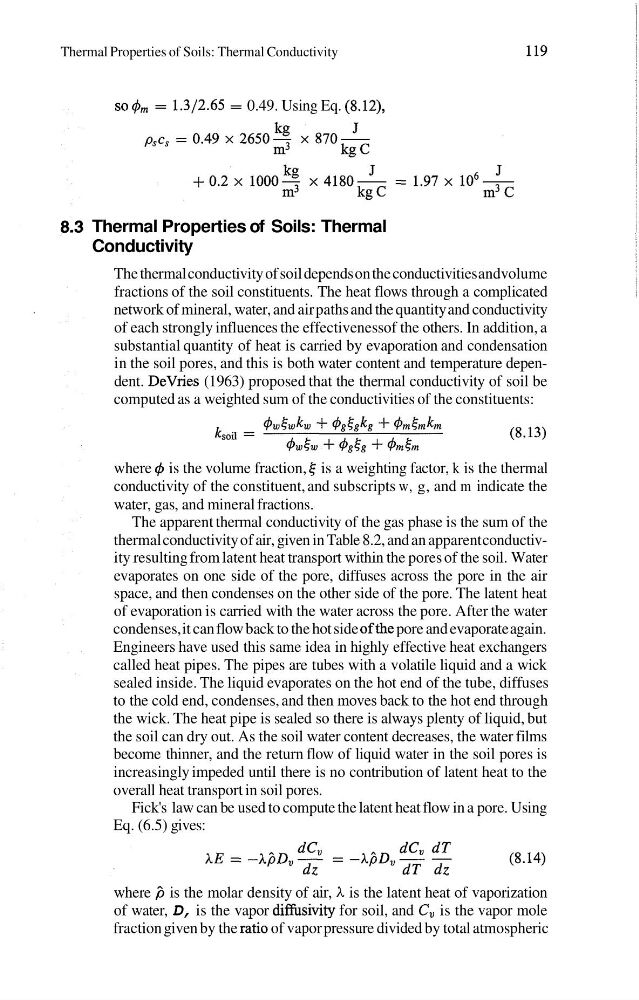
computed as a weighted sum of the conductivities of the constituents:
where 4 is the volume fraction, 6 is a weighting factor, k is the thermal
conductivity of the constituent, and subscripts w, g, and m indicate the
water, gas, and mineral fractions.
The apparent thermal conductivity of the gas phase is the sum of the
thermal conductivity of air, given in Table 8.2, and an apparent conductivity resulting from latent heat transport within the pores of the soil. Water
evaporates on one side of the pore, diffuses across the pore in the air
space, and then condenses on the other side of the pore. The latent heat
of evaporation is carried with the water across the pore. After the water
condenses, it can flow back to the hot side ofthe pore and evaporate again.
Engineers have used this same idea in highly effective heat exchangers
called heat pipes. The pipes are tubes with a volatile liquid and a wick
sealed inside. The liquid evaporates on the hot end of the tube, diffuses
to the cold end, condenses, and then moves back to the hot end through
the wick. The heat pipe is sealed so there is always plenty of liquid, but
the soil can dry out. As the soil water content decreases, the water films
become thinner, and the return flow of liquid water in the soil pores is
increasingly impeded until there is no contribution of latent heat to the
overall heat transport in soil pores.
Fick's law can be used to compute the latent heat flow in a pore. Using
Eq. (6.5) gives:
where 6 is the molar density of air, h is the latent heat of vaporization
of water, D, is the vapor diffusivity for soil, and C, is the vapor mole
fraction given by the ratio of vapor pressure divided by total atmospheric
so 4, = 1.312.65 = 0.49. Using Eq. (8.12),
Thermal Properties of Soils: Thermal
Conductivity
The thermal conductivity of soil depends on the conductivities andvolume
fractions of the soil constituents. The heat flows through a complicated
network of mineral, water, and air paths and the quantity and conductivity
of each strongly influences the effectiveness of the others. In addition, a
substantial quantity of heat is carried by evaporation and condensation
in the soil pores, and this is both water content and temperature dependent. DeVries (1963) proposed that the thermal conductivity of soil be
computed as a weighted sum of the conductivities of the constituents:
where 4 is the volume fraction, 6 is a weighting factor, k is the thermal
conductivity of the constituent, and subscripts w, g, and m indicate the
water, gas, and mineral fractions.
The apparent thermal conductivity of the gas phase is the sum of the
thermal conductivity of air, given in Table 8.2, and an apparent conductivity resulting from latent heat transport within the pores of the soil. Water
evaporates on one side of the pore, diffuses across the pore in the air
space, and then condenses on the other side of the pore. The latent heat
of evaporation is carried with the water across the pore. After the water
condenses, it can flow back to the hot side ofthe pore and evaporate again.
Engineers have used this same idea in highly effective heat exchangers
called heat pipes. The pipes are tubes with a volatile liquid and a wick
sealed inside. The liquid evaporates on the hot end of the tube, diffuses
to the cold end, condenses, and then moves back to the hot end through
the wick. The heat pipe is sealed so there is always plenty of liquid, but
the soil can dry out. As the soil water content decreases, the water films
become thinner, and the return flow of liquid water in the soil pores is
increasingly impeded until there is no contribution of latent heat to the
overall heat transport in soil pores.
Fick's law can be used to compute the latent heat flow in a pore. Using
Eq. (6.5) gives:
where 6 is the molar density of air, h is the latent heat of vaporization
of water, D, is the vapor diffusivity for soil, and C, is the vapor mole
fraction given by the ratio of vapor pressure divided by total atmospheric