

108
Conductances for Heat and Mass Transfer
7.13 Free Stream Turbulence
Most of the relationships presented so far describe conductances one
would measure in a carefully constructed wind tunnel which minimizes
the turbulence in the air. When turbulence is induced in the air that flows
over the object, the conductance increases, often dramatically. Conductances in wind tunnels with turbulence generated by placing obstructions
upwind of the object are sometimes twice those for laminar flow.
The outdoor wind is naturally turbulent, so the conductance of objects
placed in natural wind is likely to be higher than would be predicted using
the equations presented so far. The size of this enhancement is determined
by the size of the object and the size of the eddies in the air. The eddy
size increases with height in the atmosphere, so the enhancement should
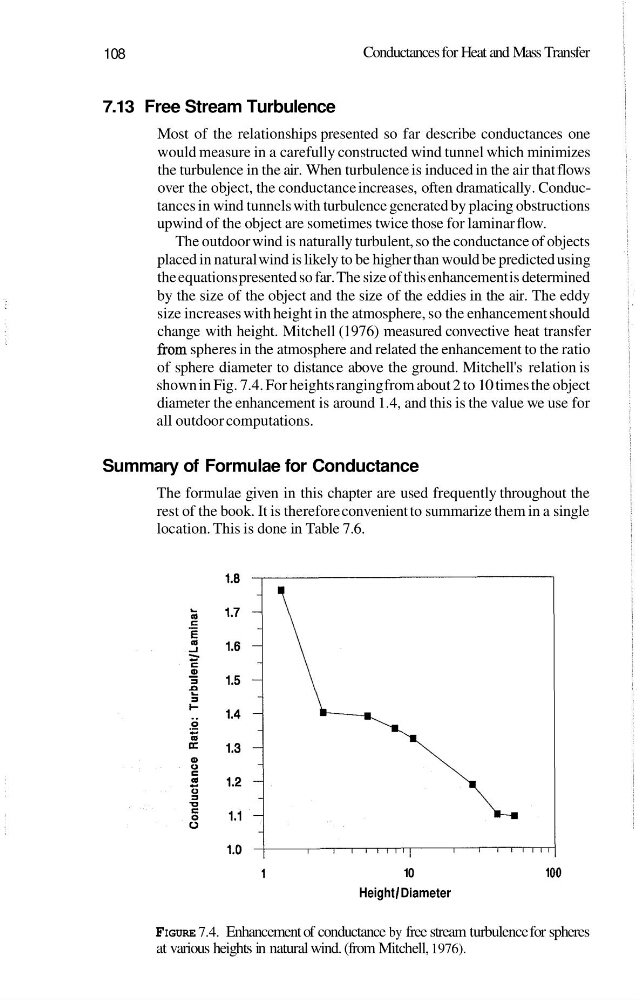
change with height. Mitchell (1976) measured convective heat transfer
from spheres in the atmosphere and related the enhancement to the ratio
of sphere diameter to distance above the ground. Mitchell's relation is
shown in Fig. 7.4. For heights ranging from about 2 to 10 times the object
diameter the enhancement is around 1.4, and this is the value we use for
all outdoor computations.
Summary of Formulae for Conductance
The formulae given in this chapter are used frequently throughout the
rest of the book. It is therefore convenient to summarize them in a single
location. This is done in Table 7.6.
10
Height / Diameter
FIGURE 7.4. Enhancement of conductance by free stream turbulence for spheres
at various heights in natural wind. (from Mitchell, 1976).
Conductances for Heat and Mass Transfer
7.13 Free Stream Turbulence
Most of the relationships presented so far describe conductances one
would measure in a carefully constructed wind tunnel which minimizes
the turbulence in the air. When turbulence is induced in the air that flows
over the object, the conductance increases, often dramatically. Conductances in wind tunnels with turbulence generated by placing obstructions
upwind of the object are sometimes twice those for laminar flow.
The outdoor wind is naturally turbulent, so the conductance of objects
placed in natural wind is likely to be higher than would be predicted using
the equations presented so far. The size of this enhancement is determined
by the size of the object and the size of the eddies in the air. The eddy
size increases with height in the atmosphere, so the enhancement should
change with height. Mitchell (1976) measured convective heat transfer
from spheres in the atmosphere and related the enhancement to the ratio
of sphere diameter to distance above the ground. Mitchell's relation is
shown in Fig. 7.4. For heights ranging from about 2 to 10 times the object
diameter the enhancement is around 1.4, and this is the value we use for
all outdoor computations.
Summary of Formulae for Conductance
The formulae given in this chapter are used frequently throughout the
rest of the book. It is therefore convenient to summarize them in a single
location. This is done in Table 7.6.
10
Height / Diameter
FIGURE 7.4. Enhancement of conductance by free stream turbulence for spheres
at various heights in natural wind. (from Mitchell, 1976).