

Conductances for Heat and Mass Transfer
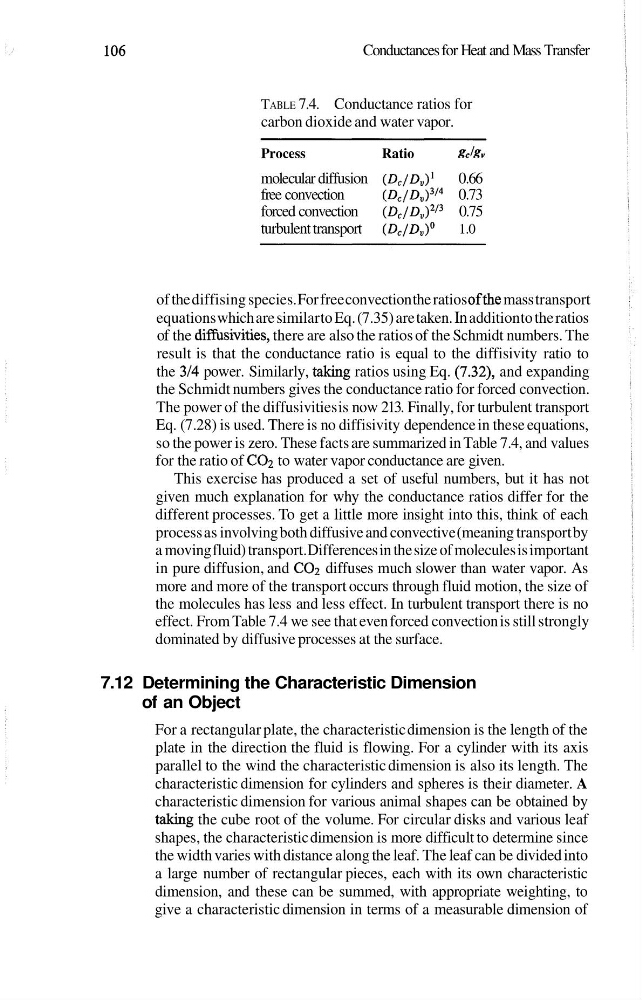
TABLE 7.4. Conductance ratios for
carbon dioxide and water vapor.
Process
Ratio
g ~ / &
molecular diffusion ( D c / D,)'
0.66
free convection
( D , / D , ) ~ / ~ 0.73
forced convection
( D , / D , ) ~ / ~ 0.75
turbulent transport (Dc/ D,)'
1.0
of the diffising species. For free convection the ratios ofthe mass transport
equations which are similar to Eq. (7.35) are taken. In addition to the ratios
of the diffisivities, there are also the ratios of the Schmidt numbers. The
result is that the conductance ratio is equal to the diffisivity ratio to
the 314 power. Similarly, taking ratios using Eq. (7.32), and expanding
the Schmidt numbers gives the conductance ratio for forced convection.
The power of the diffusivities is now 213. Finally, for turbulent transport
Eq. (7.28) is used. There is no diffisivity dependence in these equations,
so the power is zero. These facts are summarized in Table 7.4, and values
for the ratio of C02 to water vapor conductance are given.
This exercise has produced a set of useful numbers, but it has not
given much explanation for why the conductance ratios differ for the
different processes. To get a little more insight into this, think of each
process as involving both diffusive and convective (meaning transport by
a moving fluid) transport. Differences in the size of molecules is important
in pure diffusion, and CO2 diffuses much slower than water vapor. As
more and more of the transport occurs through fluid motion, the size of
the molecules has less and less effect. In turbulent transport there is no
effect. From Table 7.4 we see that even forced convection is still strongly
dominated by diffusive processes at the surface.
7.12 Determining the Characteristic Dimension
of an Object
For a rectangular plate, the characteristic dimension is the length of the
plate in the direction the fluid is flowing. For a cylinder with its axis
parallel to the wind the characteristic dimension is also its length. The
characteristic dimension for cylinders and spheres is their diameter. A
characteristic dimension for various animal shapes can be obtained by
taking the cube root of the volume. For circular disks and various leaf
shapes, the characteristic dimension is more difficult to determine since
the width varies with distance along the leaf. The leaf can be divided into
a large number of rectangular pieces, each with its own characteristic
dimension, and these can be summed, with appropriate weighting, to
give a characteristic dimension in terms of a measurable dimension of
TABLE 7.4. Conductance ratios for
carbon dioxide and water vapor.
Process
Ratio
g ~ / &
molecular diffusion ( D c / D,)'
0.66
free convection
( D , / D , ) ~ / ~ 0.73
forced convection
( D , / D , ) ~ / ~ 0.75
turbulent transport (Dc/ D,)'
1.0
of the diffising species. For free convection the ratios ofthe mass transport
equations which are similar to Eq. (7.35) are taken. In addition to the ratios
of the diffisivities, there are also the ratios of the Schmidt numbers. The
result is that the conductance ratio is equal to the diffisivity ratio to
the 314 power. Similarly, taking ratios using Eq. (7.32), and expanding
the Schmidt numbers gives the conductance ratio for forced convection.
The power of the diffusivities is now 213. Finally, for turbulent transport
Eq. (7.28) is used. There is no diffisivity dependence in these equations,
so the power is zero. These facts are summarized in Table 7.4, and values
for the ratio of C02 to water vapor conductance are given.
This exercise has produced a set of useful numbers, but it has not
given much explanation for why the conductance ratios differ for the
different processes. To get a little more insight into this, think of each
process as involving both diffusive and convective (meaning transport by
a moving fluid) transport. Differences in the size of molecules is important
in pure diffusion, and CO2 diffuses much slower than water vapor. As
more and more of the transport occurs through fluid motion, the size of
the molecules has less and less effect. In turbulent transport there is no
effect. From Table 7.4 we see that even forced convection is still strongly
dominated by diffusive processes at the surface.
7.12 Determining the Characteristic Dimension
of an Object
For a rectangular plate, the characteristic dimension is the length of the
plate in the direction the fluid is flowing. For a cylinder with its axis
parallel to the wind the characteristic dimension is also its length. The
characteristic dimension for cylinders and spheres is their diameter. A
characteristic dimension for various animal shapes can be obtained by
taking the cube root of the volume. For circular disks and various leaf
shapes, the characteristic dimension is more difficult to determine since
the width varies with distance along the leaf. The leaf can be divided into
a large number of rectangular pieces, each with its own characteristic
dimension, and these can be summed, with appropriate weighting, to
give a characteristic dimension in terms of a measurable dimension of