

Conductances for Heat and Mass Transfer in Laminar Forced Convection
99
Canopy Temperature - Air Temperature (C)
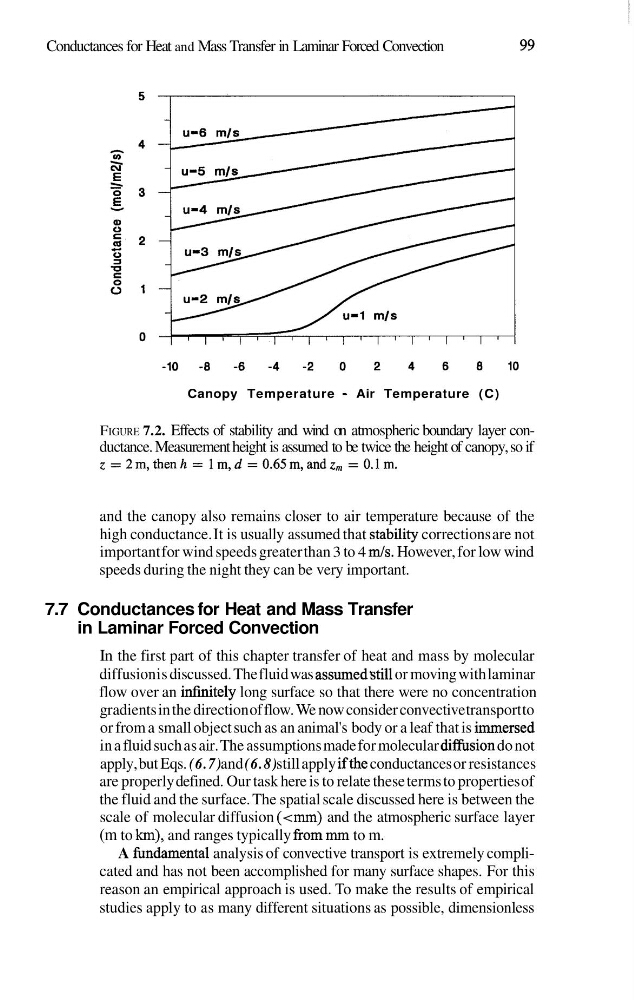
FIGURE 7.2. Effects of stability and wind on atmospheric boundary layer conductance. Measurement height is assumed to be twice the height of canopy, so if
z=2m,thenh= 1m,d=0.65m,andzn, =O.lm.
and the canopy also remains closer to air temperature because of the
high conductance. It is usually assumed that stability corrections are not
important for wind speeds greater than 3 to 4 rnls. However, for low wind
speeds during the night they can be very important.
7.7 Conductances for Heat and Mass Transfer
in Laminar Forced Convection
In the first part of this chapter transfer of heat and mass by molecular
diffusion is discussed. The fluid was assurnedstill or moving with laminar
flow over an infinitely long surface so that there were no concentration
gradients in the direction of flow. We now consider convective transport to
or from a small object such as an animal's body or a leaf that is immersed
in a fluid such as air. The assumptions made for molecular diffusion do not
apply, but Eqs. (6.7) and (6.8) still apply ifthe conductances or resistances
are properly defined. Our task here is to relate these terms to properties of
the fluid and the surface. The spatial scale discussed here is between the
scale of molecular diffusion (
A fimdamental analysis of convective transport is extremely complicated and has not been accomplished for many surface shapes. For this
reason an empirical approach is used. To make the results of empirical
studies apply to as many different situations as possible, dimensionless
99
Canopy Temperature - Air Temperature (C)
FIGURE 7.2. Effects of stability and wind on atmospheric boundary layer conductance. Measurement height is assumed to be twice the height of canopy, so if
z=2m,thenh= 1m,d=0.65m,andzn, =O.lm.
and the canopy also remains closer to air temperature because of the
high conductance. It is usually assumed that stability corrections are not
important for wind speeds greater than 3 to 4 rnls. However, for low wind
speeds during the night they can be very important.
7.7 Conductances for Heat and Mass Transfer
in Laminar Forced Convection
In the first part of this chapter transfer of heat and mass by molecular
diffusion is discussed. The fluid was assurnedstill or moving with laminar
flow over an infinitely long surface so that there were no concentration
gradients in the direction of flow. We now consider convective transport to
or from a small object such as an animal's body or a leaf that is immersed
in a fluid such as air. The assumptions made for molecular diffusion do not
apply, but Eqs. (6.7) and (6.8) still apply ifthe conductances or resistances
are properly defined. Our task here is to relate these terms to properties of
the fluid and the surface. The spatial scale discussed here is between the
scale of molecular diffusion (
A fimdamental analysis of convective transport is extremely complicated and has not been accomplished for many surface shapes. For this
reason an empirical approach is used. To make the results of empirical
studies apply to as many different situations as possible, dimensionless