

Problems
85
sleeping, is around 0.5 rnol m-2 s-' . Heat exchange with the surroundings
is by radiation and convection in parallel. The convective conductance is
0.25 mol m-2 s-I and the radiative conductance is 0.1 mol m-2 s-I . What
is the coldest temperature that the sleeping bag can be used at if the person
maintains a metabolic rate of 50 w/m2 and a body temperature of 37" C?
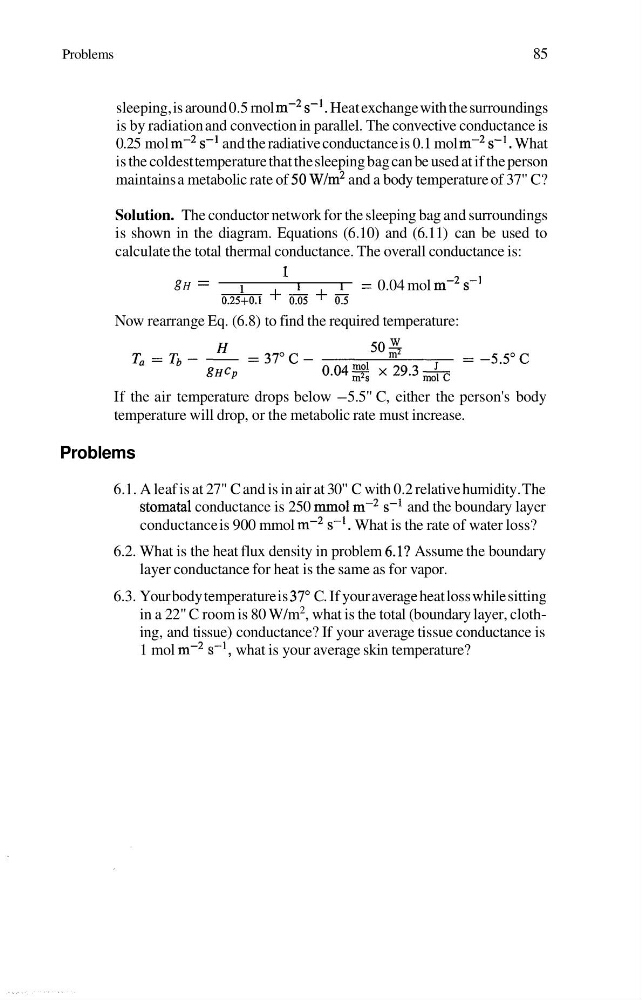
Solution. The conductor network for the sleeping bag and surroundings
is shown in the diagram. Equations (6.10) and (6.11) can be used to
calculate the total thermal conductance. The overall conductance is:
1
gu =
I
1
1 = 0.04 mol m-2 s-'
0.25f0.1 +
+
Now rearrange Eq. (6.8) to find the required temperature:
If the air temperature drops below -5.5" C, either the person's body
temperature will drop, or the metabolic rate must increase.
Problems
6.1. A leaf is at 27" C and is in air at 30" C with 0.2 relative humidity. The
stomata1 conductance is 250 mmol m-2 s-' and the boundary layer
conductance is 900 mmol m-2 s-' . What is the rate of water loss?
6.2. What is the heat flux density in problem 6.1? Assume the boundary
layer conductance for heat is the same as for vapor.
6.3. Your body temperature is 37" C. If your average heat loss while sitting
in a 22" C room is 80 W/m
2 , what is the total (boundary layer, clothing, and tissue) conductance? If your average tissue conductance is
1 mol m-2 s-', what is your average skin temperature?
85
sleeping, is around 0.5 rnol m-2 s-' . Heat exchange with the surroundings
is by radiation and convection in parallel. The convective conductance is
0.25 mol m-2 s-I and the radiative conductance is 0.1 mol m-2 s-I . What
is the coldest temperature that the sleeping bag can be used at if the person
maintains a metabolic rate of 50 w/m2 and a body temperature of 37" C?
Solution. The conductor network for the sleeping bag and surroundings
is shown in the diagram. Equations (6.10) and (6.11) can be used to
calculate the total thermal conductance. The overall conductance is:
1
gu =
I
1
1 = 0.04 mol m-2 s-'
0.25f0.1 +
+
Now rearrange Eq. (6.8) to find the required temperature:
If the air temperature drops below -5.5" C, either the person's body
temperature will drop, or the metabolic rate must increase.
Problems
6.1. A leaf is at 27" C and is in air at 30" C with 0.2 relative humidity. The
stomata1 conductance is 250 mmol m-2 s-' and the boundary layer
conductance is 900 mmol m-2 s-' . What is the rate of water loss?
6.2. What is the heat flux density in problem 6.1? Assume the boundary
layer conductance for heat is the same as for vapor.
6.3. Your body temperature is 37" C. If your average heat loss while sitting
in a 22" C room is 80 W/m
2 , what is the total (boundary layer, clothing, and tissue) conductance? If your average tissue conductance is
1 mol m-2 s-', what is your average skin temperature?