

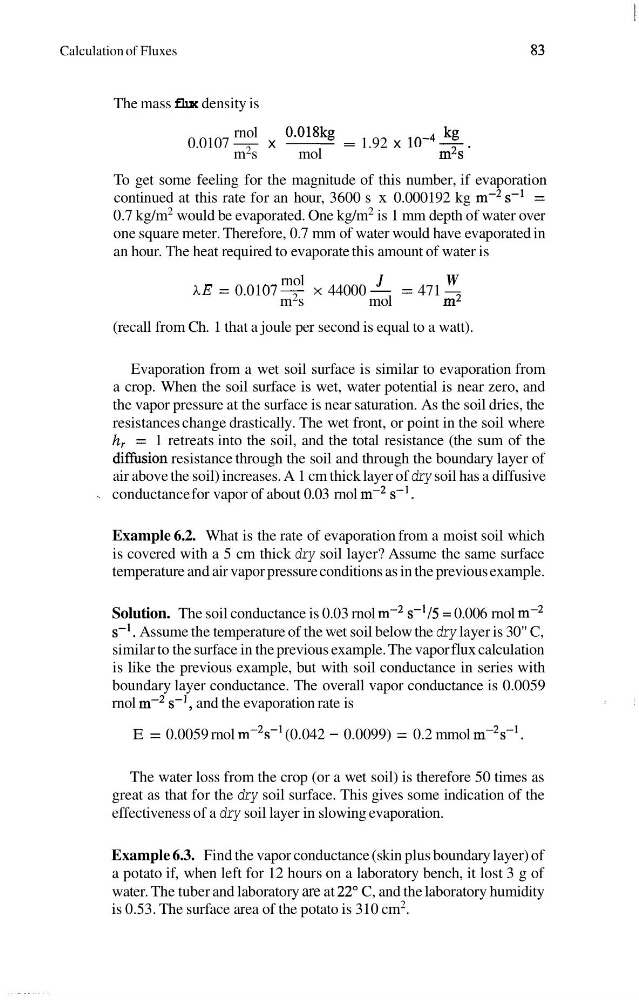
Calculation of Fluxes
The mass flux density is
rnol
0.018kg
0.0107- x -
kg
= 1.92 x
- .
m 2 s
mol
m2s
To get some feeling for the magnitude of this number, if evaporation
continued at this rate for an hour, 3600 s x 0.000192 kg m-2 s-' =
0.7 kg/m 2 would be evaporated. One kg/m 2 is 1 mm depth of water over
one square meter. Therefore, 0.7 mm of water would have evaporated in
an hour. The heat required to evaporate this amount of water is
-
. . . .- rnol
. . . . .
J
.
W
k E = 0.0107 - X 44000 - = 471 -
m 2 s
mol
m2
(recall from Ch. 1 that a joule per second is equal to a watt).
Evaporation from a wet soil surface is similar to evaporation from
a crop. When the soil surface is wet, water potential is near zero, and
the vapor pressure at the surface is near saturation. As the soil dries, the
resistances change drastically. The wet front, or point in the soil where
h, = 1 retreats into the soil, and the total resistance (the sum of the
diffusion resistance through the soil and through the boundary layer of
air above the soil) increases. A 1 cm thick layer of dry soil has a diffusive
conductance for vapor of about 0.03 rnol mP2 s-'.
Example 6.2. What is the rate of evaporation from a moist soil which
is covered with a 5 cm thick dry soil layer? Assume the same surface
temperature and air vapor pressure conditions as in the previous example.
Solution. The soil conductance is 0.03 rnol m-2 s-'15 = 0.006 rnol m-2
s-'. Assume the temperature of the wet soil below the dry layer is 30" C,
similar to the surface in the previous example. The vapor flux calculation
is like the previous example, but with soil conductance in series with
boundary layer conductance. The overall vapor conductance is 0.0059
rnol m-2 s-', and the evaporation rate is
E = 0.0059 rnol m-'s-' (0.042 - 0.0099) = 0.2 mmol m-'s-'.
The water loss from the crop (or a wet soil) is therefore 50 times as
great as that for the dry soil surface. This gives some indication of the
effectiveness of a dry soil layer in slowing evaporation.
Example 6.3. Find the vapor conductance (skin plus boundary layer) of
a potato if, when left for 12 hours on a laboratory bench, it lost 3 g of
water. The tuber and laboratory are at 22" C, and the laboratory humidity
is 0.53. The surface area of the potato is 310 cm
2 .
The mass flux density is
rnol
0.018kg
0.0107- x -
kg
= 1.92 x
- .
m 2 s
mol
m2s
To get some feeling for the magnitude of this number, if evaporation
continued at this rate for an hour, 3600 s x 0.000192 kg m-2 s-' =
0.7 kg/m 2 would be evaporated. One kg/m 2 is 1 mm depth of water over
one square meter. Therefore, 0.7 mm of water would have evaporated in
an hour. The heat required to evaporate this amount of water is
-
. . . .- rnol
. . . . .
J
.
W
k E = 0.0107 - X 44000 - = 471 -
m 2 s
mol
m2
(recall from Ch. 1 that a joule per second is equal to a watt).
Evaporation from a wet soil surface is similar to evaporation from
a crop. When the soil surface is wet, water potential is near zero, and
the vapor pressure at the surface is near saturation. As the soil dries, the
resistances change drastically. The wet front, or point in the soil where
h, = 1 retreats into the soil, and the total resistance (the sum of the
diffusion resistance through the soil and through the boundary layer of
air above the soil) increases. A 1 cm thick layer of dry soil has a diffusive
conductance for vapor of about 0.03 rnol mP2 s-'.
Example 6.2. What is the rate of evaporation from a moist soil which
is covered with a 5 cm thick dry soil layer? Assume the same surface
temperature and air vapor pressure conditions as in the previous example.
Solution. The soil conductance is 0.03 rnol m-2 s-'15 = 0.006 rnol m-2
s-'. Assume the temperature of the wet soil below the dry layer is 30" C,
similar to the surface in the previous example. The vapor flux calculation
is like the previous example, but with soil conductance in series with
boundary layer conductance. The overall vapor conductance is 0.0059
rnol m-2 s-', and the evaporation rate is
E = 0.0059 rnol m-'s-' (0.042 - 0.0099) = 0.2 mmol m-'s-'.
The water loss from the crop (or a wet soil) is therefore 50 times as
great as that for the dry soil surface. This gives some indication of the
effectiveness of a dry soil layer in slowing evaporation.
Example 6.3. Find the vapor conductance (skin plus boundary layer) of
a potato if, when left for 12 hours on a laboratory bench, it lost 3 g of
water. The tuber and laboratory are at 22" C, and the laboratory humidity
is 0.53. The surface area of the potato is 310 cm
2 .