

Signs of Change
Mariculture and fisheries
enhancement
The use of mariculture (the farming, or aquaculture, of
marine organisms) is growing in many reef areas. Clearly, by
providing an alternative source of income and employment
in coastal areas, mariculture can reduce the numbers who
fish on the reefs themselves, and replace some of the
demand for reef-caught protein. Mariculture is also occasionally used in replenishment schemes where species that
have been greatly diminished in abundance are restored to
certain areas. This has been successful for returning species
such as giant clams and trochus to reefs where they have
been largely or completely exterminated by overfishing.
Another form of reducing fishing pressure has been
the establishment of artificial reefs. These are artificial
structures which are placed onto the seabed and serve as a
complex habitat attracting fish, and hence being popular
with fishers. They are often purpose-built structures,
utilizing materials from car tyres, to boulders, to moulded
concrete shapes, but alternatively may be pre-existing
structures, typically boats, which are taken out and sunk in
relatively shallow waters. The deployment of these has
been highly controversial in many coral reef areas. There
have been failures in the design of some artificial reefs
(car tyres have come adrift, or boats have not been
properly cleaned and leak oil). Also, some concerns have
been expressed that these structures may not be increasing
overall fish stocks, just attracting species away from the
reefs to areas where they are more readily caught. Despite
this controversy, artificial reef technology is quite widely
used in many non-reef areas, and may prove to be valuable
and sustainable in some environments.
Reef recovery and restoration
As reefs are degraded so it is critical to establish
management regimes which may promote their recovery.
Increasingly it is possible to pinpoint the causes of a reef's
degradation or loss, and management measures can be
found to reduce or remove these causal factors and to
reverse the conditions. These may include changes to the
fishing regime, or to adjacent activities on agricultural
land or in industrial or urban areas.
Such restoration techniques may be enhanced by
more active processes of restocking, although the value
of such approaches, when compared to allowing natural
recovery processes, is sometimes questionable. A number
of suggestions have been made regarding "planting out" of
artificially reared corals, transplanting coral fragments
from other areas, or enhancing coral growth rates with
various processes. These may well prove successful in a
few cases, but the high cost of such activities means that
they are rarely, if ever, a viable process for restoring wide
areas of reef ecosystems.
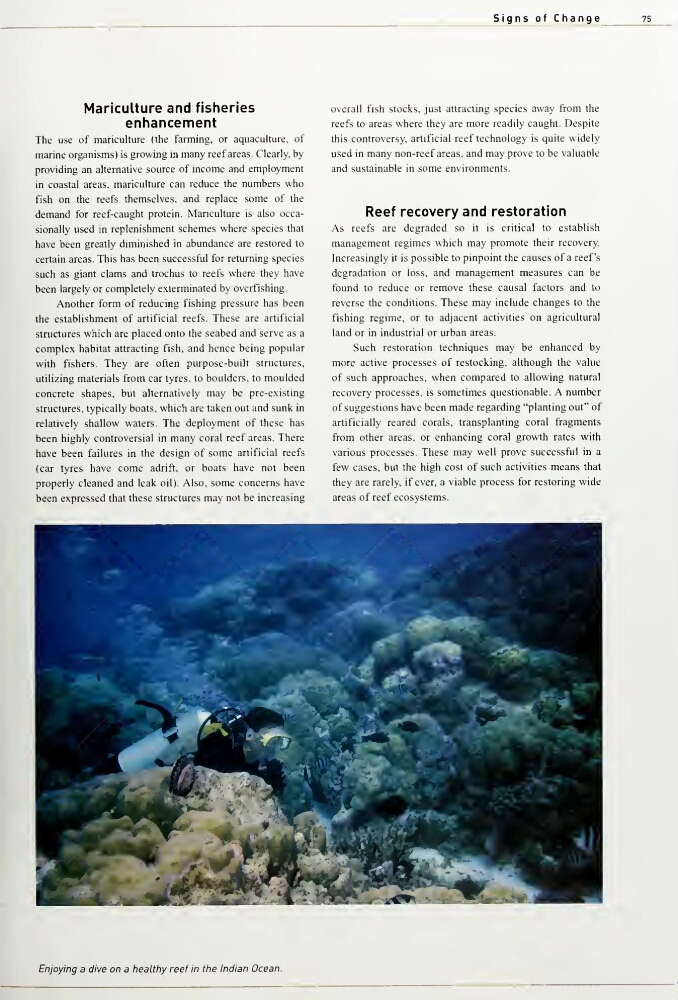
Enjoying a dive on a tiealtliy reef in the Indian Ocean.
Mariculture and fisheries
enhancement
The use of mariculture (the farming, or aquaculture, of
marine organisms) is growing in many reef areas. Clearly, by
providing an alternative source of income and employment
in coastal areas, mariculture can reduce the numbers who
fish on the reefs themselves, and replace some of the
demand for reef-caught protein. Mariculture is also occasionally used in replenishment schemes where species that
have been greatly diminished in abundance are restored to
certain areas. This has been successful for returning species
such as giant clams and trochus to reefs where they have
been largely or completely exterminated by overfishing.
Another form of reducing fishing pressure has been
the establishment of artificial reefs. These are artificial
structures which are placed onto the seabed and serve as a
complex habitat attracting fish, and hence being popular
with fishers. They are often purpose-built structures,
utilizing materials from car tyres, to boulders, to moulded
concrete shapes, but alternatively may be pre-existing
structures, typically boats, which are taken out and sunk in
relatively shallow waters. The deployment of these has
been highly controversial in many coral reef areas. There
have been failures in the design of some artificial reefs
(car tyres have come adrift, or boats have not been
properly cleaned and leak oil). Also, some concerns have
been expressed that these structures may not be increasing
overall fish stocks, just attracting species away from the
reefs to areas where they are more readily caught. Despite
this controversy, artificial reef technology is quite widely
used in many non-reef areas, and may prove to be valuable
and sustainable in some environments.
Reef recovery and restoration
As reefs are degraded so it is critical to establish
management regimes which may promote their recovery.
Increasingly it is possible to pinpoint the causes of a reef's
degradation or loss, and management measures can be
found to reduce or remove these causal factors and to
reverse the conditions. These may include changes to the
fishing regime, or to adjacent activities on agricultural
land or in industrial or urban areas.
Such restoration techniques may be enhanced by
more active processes of restocking, although the value
of such approaches, when compared to allowing natural
recovery processes, is sometimes questionable. A number
of suggestions have been made regarding "planting out" of
artificially reared corals, transplanting coral fragments
from other areas, or enhancing coral growth rates with
various processes. These may well prove successful in a
few cases, but the high cost of such activities means that
they are rarely, if ever, a viable process for restoring wide
areas of reef ecosystems.
Enjoying a dive on a tiealtliy reef in the Indian Ocean.