

The World of Coral Reefs
on the underside of their thorax. All have four pairs of
walking legs and often a well developed pair of pincers.
Stomatopoda
Also known as mantis shrimps, these are an ancient group
which are thought to have diverged among the Crustacea
around 400 million years ago. Over 400 species have been
described, the majority of which are to be found in shallow
tropical seas. All are active predators, with highly developed
visual acuity and a specially adapted second pair of thoracic
legs. In one major group, the smashing mantis shrimps
(Gonodactylidae), these legs are strengthened into club-like
appendages, while in the other group, the spearing mantis
shrimps (Lysiosquillidae), they are adapted into barbed
spears. Both groups are able to unfold these appendages
at remarkable speeds to hit their prey. Smashing mantis
shrimps are capable of breaking open the shells of molluscs
and crabs, while spearing mantis shrimps are able to impale
softer bodied shrimps and fishes.
Molluscs
Molluscs are another highly diverse group found on the
reefs, with one estimate of more than 10 000 described
species from coral reefs. Members of this phylum all have
a body which can be broadly divided into a head, a central
visceral mass and a strong muscular foot. Most also have
a mantle which to varying degrees folds around the body.
A rasping tongue, or radula, is common and most species
secrete a calcareous shell. Four groups predominate, and
all are present on reefs.
Chitons (Polyplacophora)
These are regarded as the most ancient of the molluscs,
recognizable by their low, oval shape dominated by the
presence of eight transverse and overlapping shell plates.
They are grazers, and are most commonly found in shallow and intertidal areas.
Snails (Gastropoda)
The largest and most diverse group, the Gastropoda usually
have a single coiled shell. The simplest forms (Archaeogastropoda) include the limpets, abalones, trochus, turbans
and nerites, all of which are algal grazers. Another major
group is the Mesogastropoda, which encompasses many
reef species, including the cowries, periwinkles and
conches. Many are algal grazers, although some have
developed specialized diets - the helmet shells, tritons and
tun shells feed on echinoderms. The Neogastropoda are a
more advanced group. Many have an elongated siphonal
canal and highly developed proboscis which can be used for
capturing prey. In this way, the mure.x shells are capable of
boring through the shells of other molluscs and injecting
them with venom, while the cone shells have developed a
highly specialized radula tooth attached to a poison sac.
They are able to fire this, rather like a harpoon, and
rapidly kill even highly mobile prey such as fish.
Opisthobranch gastropods are another well known
sub-group, with some shelled forms such as the bubble
shells, but also a large number of shell-less forms including the algal-grazing sea hares and the highly diverse and
colorful nudibranchs. The latter are all carnivorous and
many have relatively specialized diets. Some are able to
maintain nematocysts from their prey and use them in
defense, while others utilize the toxic chemicals their prey
have developed, again for their own protection.
Bivalves (Bivalvia)
These are a large group of bilaterally symmetrical molluscs
with a shell completely split into two matching halves and
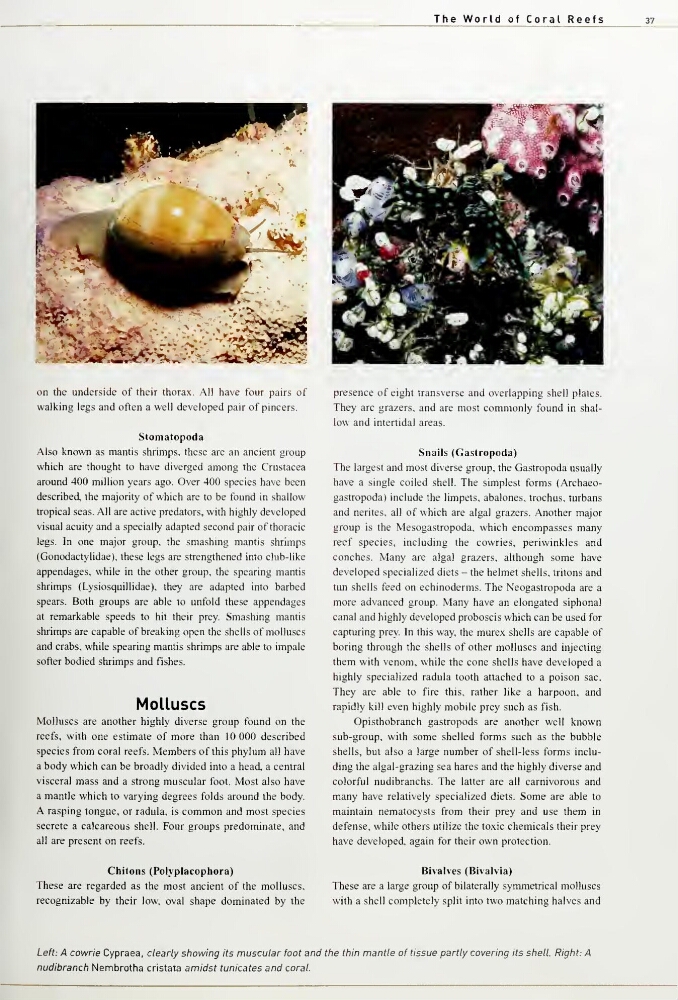
Left: A cowrie Cypraea, dearly showing its muscular foot and the thin mantle of tissue partly covering its shell. Right: A
nudibranch Nembrotha cristata amidst tunicates and coral.
on the underside of their thorax. All have four pairs of
walking legs and often a well developed pair of pincers.
Stomatopoda
Also known as mantis shrimps, these are an ancient group
which are thought to have diverged among the Crustacea
around 400 million years ago. Over 400 species have been
described, the majority of which are to be found in shallow
tropical seas. All are active predators, with highly developed
visual acuity and a specially adapted second pair of thoracic
legs. In one major group, the smashing mantis shrimps
(Gonodactylidae), these legs are strengthened into club-like
appendages, while in the other group, the spearing mantis
shrimps (Lysiosquillidae), they are adapted into barbed
spears. Both groups are able to unfold these appendages
at remarkable speeds to hit their prey. Smashing mantis
shrimps are capable of breaking open the shells of molluscs
and crabs, while spearing mantis shrimps are able to impale
softer bodied shrimps and fishes.
Molluscs
Molluscs are another highly diverse group found on the
reefs, with one estimate of more than 10 000 described
species from coral reefs. Members of this phylum all have
a body which can be broadly divided into a head, a central
visceral mass and a strong muscular foot. Most also have
a mantle which to varying degrees folds around the body.
A rasping tongue, or radula, is common and most species
secrete a calcareous shell. Four groups predominate, and
all are present on reefs.
Chitons (Polyplacophora)
These are regarded as the most ancient of the molluscs,
recognizable by their low, oval shape dominated by the
presence of eight transverse and overlapping shell plates.
They are grazers, and are most commonly found in shallow and intertidal areas.
Snails (Gastropoda)
The largest and most diverse group, the Gastropoda usually
have a single coiled shell. The simplest forms (Archaeogastropoda) include the limpets, abalones, trochus, turbans
and nerites, all of which are algal grazers. Another major
group is the Mesogastropoda, which encompasses many
reef species, including the cowries, periwinkles and
conches. Many are algal grazers, although some have
developed specialized diets - the helmet shells, tritons and
tun shells feed on echinoderms. The Neogastropoda are a
more advanced group. Many have an elongated siphonal
canal and highly developed proboscis which can be used for
capturing prey. In this way, the mure.x shells are capable of
boring through the shells of other molluscs and injecting
them with venom, while the cone shells have developed a
highly specialized radula tooth attached to a poison sac.
They are able to fire this, rather like a harpoon, and
rapidly kill even highly mobile prey such as fish.
Opisthobranch gastropods are another well known
sub-group, with some shelled forms such as the bubble
shells, but also a large number of shell-less forms including the algal-grazing sea hares and the highly diverse and
colorful nudibranchs. The latter are all carnivorous and
many have relatively specialized diets. Some are able to
maintain nematocysts from their prey and use them in
defense, while others utilize the toxic chemicals their prey
have developed, again for their own protection.
Bivalves (Bivalvia)
These are a large group of bilaterally symmetrical molluscs
with a shell completely split into two matching halves and
Left: A cowrie Cypraea, dearly showing its muscular foot and the thin mantle of tissue partly covering its shell. Right: A
nudibranch Nembrotha cristata amidst tunicates and coral.