

Polynesia
389
suspended in lagoons, and while there is no detailed
knowledge of the impact they may have on planktonic
systems or the predation of reef larvae, no major detrimental effects have been observed to date. There is also
some prawn aquaculture for local markets. Trochus and
green snails have been introduced and are now utilized for
food and in local handicrafts.
Tourism is another major industry on some islands,
with 164 000 visitors in 1996. All hotel developments are
coastal, and a number of hotels extend over the reef flat on
jetties or pontoons. While hotels are required to treat their
wastewater there may be some introduction of nutrient-rich
waters into the lagoon or via the groundwater. Coastal
development more generally has led to considerable
modifications of the coastline in Tahiti and Moorea.
Sewage pollution is also a problem close to urban areas in
these two islands, while they also have high levels of
sediment runoff, possibly exacerbated by pesticides and
fertilizers, which may have localized impacts. In Tahiti it
has been estimated that 20 percent of reefs in urban areas
have been destroyed, while 75 percent of the fringing reefs
in Bora-Bora, which is one of the most popular tourist
destinations, have been moderately to severely disturbed.
Overall however, the total extent of these impacts is low
or very low compared to the total area of coral reefs in
French Polynesia.
The remote atolls of Mururoa and Fangataufa were
used for nuclear tests, including atmospheric tests from
1966 to 1974. and for subsequent underground tests until
1996. The effects of these are not well known, although it is
likely that the atmospheric tests in particular would have
caused considerable damage to some areas. Only three
protected areas currently incorporate coral reefs, making up
a tiny proportion of the total reef area in the country. There
are ongoing efforts to increase the total area protected, and
to develop community-based management systems for a
number of atoll lagoons.
Pitcairn
The easternmost islands of the Indo-Pacific region consist
of the small group of the Pitcairn Islands. Pitcairn itself
is a relatively recent volcanic island reaching some 347
meters above sea level. Henderson Island is a raised atoll
which reaches 34 meters above sea level, while there are
two small atolls, Oeno, with only one small island, and
Ducie with one main island and three smaller islets. Coral
cover is reported to be very high, typically 80-90 percent on
Ducie at 10-30 meters, but slightly lower (40-70 percent)
around Oeno, dominated by Acropoia and Montiponi. The
fringing reefs around Henderson have lower coral cover,
typically 10-30 percent on the fore reef slope, dominated by
Pocillopora. There are no reefs around Pitcairn.
In terms of biodiversity these reefs have low species
numbers, as might be expected from their easterly location
and high latitude. Ducie is both the most easterly atoll of
the Indo-Pacific and the most southerly atoll in the world.
Pitcairn is the only inhabited island, with a low population.
The islanders make very occasional visits to Oeno atoll for
fishing but do not rely on these visits. The reefs and islands
are largely protected by their isolation, whilst Henderson
Island is now a World Heritage Site.
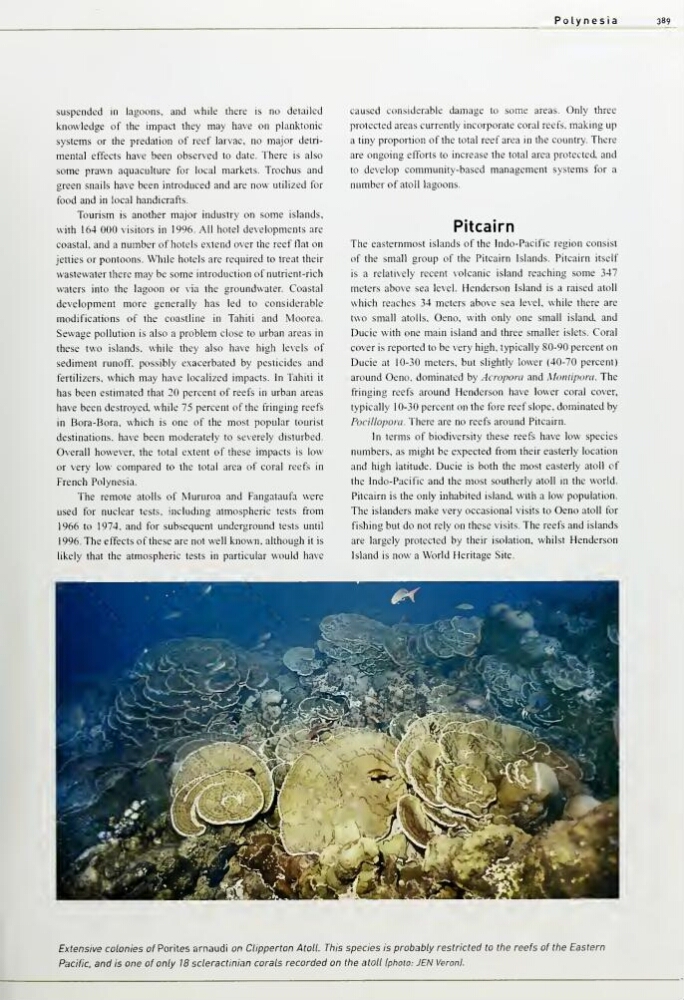
Extensive colonies of Porites arnaudi on Clipperton Atoll. Ttiis species is probably restricted to ttie reefs of the Eastern
Pacific, and is one of only 18 scleractmian corals recorded on tfie atoll tpfjolo: JEN Veronl.
389
suspended in lagoons, and while there is no detailed
knowledge of the impact they may have on planktonic
systems or the predation of reef larvae, no major detrimental effects have been observed to date. There is also
some prawn aquaculture for local markets. Trochus and
green snails have been introduced and are now utilized for
food and in local handicrafts.
Tourism is another major industry on some islands,
with 164 000 visitors in 1996. All hotel developments are
coastal, and a number of hotels extend over the reef flat on
jetties or pontoons. While hotels are required to treat their
wastewater there may be some introduction of nutrient-rich
waters into the lagoon or via the groundwater. Coastal
development more generally has led to considerable
modifications of the coastline in Tahiti and Moorea.
Sewage pollution is also a problem close to urban areas in
these two islands, while they also have high levels of
sediment runoff, possibly exacerbated by pesticides and
fertilizers, which may have localized impacts. In Tahiti it
has been estimated that 20 percent of reefs in urban areas
have been destroyed, while 75 percent of the fringing reefs
in Bora-Bora, which is one of the most popular tourist
destinations, have been moderately to severely disturbed.
Overall however, the total extent of these impacts is low
or very low compared to the total area of coral reefs in
French Polynesia.
The remote atolls of Mururoa and Fangataufa were
used for nuclear tests, including atmospheric tests from
1966 to 1974. and for subsequent underground tests until
1996. The effects of these are not well known, although it is
likely that the atmospheric tests in particular would have
caused considerable damage to some areas. Only three
protected areas currently incorporate coral reefs, making up
a tiny proportion of the total reef area in the country. There
are ongoing efforts to increase the total area protected, and
to develop community-based management systems for a
number of atoll lagoons.
Pitcairn
The easternmost islands of the Indo-Pacific region consist
of the small group of the Pitcairn Islands. Pitcairn itself
is a relatively recent volcanic island reaching some 347
meters above sea level. Henderson Island is a raised atoll
which reaches 34 meters above sea level, while there are
two small atolls, Oeno, with only one small island, and
Ducie with one main island and three smaller islets. Coral
cover is reported to be very high, typically 80-90 percent on
Ducie at 10-30 meters, but slightly lower (40-70 percent)
around Oeno, dominated by Acropoia and Montiponi. The
fringing reefs around Henderson have lower coral cover,
typically 10-30 percent on the fore reef slope, dominated by
Pocillopora. There are no reefs around Pitcairn.
In terms of biodiversity these reefs have low species
numbers, as might be expected from their easterly location
and high latitude. Ducie is both the most easterly atoll of
the Indo-Pacific and the most southerly atoll in the world.
Pitcairn is the only inhabited island, with a low population.
The islanders make very occasional visits to Oeno atoll for
fishing but do not rely on these visits. The reefs and islands
are largely protected by their isolation, whilst Henderson
Island is now a World Heritage Site.
Extensive colonies of Porites arnaudi on Clipperton Atoll. Ttiis species is probably restricted to ttie reefs of the Eastern
Pacific, and is one of only 18 scleractmian corals recorded on tfie atoll tpfjolo: JEN Veronl.