

Polynesia
377
Tonga and Niue
MAP lAc
TOnQd
S islands stretch for over 800 kilometers
from north to south. They are located along the
western edge of the convergent margins of the
Indo-Australian and Pacific tectonic plates. To their east
is the Tonga Trench, which at nearly 1 1 000 meters is one
of the deepest points of the ocean. The islands consist
of both relatively low-lying limestone islands and high
volcanic ones. The volcanic islands form a westerly chain
along a volcanic arc (the Tofua Arc), from 'Ata in the
south to Niuafo'ou in the north. Many of these are still
active - the last major eruption of Niuafo'ou was in
1942, with more recent activity recorded in 1985. Further
south there have been recent eruptions in a number of
submarine locations, and on a few occasions these have
led to the appearance of new islands. Around the Metis
Shoal new islands have occurred as many as five times
in recent history, while a new island was reported 35
kilometers northwest of Tongatapu in 1999. Despite being
quite large and reaching to over 100 meters above sea
level, most of these islands soon disappear below sea
level again. Although these volcanic islands lie in close
proximity to the limestone ones of Tonga, they are actually
separated by the Tofua Trough which reaches depths of
1 800 meters.
8 km
The majority of Tonga's islands lie in the eastern arc.
These are largely of reef origin, although there are also
significant ash deposits, up to 5 meters thick on Tongatapu
and 13 meters thick on Kotu. They fall into three main
groups. The Tongatapu group in the south is dominated
by the large uplifted islands of Tongatapu and 'Eua. The
central Ha'apai group is a complex spread of reefs and
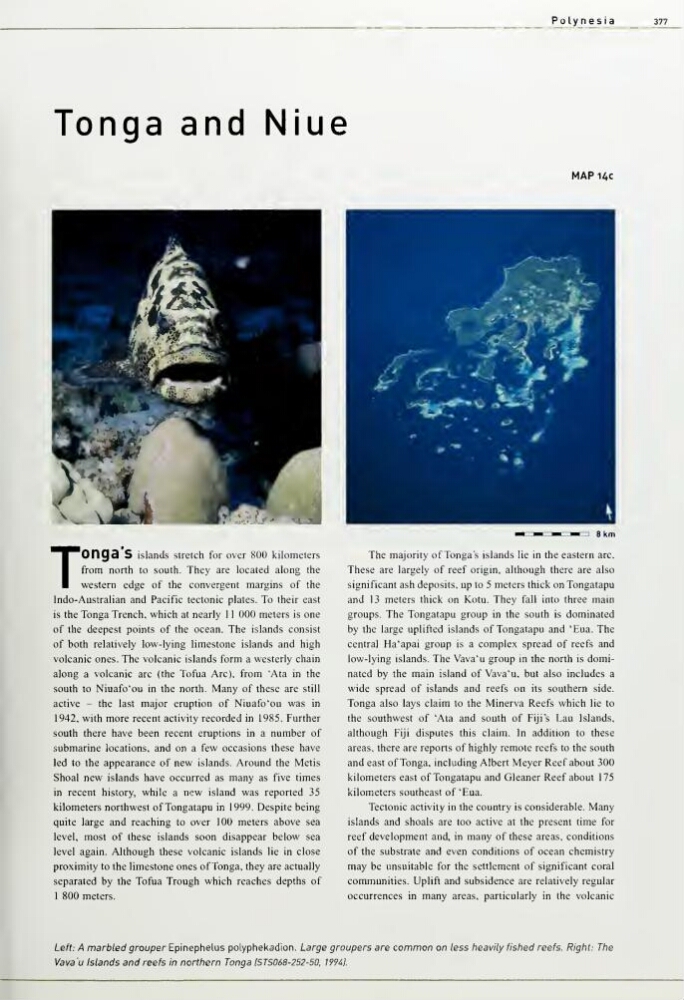
low-lying islands. The Vava'u group in the north is dominated by the main island of Vava'u, but also includes a
wide spread of islands and reefs on its southern side.
Tonga also lays claim to the Minerva Reefs which lie to
the southwest of 'Ata and south of Fiji's Lau Islands,
although Fiji disputes this claim. In addition to these
areas, there are reports of highly remote reefs to the south
and east of Tonga, including Albert Meyer Reef about 300
kilometers east of Tongatapu and Gleaner Reef about 175
kilometers southeast of 'Eua.
Tectonic activity in the country is considerable. Many
islands and shoals are too active at the present time for
reef development and, in many of these areas, conditions
of the substrate and even conditions of ocean chemistry
may be unsuitable for the settlement of significant coral
communities. Uplift and subsidence are relatively regular
occurrences in many areas, particularly in the volcanic
Left: A marbled grouper Epinephelus polyphekadion. Large groupers are common on less heavily fished reefs. Right: The
Vava'u Islands and reefs in northern Tonga ISTS068-252-50, 19941.
377
Tonga and Niue
MAP lAc
TOnQd
S islands stretch for over 800 kilometers
from north to south. They are located along the
western edge of the convergent margins of the
Indo-Australian and Pacific tectonic plates. To their east
is the Tonga Trench, which at nearly 1 1 000 meters is one
of the deepest points of the ocean. The islands consist
of both relatively low-lying limestone islands and high
volcanic ones. The volcanic islands form a westerly chain
along a volcanic arc (the Tofua Arc), from 'Ata in the
south to Niuafo'ou in the north. Many of these are still
active - the last major eruption of Niuafo'ou was in
1942, with more recent activity recorded in 1985. Further
south there have been recent eruptions in a number of
submarine locations, and on a few occasions these have
led to the appearance of new islands. Around the Metis
Shoal new islands have occurred as many as five times
in recent history, while a new island was reported 35
kilometers northwest of Tongatapu in 1999. Despite being
quite large and reaching to over 100 meters above sea
level, most of these islands soon disappear below sea
level again. Although these volcanic islands lie in close
proximity to the limestone ones of Tonga, they are actually
separated by the Tofua Trough which reaches depths of
1 800 meters.
8 km
The majority of Tonga's islands lie in the eastern arc.
These are largely of reef origin, although there are also
significant ash deposits, up to 5 meters thick on Tongatapu
and 13 meters thick on Kotu. They fall into three main
groups. The Tongatapu group in the south is dominated
by the large uplifted islands of Tongatapu and 'Eua. The
central Ha'apai group is a complex spread of reefs and
low-lying islands. The Vava'u group in the north is dominated by the main island of Vava'u, but also includes a
wide spread of islands and reefs on its southern side.
Tonga also lays claim to the Minerva Reefs which lie to
the southwest of 'Ata and south of Fiji's Lau Islands,
although Fiji disputes this claim. In addition to these
areas, there are reports of highly remote reefs to the south
and east of Tonga, including Albert Meyer Reef about 300
kilometers east of Tongatapu and Gleaner Reef about 175
kilometers southeast of 'Eua.
Tectonic activity in the country is considerable. Many
islands and shoals are too active at the present time for
reef development and, in many of these areas, conditions
of the substrate and even conditions of ocean chemistry
may be unsuitable for the settlement of significant coral
communities. Uplift and subsidence are relatively regular
occurrences in many areas, particularly in the volcanic
Left: A marbled grouper Epinephelus polyphekadion. Large groupers are common on less heavily fished reefs. Right: The
Vava'u Islands and reefs in northern Tonga ISTS068-252-50, 19941.