

Polynesia
373
Tokelau, Samoa and
American Samoa
MAP 14b
T0K613U
is a group of three small coral atolls,
each with numerous islands on its rim. The lagoons
are shallow with large numbers of coral outcrops,
while the maximum height of the islands is about 4.5 meters.
None of these atolls has a deep channel into the lagoon,
making boat access difficult. The area has been affected by
cyclones on a number of occasions, including 1987, 1990
and 1991. Detailed information about the biodiversity of
these reefs is unavailable, but it is likely to be similar to that
of the Samoan Islands to the south and Tuvalu to the west.
Tokelau, a territory of New Zealand, is heavily dependent on financial support for development. Concerns about
degradation of the natural environment from overfishing
and sewage pollution have led to some efforts to improve
environmental management. There is a small fish processing plant on Atafu which prepares sundried tuna. At the
end of the 1990s the overall threats were very low, although
there had been depletion of a number of species such as
giant clam and trochus. There is a relatively small population and there are very few visitors.
Samoa
The Samoa Archipelago is a hotspot chain of predominantly
high volcanic islands divided into the politically independent western islands of Samoa (formerly Western
Samoa) and the eastern islands of American Samoa.
Samoa itself is dominated by the two large islands of
Upolu and Savai'i with a few very small islands nearby.
Savai'i, geologically the youngest, experienced eruptions
from two of its volcanoes in the early 1900s. There are
fringing reefs around most of the coastline, generally
close to the shore, but reaching up to 3 kilometers offshore
along the northwestern coast of Upolu.
Information on biodiversity is relatively limited.
About 50 species of hard coral have been listed, although
this is likely to be a considerable underestimate. Studies
of marine algae have been more complete, and some 300
species have so far been described. Some 991 fish species
have been recorded in the wider Samoan archipelago, of
which at least 890 are shallow reef-dwelling species. There
are small areas of seagrass, and mangrove communities
are well developed at a few locations around Upolu. The
reefs and islands of Samoa were severely impacted by
cyclones Ofa and Val in 1990 and 1991, although there is
reported to have been good recovery of coral cover and
diversity in many areas.
The people of Samoa are generally heavily dependent
on the reefs at a subsistence level and for the domestic
market. An estimated 4 600 tons of fish were taken for
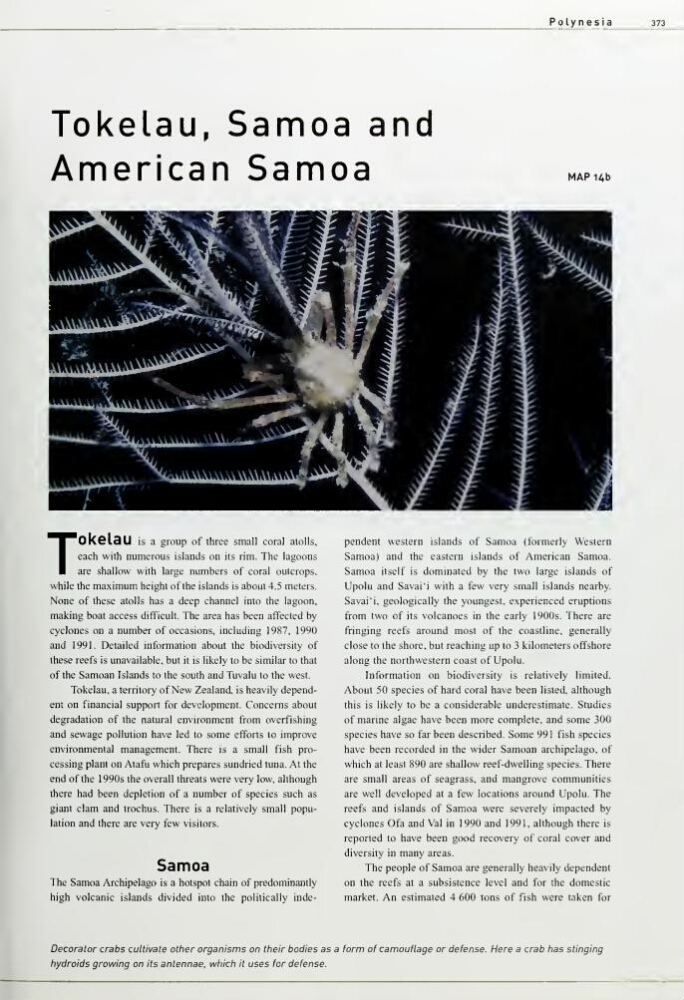
Decorator crabs cultivate other organisms on their bodies as a form of camouflage or defense. Here a crab has stinging
hydroids growing on its antennae, which it uses for defense.
373
Tokelau, Samoa and
American Samoa
MAP 14b
T0K613U
is a group of three small coral atolls,
each with numerous islands on its rim. The lagoons
are shallow with large numbers of coral outcrops,
while the maximum height of the islands is about 4.5 meters.
None of these atolls has a deep channel into the lagoon,
making boat access difficult. The area has been affected by
cyclones on a number of occasions, including 1987, 1990
and 1991. Detailed information about the biodiversity of
these reefs is unavailable, but it is likely to be similar to that
of the Samoan Islands to the south and Tuvalu to the west.
Tokelau, a territory of New Zealand, is heavily dependent on financial support for development. Concerns about
degradation of the natural environment from overfishing
and sewage pollution have led to some efforts to improve
environmental management. There is a small fish processing plant on Atafu which prepares sundried tuna. At the
end of the 1990s the overall threats were very low, although
there had been depletion of a number of species such as
giant clam and trochus. There is a relatively small population and there are very few visitors.
Samoa
The Samoa Archipelago is a hotspot chain of predominantly
high volcanic islands divided into the politically independent western islands of Samoa (formerly Western
Samoa) and the eastern islands of American Samoa.
Samoa itself is dominated by the two large islands of
Upolu and Savai'i with a few very small islands nearby.
Savai'i, geologically the youngest, experienced eruptions
from two of its volcanoes in the early 1900s. There are
fringing reefs around most of the coastline, generally
close to the shore, but reaching up to 3 kilometers offshore
along the northwestern coast of Upolu.
Information on biodiversity is relatively limited.
About 50 species of hard coral have been listed, although
this is likely to be a considerable underestimate. Studies
of marine algae have been more complete, and some 300
species have so far been described. Some 991 fish species
have been recorded in the wider Samoan archipelago, of
which at least 890 are shallow reef-dwelling species. There
are small areas of seagrass, and mangrove communities
are well developed at a few locations around Upolu. The
reefs and islands of Samoa were severely impacted by
cyclones Ofa and Val in 1990 and 1991, although there is
reported to have been good recovery of coral cover and
diversity in many areas.
The people of Samoa are generally heavily dependent
on the reefs at a subsistence level and for the domestic
market. An estimated 4 600 tons of fish were taken for
Decorator crabs cultivate other organisms on their bodies as a form of camouflage or defense. Here a crab has stinging
hydroids growing on its antennae, which it uses for defense.