

Polynesia
371
Tuvalu and
Wallis and Futuna
MAP 14a
TUVSlU
is a small archipelago (formerly the Ellice
Islands) consisting of five true atolls and four
other platform islands with encircling fringing
reefs. There are also several other seamounts which may
reach within 30 meters of the surface.
The lagoons are predominantly sandy with some
coral heads. The outer slopes are reported to be rich in
both coral cover and diversity, although detailed faunal
inventories have not been prepared. Some 400 fish species
have been recorded from Funafuti There are small mangrove stands in a few areas.
Attempts at establishing commercial fisheries have
been largely unsuccessful. Some sea cucumbers were
exported until 1982, but current densities are not
considered high enough to revive the fishery. Efforts to
establish a deep water snapper industry for export have
largely failed. The country receives its main foreign
income through the grantmg of fishing licenses for
offshore pelagics (predominantly tuna). There is no major
tourist industry.
between the Pacific and Indo-Australian tectonic plates.
Wallis has fringing reefs around most of its coastline and is
further completely encircled by a barrier reef, with a number
of sand cays on the reef edge. There is only a small number
of deeper channels into the lagoon proper. Futuna has
narrow fringing reefs on all coasts, while the uninhabited
Alofi has only a few such areas.
There is little in the way of scientific description of
the reef communities around these islands. The few studies
that have been undertaken show modest levels of diversity,
with only 30 coral genera and some 330 species of benthic
fish so far described.
Fishing is an important activity, although largely still
operating at a subsistence level. However, there have been
records of blast fishing. Fringing reefs around Futuna may
have been impacted by sediment runoff and are reported
to be degraded. There is no significant tourism to the
islands, and there are no formal management regimes or
protected areas.
Wallis and Futuna
This overseas territory of France consists of three main
islands: Wallis (Uvea), Futuna and Alofi. All are high
islands of volcanic origin, lying close to the boundary
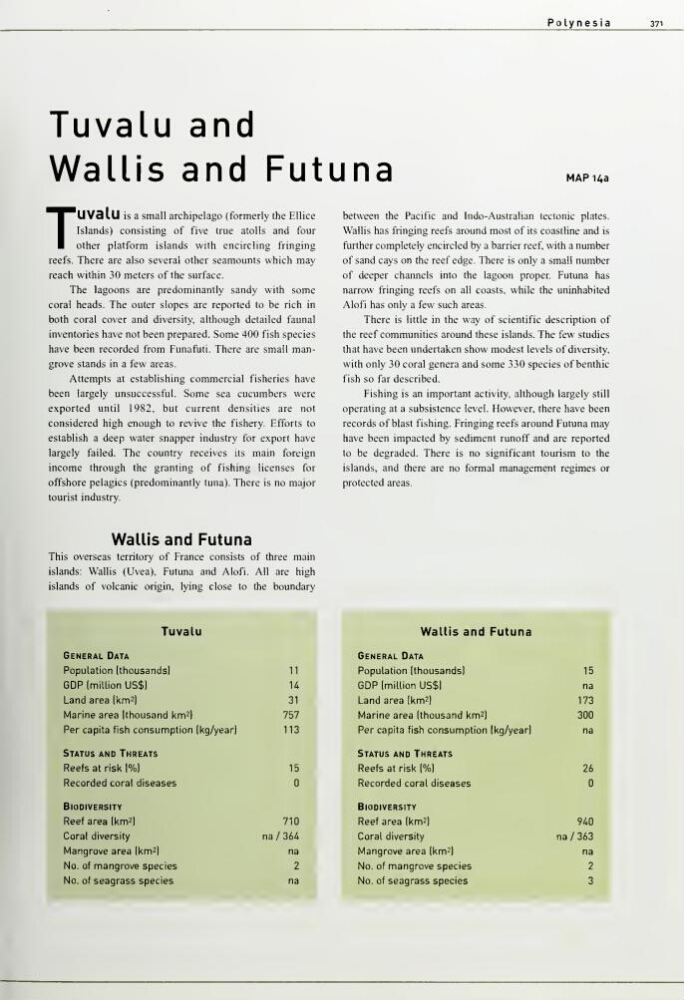
Tuval U
J ^^
General Data
Population Ithousandsl
11
GDP (million US$1
U
Land area Ikm^l
31
Marine area (thousand km^l
757
Per capita fish consumption (kg/yearl
113
Status and Threats
Reefs at risk (%1
15
Recorded coral diseases
Biodiversity
Reef area (km^l
710
Coral diversity
na/36/1
Mangrove area (km^l
na
No. of mangrove species
2
No. of seagrass species
w
mm
na
B^^
1^^^^^H
Wallis an d Futuna
j^^H
General Data
Population (thousands)
15
GOP (million US$1
na
Land area (km^j
173
Marine area (thousand km^)
300
Per capita fish consumption (kg/year|
na
Status and Threats
Reefs at risk (%l
26
Recorded coral diseases
Biodiversity
Reef area (km^)
9iO
Coral diversity
na/363
Mangrove area (km^l
na
No. of mangrove species
2
No. of seagrass species
ff
3
371
Tuvalu and
Wallis and Futuna
MAP 14a
TUVSlU
is a small archipelago (formerly the Ellice
Islands) consisting of five true atolls and four
other platform islands with encircling fringing
reefs. There are also several other seamounts which may
reach within 30 meters of the surface.
The lagoons are predominantly sandy with some
coral heads. The outer slopes are reported to be rich in
both coral cover and diversity, although detailed faunal
inventories have not been prepared. Some 400 fish species
have been recorded from Funafuti There are small mangrove stands in a few areas.
Attempts at establishing commercial fisheries have
been largely unsuccessful. Some sea cucumbers were
exported until 1982, but current densities are not
considered high enough to revive the fishery. Efforts to
establish a deep water snapper industry for export have
largely failed. The country receives its main foreign
income through the grantmg of fishing licenses for
offshore pelagics (predominantly tuna). There is no major
tourist industry.
between the Pacific and Indo-Australian tectonic plates.
Wallis has fringing reefs around most of its coastline and is
further completely encircled by a barrier reef, with a number
of sand cays on the reef edge. There is only a small number
of deeper channels into the lagoon proper. Futuna has
narrow fringing reefs on all coasts, while the uninhabited
Alofi has only a few such areas.
There is little in the way of scientific description of
the reef communities around these islands. The few studies
that have been undertaken show modest levels of diversity,
with only 30 coral genera and some 330 species of benthic
fish so far described.
Fishing is an important activity, although largely still
operating at a subsistence level. However, there have been
records of blast fishing. Fringing reefs around Futuna may
have been impacted by sediment runoff and are reported
to be degraded. There is no significant tourism to the
islands, and there are no formal management regimes or
protected areas.
Wallis and Futuna
This overseas territory of France consists of three main
islands: Wallis (Uvea), Futuna and Alofi. All are high
islands of volcanic origin, lying close to the boundary
Tuval U
J ^^
General Data
Population Ithousandsl
11
GDP (million US$1
U
Land area Ikm^l
31
Marine area (thousand km^l
757
Per capita fish consumption (kg/yearl
113
Status and Threats
Reefs at risk (%1
15
Recorded coral diseases
Biodiversity
Reef area (km^l
710
Coral diversity
na/36/1
Mangrove area (km^l
na
No. of mangrove species
2
No. of seagrass species
w
mm
na
B^^
1^^^^^H
Wallis an d Futuna
j^^H
General Data
Population (thousands)
15
GOP (million US$1
na
Land area (km^j
173
Marine area (thousand km^)
300
Per capita fish consumption (kg/year|
na
Status and Threats
Reefs at risk (%l
26
Recorded coral diseases
Biodiversity
Reef area (km^)
9iO
Coral diversity
na/363
Mangrove area (km^l
na
No. of mangrove species
2
No. of seagrass species
ff
3