

Polynesia
369
Chapter 14
Polynesia
20 km
The
eastern section of the Pacific, stretching
in an easterly direction from Tonga, and to
Hawaii in the north and French Polynesia
in the south, constitutes the area known as
Polynesia. A very large number of islands
and reefs are scattered across this wide region. The
westernmost islands of Tonga and Wallis and Futuna lie
on the boundary between the Pacific and Indo-Australian
plates, with considerable ongoing plate-margin volcanic
activity in Tonga. The remainder of the region is located
on the Pacific plate, and all of the other islands can be
linked to mid-plate volcanic activity. There are many
island chains that have been produced by the movement of the plate surface over hotspots, and volcanic
activity continues in the Hawaiian Islands.
With over 11 000 square kilometers of coral reefs
there is a wide range of reef types harboring highly
varied morphologies and ecological communities.
The island arcs provide excellent examples of atoll
development, from volcanic coastlines with only
sporadic coral communities through high islands with
fringing reefs, to partially submerged volcanoes with
barrier reefs, and finally true atolls. In the north and
south the Hawaiian and Austral Archipelagos both
provide examples of the latitudinal limits to reef
development, with decreases in both diversity and reef
constructions in the cooler waters away from the
tropics. Polynesia also marks the edge of the IndoPacific region. Species diversity is relatively low in
almost all species groups, and there are marked
declines in diversity as one moves eastwards.
Polynesia's limits are defined by the common
features of its peoples. It includes both New Zealand
and Easter Island, though these harbor no coral reefs.
It was one of the last areas in the world to be reached
by humans, probably to central Polynesia some 3 000U 000 years ago, with secondary migrations spreading
out from these first populations. The Samoans are
thought to have populated the Marquesas around 300
AD. Hawai'i, by contrast, was probably not settled until
between 500 and 1000 AD. Large double canoes some
30-45 meters in length were used for inter-island
movement and in the settlement of new areas.
In modern times this region has become an area of
contrasts. A number of the countries and states remain
remote and isolated with small populations dependent
on fisheries. Tourism has become a very important
economic resource for a few countries, in particular
Tonga, French Polynesia and Hawai'i. Traditional utilization and management of reef resources has largely
been lost in the more developed islands, and there are
typical problems of overexploitation and pollution
associated with the areas of most intense human
development. In all, however, the extent of such pressures remains localized, and there are vast areas of
reefs in very good condition.
Hawai'i is largely populated by people of nonPolynesian origin and traditional uses of coral reefs
have almost completely ceased. Alongside these
changes Hawai'i has developed the most extensive
network of marine protected areas in the entire Pacific
Ocean outside Australia.
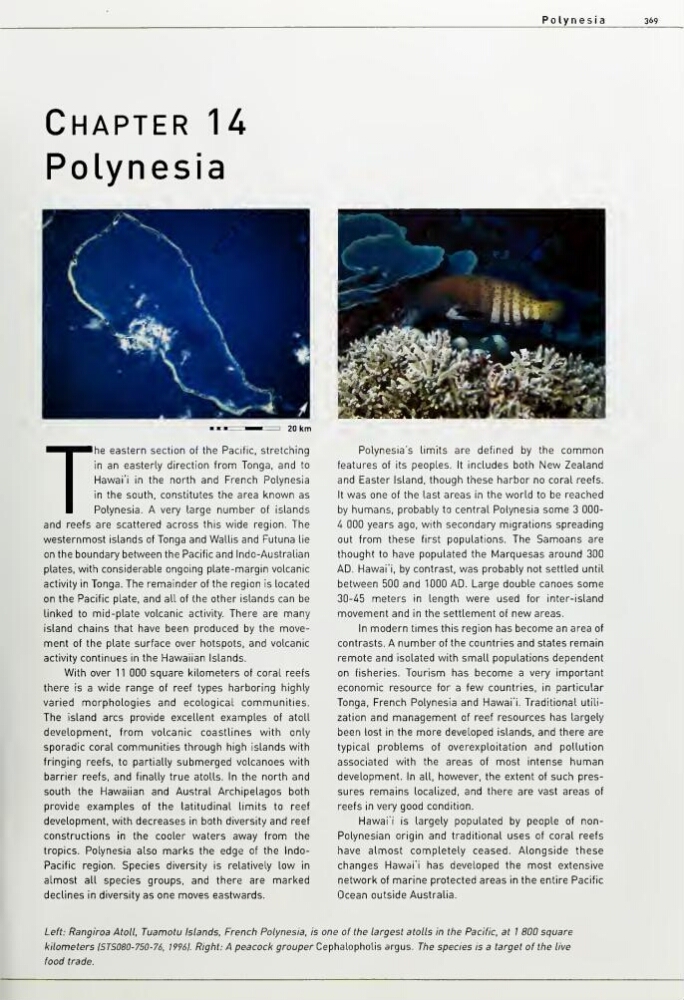
Left: Rangiroa Atoll, Tuamotu Islands, French Polynesia, is one of the largest atolls in the Pacific, at 1 800 square
kilometers ISTS080-750-76, 19961. Right: A peacock grouper Cephalopholis argus. The species is a target of the live
food trade.
369
Chapter 14
Polynesia
20 km
The
eastern section of the Pacific, stretching
in an easterly direction from Tonga, and to
Hawaii in the north and French Polynesia
in the south, constitutes the area known as
Polynesia. A very large number of islands
and reefs are scattered across this wide region. The
westernmost islands of Tonga and Wallis and Futuna lie
on the boundary between the Pacific and Indo-Australian
plates, with considerable ongoing plate-margin volcanic
activity in Tonga. The remainder of the region is located
on the Pacific plate, and all of the other islands can be
linked to mid-plate volcanic activity. There are many
island chains that have been produced by the movement of the plate surface over hotspots, and volcanic
activity continues in the Hawaiian Islands.
With over 11 000 square kilometers of coral reefs
there is a wide range of reef types harboring highly
varied morphologies and ecological communities.
The island arcs provide excellent examples of atoll
development, from volcanic coastlines with only
sporadic coral communities through high islands with
fringing reefs, to partially submerged volcanoes with
barrier reefs, and finally true atolls. In the north and
south the Hawaiian and Austral Archipelagos both
provide examples of the latitudinal limits to reef
development, with decreases in both diversity and reef
constructions in the cooler waters away from the
tropics. Polynesia also marks the edge of the IndoPacific region. Species diversity is relatively low in
almost all species groups, and there are marked
declines in diversity as one moves eastwards.
Polynesia's limits are defined by the common
features of its peoples. It includes both New Zealand
and Easter Island, though these harbor no coral reefs.
It was one of the last areas in the world to be reached
by humans, probably to central Polynesia some 3 000U 000 years ago, with secondary migrations spreading
out from these first populations. The Samoans are
thought to have populated the Marquesas around 300
AD. Hawai'i, by contrast, was probably not settled until
between 500 and 1000 AD. Large double canoes some
30-45 meters in length were used for inter-island
movement and in the settlement of new areas.
In modern times this region has become an area of
contrasts. A number of the countries and states remain
remote and isolated with small populations dependent
on fisheries. Tourism has become a very important
economic resource for a few countries, in particular
Tonga, French Polynesia and Hawai'i. Traditional utilization and management of reef resources has largely
been lost in the more developed islands, and there are
typical problems of overexploitation and pollution
associated with the areas of most intense human
development. In all, however, the extent of such pressures remains localized, and there are vast areas of
reefs in very good condition.
Hawai'i is largely populated by people of nonPolynesian origin and traditional uses of coral reefs
have almost completely ceased. Alongside these
changes Hawai'i has developed the most extensive
network of marine protected areas in the entire Pacific
Ocean outside Australia.
Left: Rangiroa Atoll, Tuamotu Islands, French Polynesia, is one of the largest atolls in the Pacific, at 1 800 square
kilometers ISTS080-750-76, 19961. Right: A peacock grouper Cephalopholis argus. The species is a target of the live
food trade.