

Micronesia
367
On land, the entire surface of Nauru has been transformed by phosphate mining, with much of the center of
the island now unusable and the population concentrated
close to the coast. Although mining is the main source of
income the closure of mining operations is planned in the
very near future. Fishing is still an important activity, and
there are reports of certain species becoming rare as well
as average sizes of some fishes diminishing. One impact
of the minuig mdustry has been the loss of traditional
environmental knowledge. At the same time there are few
formal legal controls on reef utilization under the existing
fisheries legislation, and there are no protected areas.
Sewage pollution is a problem, although there are plans to
introduce treatment measures in the near future as part of
the environmental rehabilitation of the island. Solid waste
is also considered to be a significant problem.
Kiribati
General Data
Population (thousands)
92
GDP Imillion US$1
43
Land area (km^l
1 050
Marine area (thousand km^l
3 600
.
Per capita fish consumption [kg/yearl
182
Status and Threats
Reefs at risk (%l
A8
Recorded coral diseases
1
Biodiversity
Reef area (km^l
2 WO
Coral diversity
110/365
Mangrove area (km^l
na
No. of mangrove species
A
No. of seagrass species
na
Nauru
General Data
Population (thousands!
12
GDP (million US$1
267
Land area (km^l
28
Marine area (thousand km^l
/i36
Per capita fish consumption (kg/yearl
50
Status and Threats
Reefs at risk (%1
100
Recorded coral diseases
Biodiversity
Reef area (km^j
<50
Coral diversity
na / na
Mangrove area (km^j
1
No. of mangrove species
2
No. of seagrass species
na
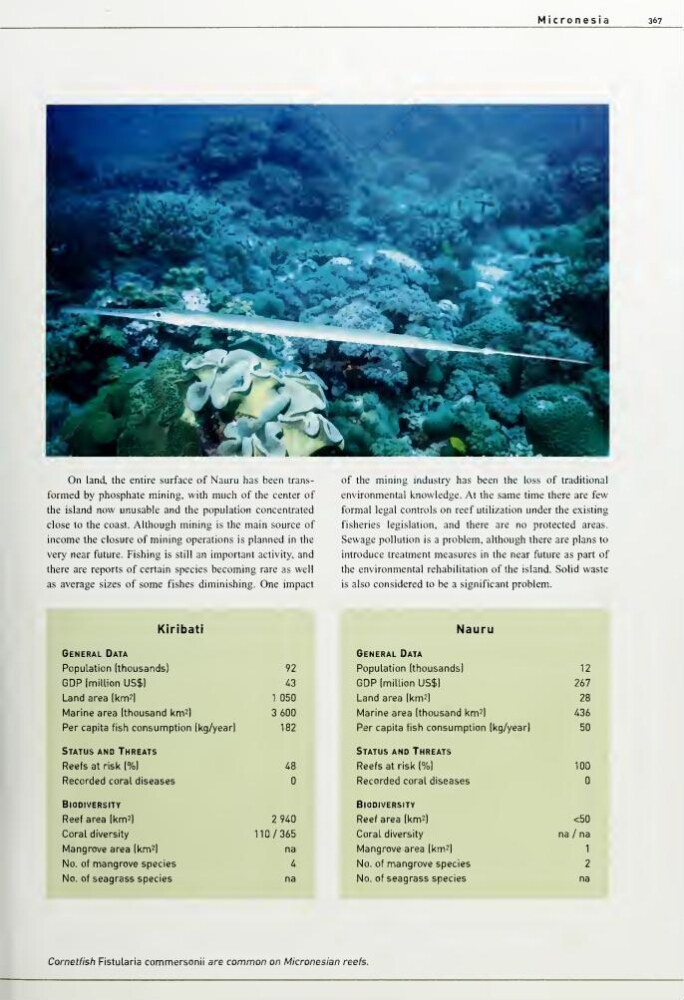
Cornetfish Fistulana commersonii are common on Micronesian reefs.
367
On land, the entire surface of Nauru has been transformed by phosphate mining, with much of the center of
the island now unusable and the population concentrated
close to the coast. Although mining is the main source of
income the closure of mining operations is planned in the
very near future. Fishing is still an important activity, and
there are reports of certain species becoming rare as well
as average sizes of some fishes diminishing. One impact
of the minuig mdustry has been the loss of traditional
environmental knowledge. At the same time there are few
formal legal controls on reef utilization under the existing
fisheries legislation, and there are no protected areas.
Sewage pollution is a problem, although there are plans to
introduce treatment measures in the near future as part of
the environmental rehabilitation of the island. Solid waste
is also considered to be a significant problem.
Kiribati
General Data
Population (thousands)
92
GDP Imillion US$1
43
Land area (km^l
1 050
Marine area (thousand km^l
3 600
.
Per capita fish consumption [kg/yearl
182
Status and Threats
Reefs at risk (%l
A8
Recorded coral diseases
1
Biodiversity
Reef area (km^l
2 WO
Coral diversity
110/365
Mangrove area (km^l
na
No. of mangrove species
A
No. of seagrass species
na
Nauru
General Data
Population (thousands!
12
GDP (million US$1
267
Land area (km^l
28
Marine area (thousand km^l
/i36
Per capita fish consumption (kg/yearl
50
Status and Threats
Reefs at risk (%1
100
Recorded coral diseases
Biodiversity
Reef area (km^j
<50
Coral diversity
na / na
Mangrove area (km^j
1
No. of mangrove species
2
No. of seagrass species
na
Cornetfish Fistulana commersonii are common on Micronesian reefs.