

348
WORLD ATLAS OF CORAL REEFS
Chapter 13
Micronesia
The
northern island areas of the Central and
Western Pacific are characterized by widely
scattered archipelagos of relatively small
islands. The western limits of this region lie
along the boundary of the Philippine plate,
and there is considerable volcanic activity in the north.
While most of the other islands and reefs can be linked
to volcanic activity, this largely occurred in the distant
geological past. Cores taken through the base of some
atolls m the Marshall Islands show reef deposits up to
1.4 kilometers thick, dating back over 50 million years.
Reefs are well developed throughout the region,
except on the coastlines of recently active volcanoes.
Patau lies closest to the center of reef diversity in the
Philippines and Indonesia, and shows very high levels
of species diversity. Biodiversity declines to the east.
The peoples of Micronesia have diverse origins,
and there is a broad complex of cultures. Patau and
the Marianas were probably first populated around
3 500 years ago by peoples from Indonesia and the
Philippines. At the same time the western parts of the
region were probably settled from eastern Melanesia.
At least 15 languages with little in common occur
across the region, giving some measure of the independent cultures that exist there. It is believed that,
while many of the high island peoples did not travel
great distances following their establishment, those of
the low islands maintained ocean-going canoes and
continued to travel. Early European travelers to the
Marshall Islands were shown "stick charts" which
consisted of frameworks of sticks, sometimes having
other Items such as shells bound to them. These charts
marked with considerable accuracy the locations of
other islands, reefs and even patterns of ocean waves,
and clearly played a critical role in oceanic navigation.
At the present time there are considerable differences both in the state of reefs and in the impacts of
human cultures. The influence of the USA, associated
with rapid Western-style development, is considerable
in a number of countries, notably Guam, but also in
parts of the Marshall Islands. Urban growth on a
few islands has brought with it the breakdown of
traditional systems and the sustainable utilization of
resources, together with associated problems of
pollution. Military activities have also had a considerable impact in this region. Intensive nuclear testing
during the 19iOs and 1950s impacted a number of
atolls in the Marshall Islands, with repercussions to
the present. There is also ongoing utilization by the
USA of some islands and reefs in the Marshall Islands
and the Marianas for military purposes, including
target practice. Tourism is a critical and growing
economic activity in a few islands, notably Guam,
Saipan and Chuuk Atoll. Away from areas of human
impact, the region still includes a very large number of
islands and reefs in good to excellent condition, where
traditional use of the reefs by local peoples remains
sustainable and well managed.
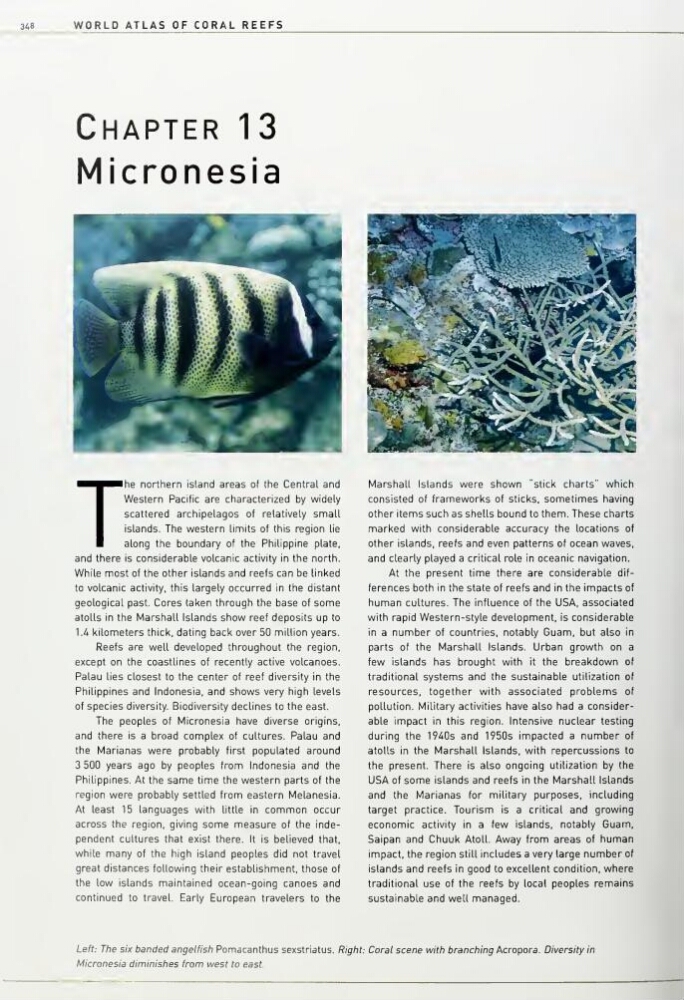
Left: The six banded angelfish Pomacanthus sexstriatus. Right: Coral scene with branching Acropora. Diversity in
Micronesia diminishes from west to east.
WORLD ATLAS OF CORAL REEFS
Chapter 13
Micronesia
The
northern island areas of the Central and
Western Pacific are characterized by widely
scattered archipelagos of relatively small
islands. The western limits of this region lie
along the boundary of the Philippine plate,
and there is considerable volcanic activity in the north.
While most of the other islands and reefs can be linked
to volcanic activity, this largely occurred in the distant
geological past. Cores taken through the base of some
atolls m the Marshall Islands show reef deposits up to
1.4 kilometers thick, dating back over 50 million years.
Reefs are well developed throughout the region,
except on the coastlines of recently active volcanoes.
Patau lies closest to the center of reef diversity in the
Philippines and Indonesia, and shows very high levels
of species diversity. Biodiversity declines to the east.
The peoples of Micronesia have diverse origins,
and there is a broad complex of cultures. Patau and
the Marianas were probably first populated around
3 500 years ago by peoples from Indonesia and the
Philippines. At the same time the western parts of the
region were probably settled from eastern Melanesia.
At least 15 languages with little in common occur
across the region, giving some measure of the independent cultures that exist there. It is believed that,
while many of the high island peoples did not travel
great distances following their establishment, those of
the low islands maintained ocean-going canoes and
continued to travel. Early European travelers to the
Marshall Islands were shown "stick charts" which
consisted of frameworks of sticks, sometimes having
other Items such as shells bound to them. These charts
marked with considerable accuracy the locations of
other islands, reefs and even patterns of ocean waves,
and clearly played a critical role in oceanic navigation.
At the present time there are considerable differences both in the state of reefs and in the impacts of
human cultures. The influence of the USA, associated
with rapid Western-style development, is considerable
in a number of countries, notably Guam, but also in
parts of the Marshall Islands. Urban growth on a
few islands has brought with it the breakdown of
traditional systems and the sustainable utilization of
resources, together with associated problems of
pollution. Military activities have also had a considerable impact in this region. Intensive nuclear testing
during the 19iOs and 1950s impacted a number of
atolls in the Marshall Islands, with repercussions to
the present. There is also ongoing utilization by the
USA of some islands and reefs in the Marshall Islands
and the Marianas for military purposes, including
target practice. Tourism is a critical and growing
economic activity in a few islands, notably Guam,
Saipan and Chuuk Atoll. Away from areas of human
impact, the region still includes a very large number of
islands and reefs in good to excellent condition, where
traditional use of the reefs by local peoples remains
sustainable and well managed.
Left: The six banded angelfish Pomacanthus sexstriatus. Right: Coral scene with branching Acropora. Diversity in
Micronesia diminishes from west to east.