

Melanesia
341
Protected areas with coral reefs
Site name
Designation
Vanuatu
President Coolidge
and Million Dollar Point
Abbreviation
Marine Reserve
lUCN cat.
Size (km^i
Year
Aore
Recreation Reserve
RecR
Unassigned
0.37
1984
Bucaro Aore
Recreation Reserve
RecR
Unassigned
0.20
1984
Naomebaravu -- Malo
Reserve
R
Unassigned
0.11
1984
MR
Unassigned
robust plate and branching corals, particularly in exposed
locations, with a predominance of massive and branching
corals below a depth of 3-5 meters. Massive coral also
becomes predominant in embayments, with soft corals in
more sheltered locations. In all some 469 fish species and
295 scleractinian corals were observed during this survey,
although the complete list, particularly for the fish, is
likely to be far longer. Periodic crown-of-thorns starfish
outbreaks have been reported, and these combined with
the impacts of cyclones and tectonic activity mean that
live coral cover and physical state are quite variable
across the country.
Vanuatu has a rapidly growing population. While a
large number live in the two main towns, over 70 percent
live on their traditional lands and remain heavily reliant
on subsistence from the land and ocean. Catch methods
include gill netting, capture by hand and spear gun and,
in more remote areas, traditional techniques including
bow and arrow, spears, traps and traditional poisons.
Subsistence capture is largely of fish, but also includes
substantial amounts of shellfish (34 percent) and lobster
(20 percent). Cash income is also provided at the local
level through collection of sea cucumbers, trochus. green
snails, crustaceans and aquarium fish.
Up to the present time the larger islands of Vanuatu
have remained heavily forested. However, there are now
increased logging activities in a number of areas which
may be impacting coral reefs through sediment runoff
Close to the main urban centers there are considerable
concerns about pollution arising from sewage inputs,
sediments and storm-water runoff, notably around Port
Vila and the airport. Away from these areas concern has
been expressed about the overharvesting of some nonmotile reef species.
Although relatively restricted in terms of where it
operates, tourism is an increasingly important sector of
the economy, and diving is a highly popular activity
among visitors. Formal protection of reef resources is
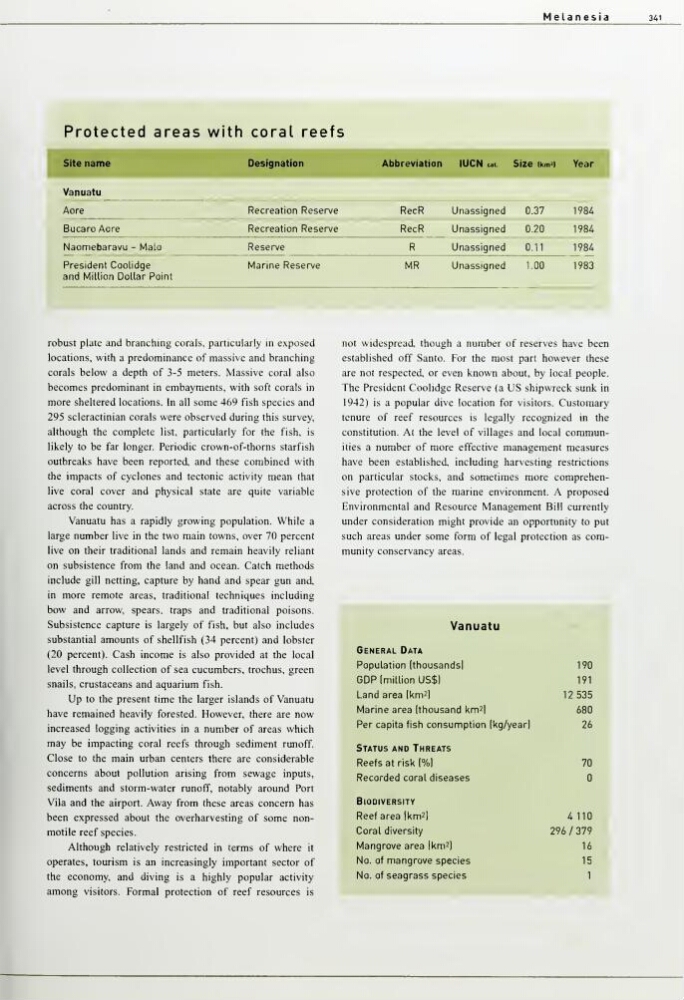
not widespread, though a number of reserves have been
established off Santo. For the most part however these
are not respected, or even known about, by local people.
The President Coolidge Reserve (a US shipwreck sunk in
1942) is a popular dive location for visitors. Customary
tenure of reef resources is legally recognized in the
constitution. At the level of villages and local communities a number of more effective management measures
have been established, including harvesting restrictions
on particular stocks, and sometimes more comprehensive protection of the marine environment. A proposed
Environmental and Resource Management Bill currently
under consideration might provide an opportunity to put
such areas under some form of legal protection as community conservancy areas.
Vanuatu
General Data
Population (thousands)
190
GDP (million US$1
191
Land area (km^l
12 535
Marine area [thousand km^l
680
Per capita fish consumption (kg/yearl
26
Status and Threats
Reefs at risk (%|
70
Recorded coral diseases
Biodiversity
Reef area (km^l
L. 110
Coral diversity
29b 1 219
Mangrove area (km^l
16
No. of mangrove species
15
No. of seagrass species
1
341
Protected areas with coral reefs
Site name
Designation
Vanuatu
President Coolidge
and Million Dollar Point
Abbreviation
Marine Reserve
lUCN cat.
Size (km^i
Year
Aore
Recreation Reserve
RecR
Unassigned
0.37
1984
Bucaro Aore
Recreation Reserve
RecR
Unassigned
0.20
1984
Naomebaravu -- Malo
Reserve
R
Unassigned
0.11
1984
MR
Unassigned
robust plate and branching corals, particularly in exposed
locations, with a predominance of massive and branching
corals below a depth of 3-5 meters. Massive coral also
becomes predominant in embayments, with soft corals in
more sheltered locations. In all some 469 fish species and
295 scleractinian corals were observed during this survey,
although the complete list, particularly for the fish, is
likely to be far longer. Periodic crown-of-thorns starfish
outbreaks have been reported, and these combined with
the impacts of cyclones and tectonic activity mean that
live coral cover and physical state are quite variable
across the country.
Vanuatu has a rapidly growing population. While a
large number live in the two main towns, over 70 percent
live on their traditional lands and remain heavily reliant
on subsistence from the land and ocean. Catch methods
include gill netting, capture by hand and spear gun and,
in more remote areas, traditional techniques including
bow and arrow, spears, traps and traditional poisons.
Subsistence capture is largely of fish, but also includes
substantial amounts of shellfish (34 percent) and lobster
(20 percent). Cash income is also provided at the local
level through collection of sea cucumbers, trochus. green
snails, crustaceans and aquarium fish.
Up to the present time the larger islands of Vanuatu
have remained heavily forested. However, there are now
increased logging activities in a number of areas which
may be impacting coral reefs through sediment runoff
Close to the main urban centers there are considerable
concerns about pollution arising from sewage inputs,
sediments and storm-water runoff, notably around Port
Vila and the airport. Away from these areas concern has
been expressed about the overharvesting of some nonmotile reef species.
Although relatively restricted in terms of where it
operates, tourism is an increasingly important sector of
the economy, and diving is a highly popular activity
among visitors. Formal protection of reef resources is
not widespread, though a number of reserves have been
established off Santo. For the most part however these
are not respected, or even known about, by local people.
The President Coolidge Reserve (a US shipwreck sunk in
1942) is a popular dive location for visitors. Customary
tenure of reef resources is legally recognized in the
constitution. At the level of villages and local communities a number of more effective management measures
have been established, including harvesting restrictions
on particular stocks, and sometimes more comprehensive protection of the marine environment. A proposed
Environmental and Resource Management Bill currently
under consideration might provide an opportunity to put
such areas under some form of legal protection as community conservancy areas.
Vanuatu
General Data
Population (thousands)
190
GDP (million US$1
191
Land area (km^l
12 535
Marine area [thousand km^l
680
Per capita fish consumption (kg/yearl
26
Status and Threats
Reefs at risk (%|
70
Recorded coral diseases
Biodiversity
Reef area (km^l
L. 110
Coral diversity
29b 1 219
Mangrove area (km^l
16
No. of mangrove species
15
No. of seagrass species
1