

338
WORLD ATLAS OF CORAL REEFS
Vanuatu
MAPS I2d and e
ii^stisiKm
Vanuatu
represents the main bulk of an island chain
which continues into the Santa Cruz Islands of
the eastern Solomon Islands. Lying on the western
margins of the Pacific plate, the islands are all of volcanic origin, and there is ongoing volcanic activity in a
number of locations, including the Banks Islands in the
northeast, Lopevi and Ambryn in the central islands, and
Tanna in the south. Submarine volcanoes are also active,
notably off Epi and Erromango. About 100 kilometers
south of Anatom the Gemini Seamounts are another area
of volcanic activity - explosions were observed from the
eastern seamount in 1996. However the western Gemini
Seamount, which rises to about 30 meters below the
surface, was reported to have considerable marine life.
The Matthew and Hunter Islands, in the far south of
the island chain, are disputed between Vanuatu and New
Caledonia. All of the islands are volcanic rock or uplifted
carbonate structures, or some combination of these. The
northern islands form a double chain. Current volcanic
activity is generally restricted to the eastern islands and
reef development is greatest in the western ones. Fringing
reefs predominate, though Cook Reef, north of Efate,
is a small atoll-like structure with no associated islands.
The Reef Islands north of Vanua Lava are also part of a
carbonate structure which has undergone a slight uplift.
The islands lie in an area particularly prone to tropical
cyclones, which cause damage to at least part of the
archipelago annually. Cyclone Uma in 1987 was one of
the most devastating, causing considerable harm to Efate
and its reefs. Southeast trade winds predominate between
May and October
Fringing reefs encircle most of the islands from Efate
southwards. In the central islands fringing reefs are
generally not continuous and reef flats can be quite
narrow. Typically reefs are best developed on eastern and
northern coasts. The eastern coasts of Santo (Espiritu
Santo) and Malakula both have wide fringing reefs and
a number of coral islands on their coastlines. One interesting phenomenon in relatively recent times has been
the observation of significant tectonic uplifts, particularly
along the western coastlines of Malakula and Santo. Reefs
on the northwest coasts of both islands were uplifted by
up to 6 meters in 1965.
Detailed surveys of biodiversity have not been
undertaken in most areas, although some 35 locations
were visited by divers from the Australian Institute of
Marine Sciences in 1988. Typically the reef crests and
shallow reef areas are dominated by coralline algae and
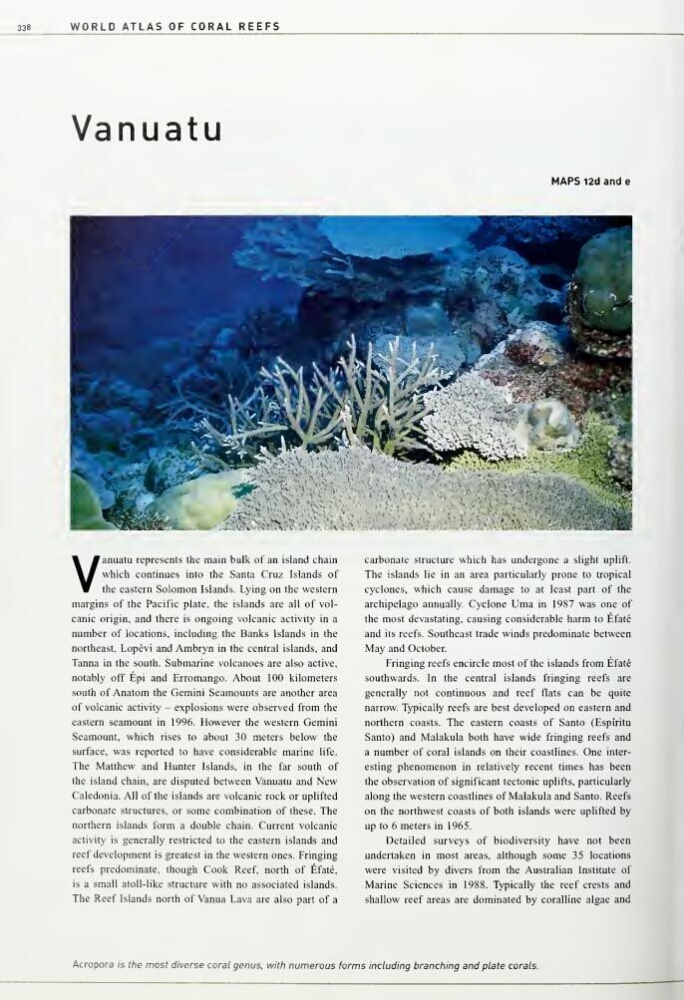
Acropora is the most diverse coral genus, with numerous forms including branching and plate corals.
WORLD ATLAS OF CORAL REEFS
Vanuatu
MAPS I2d and e
ii^stisiKm
Vanuatu
represents the main bulk of an island chain
which continues into the Santa Cruz Islands of
the eastern Solomon Islands. Lying on the western
margins of the Pacific plate, the islands are all of volcanic origin, and there is ongoing volcanic activity in a
number of locations, including the Banks Islands in the
northeast, Lopevi and Ambryn in the central islands, and
Tanna in the south. Submarine volcanoes are also active,
notably off Epi and Erromango. About 100 kilometers
south of Anatom the Gemini Seamounts are another area
of volcanic activity - explosions were observed from the
eastern seamount in 1996. However the western Gemini
Seamount, which rises to about 30 meters below the
surface, was reported to have considerable marine life.
The Matthew and Hunter Islands, in the far south of
the island chain, are disputed between Vanuatu and New
Caledonia. All of the islands are volcanic rock or uplifted
carbonate structures, or some combination of these. The
northern islands form a double chain. Current volcanic
activity is generally restricted to the eastern islands and
reef development is greatest in the western ones. Fringing
reefs predominate, though Cook Reef, north of Efate,
is a small atoll-like structure with no associated islands.
The Reef Islands north of Vanua Lava are also part of a
carbonate structure which has undergone a slight uplift.
The islands lie in an area particularly prone to tropical
cyclones, which cause damage to at least part of the
archipelago annually. Cyclone Uma in 1987 was one of
the most devastating, causing considerable harm to Efate
and its reefs. Southeast trade winds predominate between
May and October
Fringing reefs encircle most of the islands from Efate
southwards. In the central islands fringing reefs are
generally not continuous and reef flats can be quite
narrow. Typically reefs are best developed on eastern and
northern coasts. The eastern coasts of Santo (Espiritu
Santo) and Malakula both have wide fringing reefs and
a number of coral islands on their coastlines. One interesting phenomenon in relatively recent times has been
the observation of significant tectonic uplifts, particularly
along the western coastlines of Malakula and Santo. Reefs
on the northwest coasts of both islands were uplifted by
up to 6 meters in 1965.
Detailed surveys of biodiversity have not been
undertaken in most areas, although some 35 locations
were visited by divers from the Australian Institute of
Marine Sciences in 1988. Typically the reef crests and
shallow reef areas are dominated by coralline algae and
Acropora is the most diverse coral genus, with numerous forms including branching and plate corals.