

336
WORLD ATLAS OF CORAL REEFS
the south, Bellona Atoll again has a number of shallow reefs
and a few coral islands, notably along its western perimeter.
Between the Chesterfield Plateau and Grande Terre is
the wide Landsdowne Bank, which is mostly sandy and
70-80 meters in depth, but includes the small Nereus Reef
in the north. To the southeast of this area the Fairway
Reef also comes close to the surface and dries at low tide.
A number of maps show a large island to the northwest of
Nereus Reef which does not actually exist: lie de Sable.
However, there may be shallow banks and submerged reefs
in this region, which remains poorly charted.
The climate is somewhat seasonal, warm from
November to April when it is dominated by frontal systems and when cyclones may occur, followed by a cooler
season from June to September when southeast trade
winds predominate.
The location of New Caledonia relatively close to the
global center of coral reef diversity, combined with the
large area and variety of reefs, ensures very high diversity.
Unlike many other reefs in the region these have been the
subject of considerable study, although many areas in this
large archipelago nonetheless remain poorly known and
undescribed. Thus far about 1 950 fish species have been
recorded, about 5 500 molluscs, 5 000 crustaceans, 600
sponges and 300 corals. Around 5 percent of species are
thought to be endemic.
Grande Terre contains about 40 percent of the world's
known nickel deposits. Held in the sub-surface rocks of
the high mountain areas it is extracted using open-cut
techniques involving the removal of about a 30 meter
depth of surface soil and rock. Over 300 mines have been
dug in the past century, removing 280 million tons of
surface rock for the extraction of a further 110 million
tons of ore. Sedimentation from these mines has been
considerable in many streams and estuaries, and has
greatly increased turbidity in some nearshore waters. In
the Ouenghi Basin north of Noumea the delta area has
extended by 300-400 meters along a 3 kilometer stretch of
coastline as a result of this sedimentation over the last
30 years. Much of the sediment flows out onto the east
coast in the Thio and Dothio Rivers. Controls reducing
sedimentation from new mines have been in place since
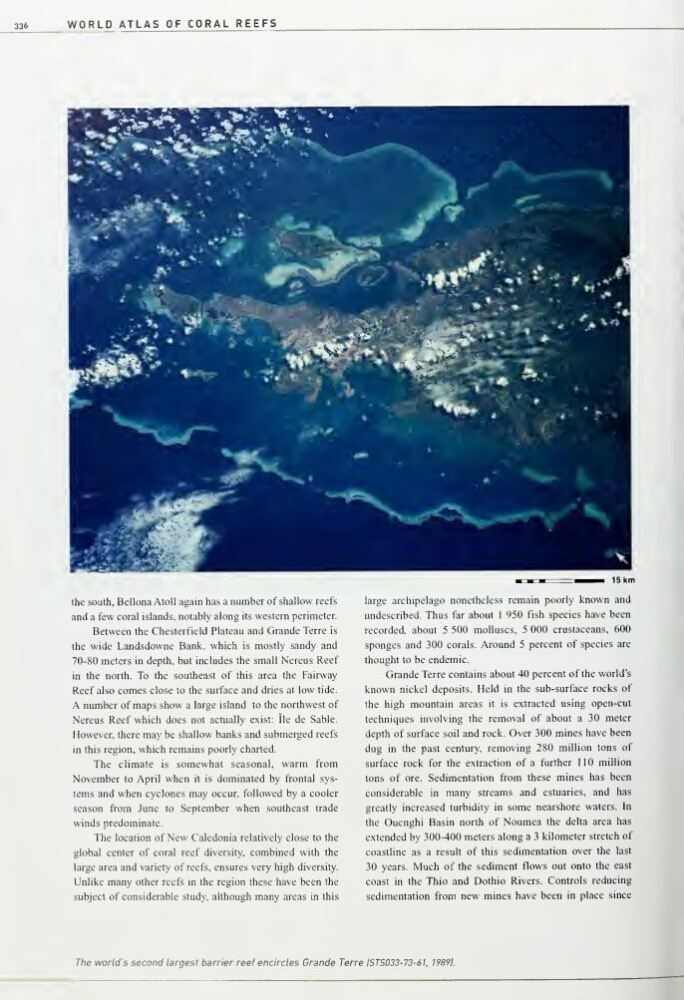
The world's second largest barrier reef encircles Grande Terre I5TS033-73-61, 19891.
WORLD ATLAS OF CORAL REEFS
the south, Bellona Atoll again has a number of shallow reefs
and a few coral islands, notably along its western perimeter.
Between the Chesterfield Plateau and Grande Terre is
the wide Landsdowne Bank, which is mostly sandy and
70-80 meters in depth, but includes the small Nereus Reef
in the north. To the southeast of this area the Fairway
Reef also comes close to the surface and dries at low tide.
A number of maps show a large island to the northwest of
Nereus Reef which does not actually exist: lie de Sable.
However, there may be shallow banks and submerged reefs
in this region, which remains poorly charted.
The climate is somewhat seasonal, warm from
November to April when it is dominated by frontal systems and when cyclones may occur, followed by a cooler
season from June to September when southeast trade
winds predominate.
The location of New Caledonia relatively close to the
global center of coral reef diversity, combined with the
large area and variety of reefs, ensures very high diversity.
Unlike many other reefs in the region these have been the
subject of considerable study, although many areas in this
large archipelago nonetheless remain poorly known and
undescribed. Thus far about 1 950 fish species have been
recorded, about 5 500 molluscs, 5 000 crustaceans, 600
sponges and 300 corals. Around 5 percent of species are
thought to be endemic.
Grande Terre contains about 40 percent of the world's
known nickel deposits. Held in the sub-surface rocks of
the high mountain areas it is extracted using open-cut
techniques involving the removal of about a 30 meter
depth of surface soil and rock. Over 300 mines have been
dug in the past century, removing 280 million tons of
surface rock for the extraction of a further 110 million
tons of ore. Sedimentation from these mines has been
considerable in many streams and estuaries, and has
greatly increased turbidity in some nearshore waters. In
the Ouenghi Basin north of Noumea the delta area has
extended by 300-400 meters along a 3 kilometer stretch of
coastline as a result of this sedimentation over the last
30 years. Much of the sediment flows out onto the east
coast in the Thio and Dothio Rivers. Controls reducing
sedimentation from new mines have been in place since
The world's second largest barrier reef encircles Grande Terre I5TS033-73-61, 19891.