

320
WORLD ATLAS OF CORAL REEFS
High latitude reefs
MAPllf
South
of the Great Barrier Reef there are several reefs
and coral communities at high latitudes. The south
flowing East Australia Current has an important
role to play in maintaining these communities, bringing
warm waters as well as the potential for new larval recruits
to settle on the reefs.
Lord Howe Island is a high volcanic island with a reef
structure extending for some 6 kilometers along its western
side. This is the most southerly coral reef in the world,
lying beyond 31°S. Elizabeth and Middleton Reefs are
platform reefs lying on older volcanic seamounts which
form a chain to the north of Lord Howe Island. On the
mainland coast there are no true coral reefs. Flinders Reef,
east of Brisbane, is a sandstone structure, but has been
colonized by a range of tropical corals and other species.
Further south, the Solitary Islands also have important coral
communities. There are also many smaller benthic communities with coral reef species elsewhere along the coastline
of South Queensland and northern New South Wales.
Biodiversity is low in these areas, but they remain
of significance as they represent the ecological limits of
many species. The offshore reefs are also of interest
because of their considerable isolation. Elizabeth and
Middleton Reefs have 122 species of reef coral while Lord
Howe Island has 65 species. Some of these, particularly at
Lord Howe Island, are thought to be temporary populations dependent on recruitment of new individuals from
Australia
^|H
General Data
Population Ithousandsl
19 165
GDP (million US$1
359 913
Land area Ikm^l
7 706 304
Marine area (thousand km^l
7 437
Per capita fish consumption ( kg/year]
19
Status and Threats
Reefs at risk I%1
32
Recorded coral diseases
6
Biodiversity
Reef area (km^j
48 960
Coral diversity
428/461
Mangrove area Ikm^l
11 500
No. of mangrove species
39
No. of seagrass species
21
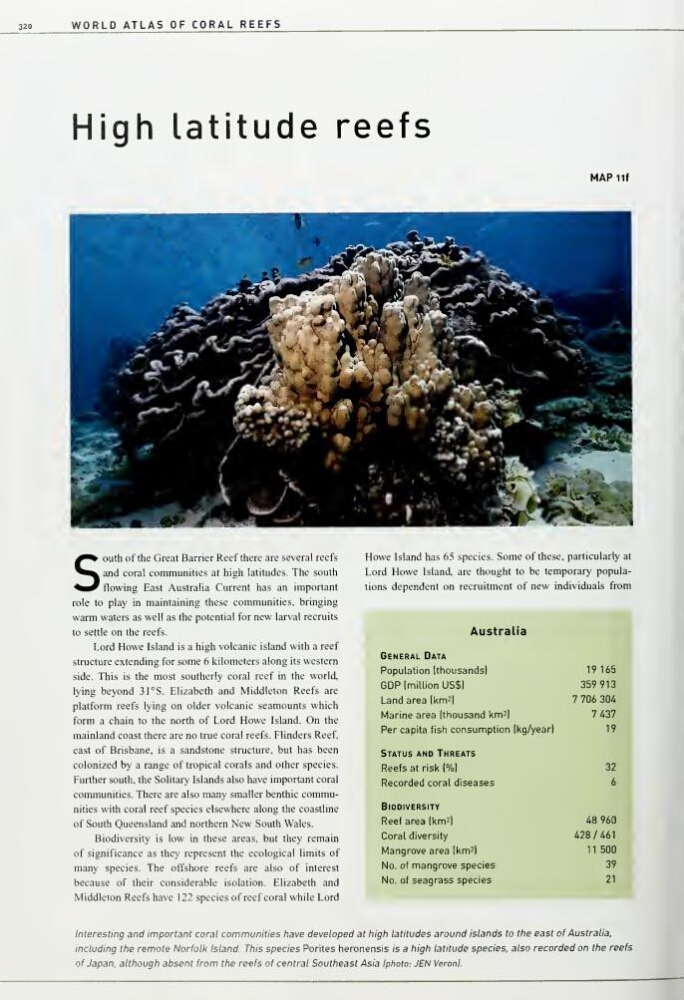
Interesting and important coral communities have developed at high latitudes around islands to the east of Australia,
including the remote Norfolk Island. This species Porites heronensis is a high latitude species, also recorded on the reefs
of Japan, although absent from the reefs of central Southeast Asia Iphoto: JEN Veronl.
WORLD ATLAS OF CORAL REEFS
High latitude reefs
MAPllf
South
of the Great Barrier Reef there are several reefs
and coral communities at high latitudes. The south
flowing East Australia Current has an important
role to play in maintaining these communities, bringing
warm waters as well as the potential for new larval recruits
to settle on the reefs.
Lord Howe Island is a high volcanic island with a reef
structure extending for some 6 kilometers along its western
side. This is the most southerly coral reef in the world,
lying beyond 31°S. Elizabeth and Middleton Reefs are
platform reefs lying on older volcanic seamounts which
form a chain to the north of Lord Howe Island. On the
mainland coast there are no true coral reefs. Flinders Reef,
east of Brisbane, is a sandstone structure, but has been
colonized by a range of tropical corals and other species.
Further south, the Solitary Islands also have important coral
communities. There are also many smaller benthic communities with coral reef species elsewhere along the coastline
of South Queensland and northern New South Wales.
Biodiversity is low in these areas, but they remain
of significance as they represent the ecological limits of
many species. The offshore reefs are also of interest
because of their considerable isolation. Elizabeth and
Middleton Reefs have 122 species of reef coral while Lord
Howe Island has 65 species. Some of these, particularly at
Lord Howe Island, are thought to be temporary populations dependent on recruitment of new individuals from
Australia
^|H
General Data
Population Ithousandsl
19 165
GDP (million US$1
359 913
Land area Ikm^l
7 706 304
Marine area (thousand km^l
7 437
Per capita fish consumption ( kg/year]
19
Status and Threats
Reefs at risk I%1
32
Recorded coral diseases
6
Biodiversity
Reef area (km^j
48 960
Coral diversity
428/461
Mangrove area Ikm^l
11 500
No. of mangrove species
39
No. of seagrass species
21
Interesting and important coral communities have developed at high latitudes around islands to the east of Australia,
including the remote Norfolk Island. This species Porites heronensis is a high latitude species, also recorded on the reefs
of Japan, although absent from the reefs of central Southeast Asia Iphoto: JEN Veronl.