

Australia
overlap in some places. These islands thus support a rare
combination of sub-tropical and temperate communities m
close proximity.
Further south there is no true reef development, though
Rottnest Island off the coast near Perth is fringed by shallow
platforms where some 25 species of zooxanthellate corals
have been recorded. The importance of the warming effect
of the Leeuwin Current is equally strong here. As well as
corals, about 25-30 percent of the fish and echinoderm
populations are generally tropical in their distribution.
Despite studies since the 1950s, the first recording of
Acropora on these reefs was not until 1988. It has been
suggested that these and other species may be dependent
on larval recruitment from the Houtman Abrolhos reefs.
Low human populations generally restrict impacts on
the reefs off the west coast of Australia, although there is
some fishing in all areas. Around the Dampier and Monte
Bello Islands there is increasing pearl oyster farming,
petroleum exploitation and now some tourism, although
the impacts of these are still not high. The Monte Bello
Islands were used for British nuclear tests in 1952-56. The
Ningaloo reefs were heavily fished until recently, however
these reefs are now zoned and fishing is restricted to certain
areas. These reefs were also reported to have been damaged
by outbreaks of the coral eating Driipella snails in the 1970s
and 1990s, but there now appears to be active recovery in
most areas. Levels of tourism are relatively high around
Shark Bay. The Houtman Abrolhos Islands were among the
first parts of Australia to be settled by Europeans, at least
temporarily, following a shipwreck and mutiny in 1629. The
islands were heavily mined for guano until the late 1940s
and now support a major, well managed commercial rock
lobster fishery. Two large protected areas have been
declared which provide at least some protection for the
reefs in Ningaloo and Shark Bay.
Cocos (Keeling) Islands and
Christmas Island
Far out in the Indian Ocean, Australia administers two other
territories with important oceanic reef communities. Cocos
(Keeling) consists of two atolls on the Cocos Rise, nearly
mid-way between Australia and Sri Lanka. They are
dominated by the southeast trade winds and swept by the
westward flowing equatorial current most of the year, and
are occasionally impacted by tropical cyclones. The main
atoll of South Keeling is a little over 15 kilometers across,
with a near continuous chain of 27 islands along much of its
rim. Horsburgh Island in the north lies apart from the others,
and holds a particularly important bird nesting colony. North
Keeling (Pulu Keeling) is a much smaller atoll, about 3
kilometers across with a single island almost completely
encircling a shallow lagoon. The island itself is of considerable interest, being one of the few in the region with its
original vegetation, mostly tall hardwood forest. It is also a
very important seabird rookery. Some 525 species of fish
have been recorded in the waters around the two atolls.
These islands were in fact the only atolls where
Charles Darwin ever landed during his voyage on the
Beagk' (in 1836) and thus have a significant place in his
development of a theory for atoll development (Chapter 1 ).
There is a small resident population of predominantly
Malaysian origin, living on two of the South Keeling
Islands, but their impact on the reefs is considered
minimal. A national park in North Keeling protects all the
island, its surrounding reefs and waters.
Christmas Island is a high, mountainous island some 15
kilometers across, reaching a height of 359 meters. It lies
about 300 kilometers south of Java. Fringing reefs surround
much of It, with narrow reef flats typically 20-200 meters
wide before a steep reef slope down to deep oceanic waters.
While the reef faunas clearly contain Indian Ocean elements
they show a close affinity to Southeast Asia. Diversity is
somewhat limited by a moderate range of reef habitats. The
island has important seabird nesting colonies, including
the endemic Christmas Island frigatebird. Large numbers of
crabs are also noted, including 13 land crabs, the best known
of which are the red crabs Gecarcoidea natalis. which have
a population of some 120 million individuals and undertake
a famous annual mass migration to spawn in the sea. The
resident population of some 2 000 people originally came to
the island to mine its large phosphate deposits, and this
continues, although it is strictly regulated. More recently a
hotel and casino complex has been developed, drawing
tourists from Southeast Asia. Over 60 percent of the island
and much of the fringing reef is protected in a national park.
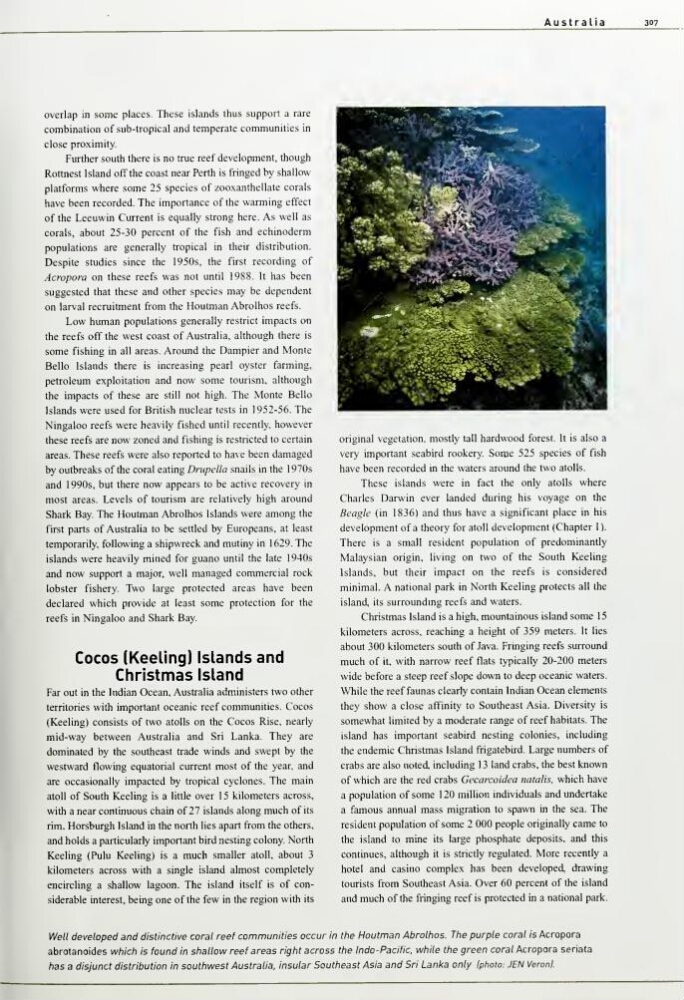
Well developed and distinctive coral reef communities occur in tlie Houtman Abrolhos. Tiie purple coral is Acropora
abrotanoides which is found in shallow reef areas right across the Indo-Pacific. while the green coral Acropora seriata
has a disjunct distribution in southwest Australia, insular Southeast Asia and Sri Lanka only (photo. JEN Veronl.
overlap in some places. These islands thus support a rare
combination of sub-tropical and temperate communities m
close proximity.
Further south there is no true reef development, though
Rottnest Island off the coast near Perth is fringed by shallow
platforms where some 25 species of zooxanthellate corals
have been recorded. The importance of the warming effect
of the Leeuwin Current is equally strong here. As well as
corals, about 25-30 percent of the fish and echinoderm
populations are generally tropical in their distribution.
Despite studies since the 1950s, the first recording of
Acropora on these reefs was not until 1988. It has been
suggested that these and other species may be dependent
on larval recruitment from the Houtman Abrolhos reefs.
Low human populations generally restrict impacts on
the reefs off the west coast of Australia, although there is
some fishing in all areas. Around the Dampier and Monte
Bello Islands there is increasing pearl oyster farming,
petroleum exploitation and now some tourism, although
the impacts of these are still not high. The Monte Bello
Islands were used for British nuclear tests in 1952-56. The
Ningaloo reefs were heavily fished until recently, however
these reefs are now zoned and fishing is restricted to certain
areas. These reefs were also reported to have been damaged
by outbreaks of the coral eating Driipella snails in the 1970s
and 1990s, but there now appears to be active recovery in
most areas. Levels of tourism are relatively high around
Shark Bay. The Houtman Abrolhos Islands were among the
first parts of Australia to be settled by Europeans, at least
temporarily, following a shipwreck and mutiny in 1629. The
islands were heavily mined for guano until the late 1940s
and now support a major, well managed commercial rock
lobster fishery. Two large protected areas have been
declared which provide at least some protection for the
reefs in Ningaloo and Shark Bay.
Cocos (Keeling) Islands and
Christmas Island
Far out in the Indian Ocean, Australia administers two other
territories with important oceanic reef communities. Cocos
(Keeling) consists of two atolls on the Cocos Rise, nearly
mid-way between Australia and Sri Lanka. They are
dominated by the southeast trade winds and swept by the
westward flowing equatorial current most of the year, and
are occasionally impacted by tropical cyclones. The main
atoll of South Keeling is a little over 15 kilometers across,
with a near continuous chain of 27 islands along much of its
rim. Horsburgh Island in the north lies apart from the others,
and holds a particularly important bird nesting colony. North
Keeling (Pulu Keeling) is a much smaller atoll, about 3
kilometers across with a single island almost completely
encircling a shallow lagoon. The island itself is of considerable interest, being one of the few in the region with its
original vegetation, mostly tall hardwood forest. It is also a
very important seabird rookery. Some 525 species of fish
have been recorded in the waters around the two atolls.
These islands were in fact the only atolls where
Charles Darwin ever landed during his voyage on the
Beagk' (in 1836) and thus have a significant place in his
development of a theory for atoll development (Chapter 1 ).
There is a small resident population of predominantly
Malaysian origin, living on two of the South Keeling
Islands, but their impact on the reefs is considered
minimal. A national park in North Keeling protects all the
island, its surrounding reefs and waters.
Christmas Island is a high, mountainous island some 15
kilometers across, reaching a height of 359 meters. It lies
about 300 kilometers south of Java. Fringing reefs surround
much of It, with narrow reef flats typically 20-200 meters
wide before a steep reef slope down to deep oceanic waters.
While the reef faunas clearly contain Indian Ocean elements
they show a close affinity to Southeast Asia. Diversity is
somewhat limited by a moderate range of reef habitats. The
island has important seabird nesting colonies, including
the endemic Christmas Island frigatebird. Large numbers of
crabs are also noted, including 13 land crabs, the best known
of which are the red crabs Gecarcoidea natalis. which have
a population of some 120 million individuals and undertake
a famous annual mass migration to spawn in the sea. The
resident population of some 2 000 people originally came to
the island to mine its large phosphate deposits, and this
continues, although it is strictly regulated. More recently a
hotel and casino complex has been developed, drawing
tourists from Southeast Asia. Over 60 percent of the island
and much of the fringing reef is protected in a national park.
Well developed and distinctive coral reef communities occur in tlie Houtman Abrolhos. Tiie purple coral is Acropora
abrotanoides which is found in shallow reef areas right across the Indo-Pacific. while the green coral Acropora seriata
has a disjunct distribution in southwest Australia, insular Southeast Asia and Sri Lanka only (photo. JEN Veronl.