

302
WORLD ATLAS OF CORAL REEFS
Chapter 1
Australia
Australia
is an island continent with an
extensive tropical coastline. Its western
shores mark the southeastern margins
of the Indian Ocean while, to the east, it
provides the southwestern boundary of
the Pacific Ocean. Between these two is a complex,
poorly known, northern coastline which runs close to
southern Indonesia, separated by the Timor Sea to the
west and the Arafura Sea to the east.
After Indonesia, Australia has the largest area
of coral reefs of any nation, nearly 50 000 square
kilometers, or some 17 percent of the world's total
area of reefs. Conditions for reef development vary
considerably along the coastline. In the far west the
climate is dry and there is little terrestrial runoff. Reef
development is not continuous, though away from loose
coastal sediments there are important areas, including Australia's best developed fringing reefs. The
southward flowing Leeuwin Current is also important
on this coastline, bringing warm waters to relatively
high latitudes and enabling the development of some
unique reef communities. Further north there are
several reefs on the outer edges of the continental
shelf. These include remnants of what may have
been a substantial barrier reef structure drowned as
a result of rising sea levels over geological time
scales. The northern coastline is less known, however
this is an area of high terrestrial runoff, and the
waters are shallow and turbid, greatly restricting reef
development. The eastern boundary of the Arafura Sea
is marked by a narrow constriction, the Torres Strait.
East of here, the world's largest coral reef complex
commences, extending out to the margins of the
continental shelf and continuing southwards as the
Great Barrier Reef. The warm, southward flowing East
Australia Current also supports the development of
high latitude reefs along Australia's eastern shores
to the south of the Great Barrier Reef. Other reefs
are found in Australia's offshore waters. Most notable
among these are the extensive reef structures of the
Coral Sea, east of the Great Barrier Reef.
Australia also administers the Cocos iKeelingI
Islands and Christmas Island in the Indian Ocean, both
of which have significant coral reefs.
Australia's
original
human population, the
Australian Aborigines, are thought to have inhabited
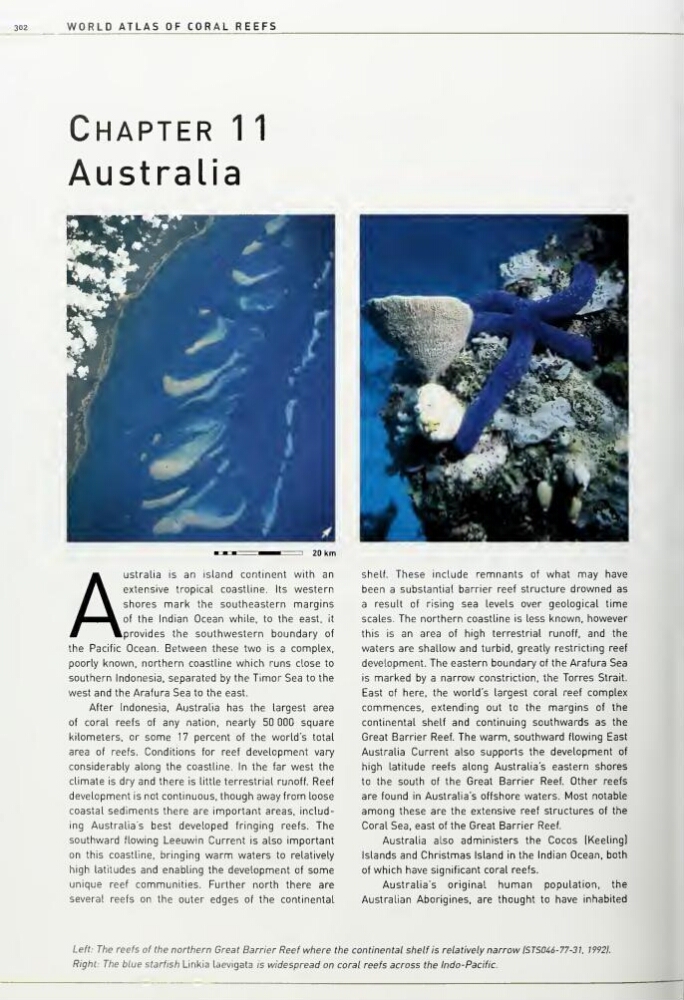
Left: The reefs of the northern Great Barrier Reef where the continental shelf is relatively narrow ISTS046-77-31, 19921.
Right: The blue starfish Linkia laevigata is widespread on coral reefs across the Indo-Pacific.
WORLD ATLAS OF CORAL REEFS
Chapter 1
Australia
Australia
is an island continent with an
extensive tropical coastline. Its western
shores mark the southeastern margins
of the Indian Ocean while, to the east, it
provides the southwestern boundary of
the Pacific Ocean. Between these two is a complex,
poorly known, northern coastline which runs close to
southern Indonesia, separated by the Timor Sea to the
west and the Arafura Sea to the east.
After Indonesia, Australia has the largest area
of coral reefs of any nation, nearly 50 000 square
kilometers, or some 17 percent of the world's total
area of reefs. Conditions for reef development vary
considerably along the coastline. In the far west the
climate is dry and there is little terrestrial runoff. Reef
development is not continuous, though away from loose
coastal sediments there are important areas, including Australia's best developed fringing reefs. The
southward flowing Leeuwin Current is also important
on this coastline, bringing warm waters to relatively
high latitudes and enabling the development of some
unique reef communities. Further north there are
several reefs on the outer edges of the continental
shelf. These include remnants of what may have
been a substantial barrier reef structure drowned as
a result of rising sea levels over geological time
scales. The northern coastline is less known, however
this is an area of high terrestrial runoff, and the
waters are shallow and turbid, greatly restricting reef
development. The eastern boundary of the Arafura Sea
is marked by a narrow constriction, the Torres Strait.
East of here, the world's largest coral reef complex
commences, extending out to the margins of the
continental shelf and continuing southwards as the
Great Barrier Reef. The warm, southward flowing East
Australia Current also supports the development of
high latitude reefs along Australia's eastern shores
to the south of the Great Barrier Reef. Other reefs
are found in Australia's offshore waters. Most notable
among these are the extensive reef structures of the
Coral Sea, east of the Great Barrier Reef.
Australia also administers the Cocos iKeelingI
Islands and Christmas Island in the Indian Ocean, both
of which have significant coral reefs.
Australia's
original
human population, the
Australian Aborigines, are thought to have inhabited
Left: The reefs of the northern Great Barrier Reef where the continental shelf is relatively narrow ISTS046-77-31, 19921.
Right: The blue starfish Linkia laevigata is widespread on coral reefs across the Indo-Pacific.