

294
WORLD ATLAS OF CORAL REEFS
growth and reef development. The southernmost islands
are a long chain, the Nansei Shoto. which clearly
subdivides into a series of smaller archipelagos, with
the Yaeyama Islands, including the important islands of
Iriomote and Ishigaki in the south, followed by the Ryukyu
Islands, including the island of Okinawa. Closest to the
large island of Kyushu is a final group of small islands, the
Tokara Islands. Following on from these the main islands
of Japan, including Kyushu. Shikoku and Honshu in the
south continue, with numerous offshore islands. One
critical factor for reef development in these islands is the
Kuroshio Current, which flows northwards along the edge
of the continental shelf of the East China Sea. bringing
relatively warm waters across the southern islands before
passing out into the Pacific Ocean just south of Kyushu.
Away from these islands Japan also has a number
of more isolated islands in the Pacific Ocean. The Daito
Islands are a small group of three islands some 300
kilometers east of Okinawa. Two are raised atolls, the third
a raised platform reef Coral growth is apparently not well
developed on the steeply shelving sides of these islands.
South of these there is also reported to be reef development on the isolated reef of Okino Tori Shima lying
on the Kyushu-Palau Ridge. Leading southwards from
Tokyo there is a sequence of small island groups which
follow the volcanic South Honshu Ridge. The Izu Shoto
are a widely spaced group of high volcanic islands, lying
relatively far north. Further south again the Ogasawara
(Bonin) and Kanzan (Volcano) Islands form two groups
along a volcanic arc linking Japan and the Mariana Islands
to the south. Volcanic activity and a lack of suitable
substrates precludes the development of reefs on many of
these islands, although rich fringing communities occur in
some areas. One of the most isolated reefs, even by Pacific
standards, is that of Minami-Torishima (Marcus Island) an
atoll lying halfway between the Ogaswara Islands and
Wake Island (USA).
The presence of relatively warm waters has enabled
hermatypic corals to reach quite high latitudes in Japan
and there are records of around 40 coral genera at the
larger islands in the north, some reaching into temperate
latitudes. In these areas, however, corals are incapable of
forming reefs, and it is generally accepted that the
northern limit for true reef development in the Nansei
chain is the Tokara Islands at around 30°N. The most
extensive fringing reef structures are those around the
Ryukyu Islands and further south. The remote islands to
the east of the country are warmed by the Kuroshio
Current and also show a high diversity of coral species.
Miyake Jima (34°N) in the north of the Izu Shoto group
was reported to have 80 hermatypic corals, while some
156 hermatypic species are recorded from this group as a
whole. As in other high latitude reefs around the world,
there appears to be considerable interaction between
corals and macroalgae, with corals being overgrown
during colder winters.
The Ryukyu and Yaeyama Islands have the highest
levels of diversity. Altogether approximately 400 coral
species have been recorded from Japan, the majority of
which are found in the waters around Iriomote and
Ishigaki. Coral cover is generally very low - a survey from
1990 to 1992 found that over 60 percent of coral
communities in the Nansei chain had less that 5 percent
coral cover while only 8 percent had cover of 50 percent
or more. It seems highly likely that these low figures
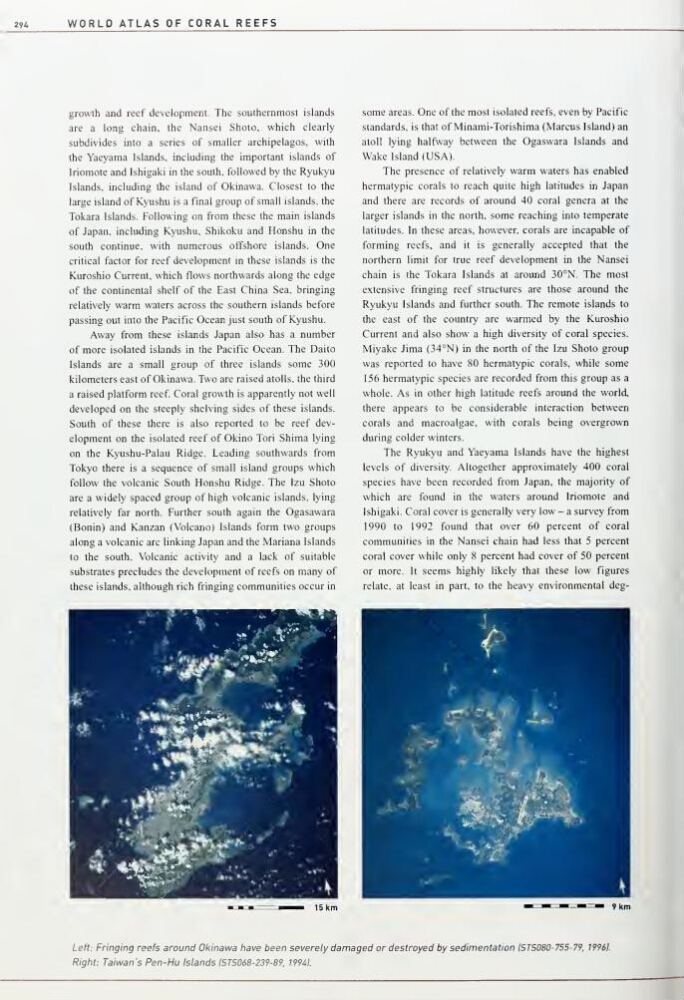
relate, at least in part, to the heavy environmental degLeft: Fringing reefs around Okinawa have been severely damaged or destroyed by sedimentation ISTS080-755-79. 19961.
Right: Taiwan's Pen-Hu Islands ISTS068-239-89, 199il.
WORLD ATLAS OF CORAL REEFS
growth and reef development. The southernmost islands
are a long chain, the Nansei Shoto. which clearly
subdivides into a series of smaller archipelagos, with
the Yaeyama Islands, including the important islands of
Iriomote and Ishigaki in the south, followed by the Ryukyu
Islands, including the island of Okinawa. Closest to the
large island of Kyushu is a final group of small islands, the
Tokara Islands. Following on from these the main islands
of Japan, including Kyushu. Shikoku and Honshu in the
south continue, with numerous offshore islands. One
critical factor for reef development in these islands is the
Kuroshio Current, which flows northwards along the edge
of the continental shelf of the East China Sea. bringing
relatively warm waters across the southern islands before
passing out into the Pacific Ocean just south of Kyushu.
Away from these islands Japan also has a number
of more isolated islands in the Pacific Ocean. The Daito
Islands are a small group of three islands some 300
kilometers east of Okinawa. Two are raised atolls, the third
a raised platform reef Coral growth is apparently not well
developed on the steeply shelving sides of these islands.
South of these there is also reported to be reef development on the isolated reef of Okino Tori Shima lying
on the Kyushu-Palau Ridge. Leading southwards from
Tokyo there is a sequence of small island groups which
follow the volcanic South Honshu Ridge. The Izu Shoto
are a widely spaced group of high volcanic islands, lying
relatively far north. Further south again the Ogasawara
(Bonin) and Kanzan (Volcano) Islands form two groups
along a volcanic arc linking Japan and the Mariana Islands
to the south. Volcanic activity and a lack of suitable
substrates precludes the development of reefs on many of
these islands, although rich fringing communities occur in
some areas. One of the most isolated reefs, even by Pacific
standards, is that of Minami-Torishima (Marcus Island) an
atoll lying halfway between the Ogaswara Islands and
Wake Island (USA).
The presence of relatively warm waters has enabled
hermatypic corals to reach quite high latitudes in Japan
and there are records of around 40 coral genera at the
larger islands in the north, some reaching into temperate
latitudes. In these areas, however, corals are incapable of
forming reefs, and it is generally accepted that the
northern limit for true reef development in the Nansei
chain is the Tokara Islands at around 30°N. The most
extensive fringing reef structures are those around the
Ryukyu Islands and further south. The remote islands to
the east of the country are warmed by the Kuroshio
Current and also show a high diversity of coral species.
Miyake Jima (34°N) in the north of the Izu Shoto group
was reported to have 80 hermatypic corals, while some
156 hermatypic species are recorded from this group as a
whole. As in other high latitude reefs around the world,
there appears to be considerable interaction between
corals and macroalgae, with corals being overgrown
during colder winters.
The Ryukyu and Yaeyama Islands have the highest
levels of diversity. Altogether approximately 400 coral
species have been recorded from Japan, the majority of
which are found in the waters around Iriomote and
Ishigaki. Coral cover is generally very low - a survey from
1990 to 1992 found that over 60 percent of coral
communities in the Nansei chain had less that 5 percent
coral cover while only 8 percent had cover of 50 percent
or more. It seems highly likely that these low figures
relate, at least in part, to the heavy environmental degLeft: Fringing reefs around Okinawa have been severely damaged or destroyed by sedimentation ISTS080-755-79. 19961.
Right: Taiwan's Pen-Hu Islands ISTS068-239-89, 199il.