

272
WORLD ATLAS OF CORAL REEFS
Indonesia
MAPS 10b, c, d and e
Indonesia is the world's largest coral reef nation, with
over 50 000 square kilometers of reefs (18 percent of
the world total), extending nearly 5 000 kilometers
from east to west, and harboring over 17 000 islands
(including rocks and sandbanks). It touches on both the
Indian and Pacific Oceans as well as many seas, including
the Andaman, Java, South China, Sulawesi, Banda and
Arafura Seas. This same country has a vast array of coral
reefs, many poorly described or completely unknown,
while It completely straddles the region with the greatest
reef biodiversity in the world. For the purposes of this
account the physical and biological descriptions are
subdivided into a number of geographic sub-units, while
human and socio-economic issues are considered together
for the entire country.
Sumatra and Java
The western end of the Indonesian islands includes
Sumatra and Java which, with Kalimantan, are located on
the Sunda Shelf, a vast continental shelf e.xtending across
a considerable part of the South China Sea. Both are
continental islands, but with the boundary between the
Indian and Eurasian tectonic plates lying off their
southwestern and southern boundaries, there are numerous
volcanoes. The continental shelf lies relatively close to the
shore on the western side of Sumatra and south of Java.
Some distance off the west coast of Sumatra and off the
continental shelf, lies the long chain of the Mentawai
Islands. Off the east coast of Sumatra there is a complex
of smaller islands at the southern end of the Strait of
Malacca, the Riau Archipelago. Further south, towards the
Java Sea, Bangka Island lies just off the Sumatra coastline
and Belitung Island lies midway between Sumatra and
Kalimantan. There are a few small islands north of Java,
while Bali lies immediately to the east. Bali, unlike the
other islands which continue in a chain to the east, is still
located on the Sunda Shelf The western side of Sumatra
is heavily mountainous, with only a narrow coastal plain.
In contrast the eastern side is low-lying and there is
considerable riverine input all along this coastline. Java is
very mountainous in its entirety, although the coastal plain
is a little wider to the north and it is here that the most
considerable riverine runoff occurs: rates of coastal progradation in the Solo Delta have been measured at
70 meters per year. The coastal waters of both eastern
Sumatra and northern Java are generally quite turbid.
Weather and water conditions are largely determined
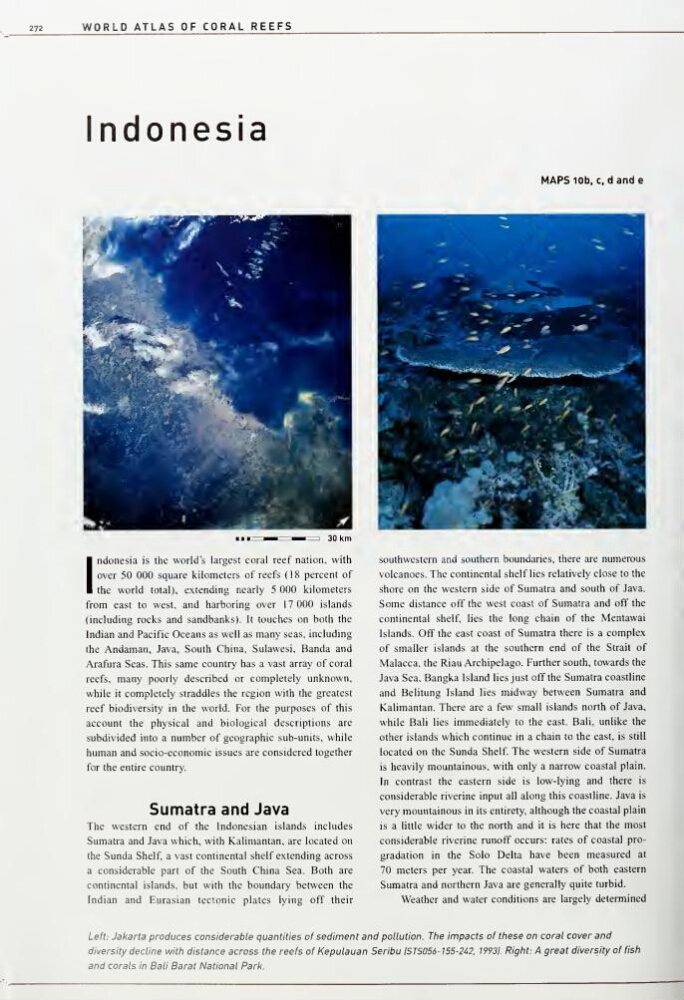
Left: Jakarta produces considerable quantities of sediment and pollution. The impacts of these on coral cover and
diversity decline with distance across the reefs of Kepulauan Seribu ISTS056- 155-242, 19931 Right: A great diversity of fish
and corals in Bali Barat National Park.
WORLD ATLAS OF CORAL REEFS
Indonesia
MAPS 10b, c, d and e
Indonesia is the world's largest coral reef nation, with
over 50 000 square kilometers of reefs (18 percent of
the world total), extending nearly 5 000 kilometers
from east to west, and harboring over 17 000 islands
(including rocks and sandbanks). It touches on both the
Indian and Pacific Oceans as well as many seas, including
the Andaman, Java, South China, Sulawesi, Banda and
Arafura Seas. This same country has a vast array of coral
reefs, many poorly described or completely unknown,
while It completely straddles the region with the greatest
reef biodiversity in the world. For the purposes of this
account the physical and biological descriptions are
subdivided into a number of geographic sub-units, while
human and socio-economic issues are considered together
for the entire country.
Sumatra and Java
The western end of the Indonesian islands includes
Sumatra and Java which, with Kalimantan, are located on
the Sunda Shelf, a vast continental shelf e.xtending across
a considerable part of the South China Sea. Both are
continental islands, but with the boundary between the
Indian and Eurasian tectonic plates lying off their
southwestern and southern boundaries, there are numerous
volcanoes. The continental shelf lies relatively close to the
shore on the western side of Sumatra and south of Java.
Some distance off the west coast of Sumatra and off the
continental shelf, lies the long chain of the Mentawai
Islands. Off the east coast of Sumatra there is a complex
of smaller islands at the southern end of the Strait of
Malacca, the Riau Archipelago. Further south, towards the
Java Sea, Bangka Island lies just off the Sumatra coastline
and Belitung Island lies midway between Sumatra and
Kalimantan. There are a few small islands north of Java,
while Bali lies immediately to the east. Bali, unlike the
other islands which continue in a chain to the east, is still
located on the Sunda Shelf The western side of Sumatra
is heavily mountainous, with only a narrow coastal plain.
In contrast the eastern side is low-lying and there is
considerable riverine input all along this coastline. Java is
very mountainous in its entirety, although the coastal plain
is a little wider to the north and it is here that the most
considerable riverine runoff occurs: rates of coastal progradation in the Solo Delta have been measured at
70 meters per year. The coastal waters of both eastern
Sumatra and northern Java are generally quite turbid.
Weather and water conditions are largely determined
Left: Jakarta produces considerable quantities of sediment and pollution. The impacts of these on coral cover and
diversity decline with distance across the reefs of Kepulauan Seribu ISTS056- 155-242, 19931 Right: A great diversity of fish
and corals in Bali Barat National Park.