

Southeast Asia
269
reefs and a small barrier reef. Offshore from the town of
Semporna lie a number of islands of volcanic origin with
extensive reef developments. Just off the continental shelf
lies Pulau Sipadan, a small coral cay with a surrounding
reef with high coral cover and diversity. Further north,
onshore reef development is restricted, but there are
fringing reefs around the Turtle Islands. Off the north and
west coasts, and particularly around the offshore islands,
there are significant areas of fringmg reefs. Over 200
kilometers off the west coast of Sabah there is a coral
atoll, Layang Layang, with high biodiversity, although
coral cover on the outer slopes was only recorded at 29
percent. Overall. some 346 species of scleractinian coral
have been identified in Malaysian waters. The impact of
the 1998 bleaching appears to have been highly varied,
but no widespread mortalities were recorded. At the same
time, declines in coral cover were noted throughout eastern Malaysia in the decade up to 1999, linked to various
anthropogenic impacts.
Marine fisheries are an important economic activity
for Malaysia, with the majority of them commercial and
focussed towards non-reef species using trawl and purse
seine. Traditional fishing methods account for about a
quarter of the total catch, only some of which is reefdependent, and overfishing is not generally regarded as
a major threat. There is significant destructive fishing,
notably using explosives, and particularly off the coast of
Sabah where more than four blasts per hour have been
recorded in several areas. Perhaps the most significant
threats to reefs arise from onshore activities, notably the
high degree of sedimentation from logging activities and
the sedimentation and pollution associated with industry.
agriculture and urban development. Tourism development
has also had impacts, through the construction of accommodation and associated infrastructure, but also through
direct damage caused by anchors and divers. Development
on Layang Layang. initially to establish a presence, but
subsequently with the construction of a tourist resort, has
Malaysia
Singapore
Brunei
Darussalam
General Data
Population Ithousandsl
21 793
4 152
336
GDP (million US$1
70 402
60 363
4 034
Land area Ikm^l
330 278
526
5 770
Marine area (thousand km^)
351
1.4
9
Per capita fish consumption
(kg/year)
53
na
22
Status and Threats
Reefs at risk 1%)
91
100
100
Recorded coral diseases
Biodiversity
Reef area (km^j
3 600
<100
210
Coral diversity
281 / 568
176/186
na / na
Mangrove area Ikm^l
bklk
6
171
No. of mangrove species
36
31
29
No. of seagrass species
12
11
4
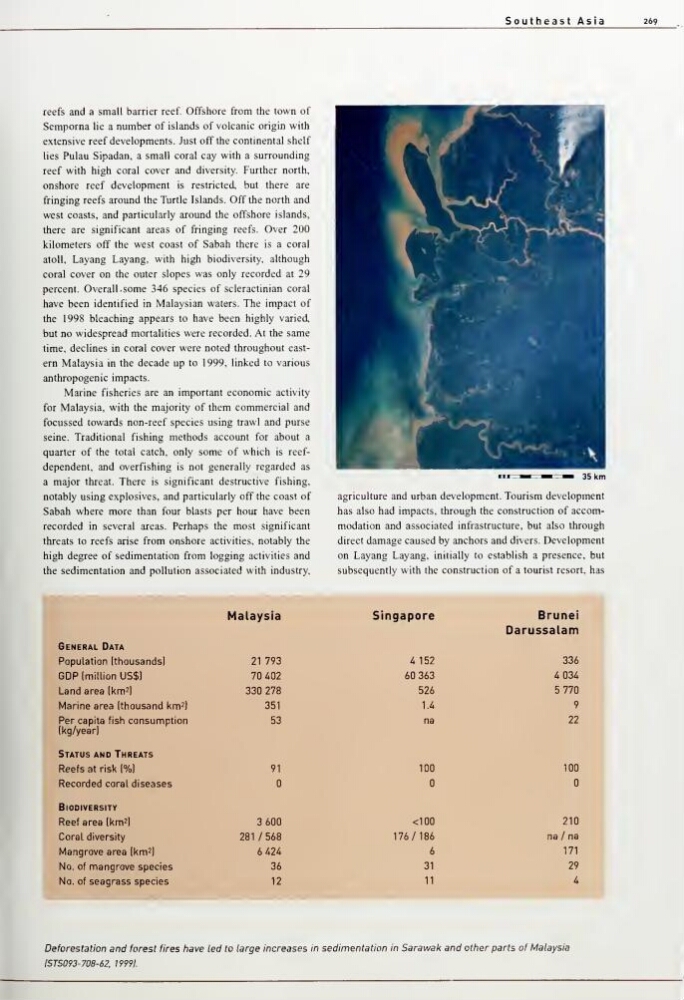
Deforestation and forest fires fiave led to large increases in sedimentation in Sarawak and otfier parts of f^alaysia
IST5093-708-62. 19991.
269
reefs and a small barrier reef. Offshore from the town of
Semporna lie a number of islands of volcanic origin with
extensive reef developments. Just off the continental shelf
lies Pulau Sipadan, a small coral cay with a surrounding
reef with high coral cover and diversity. Further north,
onshore reef development is restricted, but there are
fringing reefs around the Turtle Islands. Off the north and
west coasts, and particularly around the offshore islands,
there are significant areas of fringmg reefs. Over 200
kilometers off the west coast of Sabah there is a coral
atoll, Layang Layang, with high biodiversity, although
coral cover on the outer slopes was only recorded at 29
percent. Overall. some 346 species of scleractinian coral
have been identified in Malaysian waters. The impact of
the 1998 bleaching appears to have been highly varied,
but no widespread mortalities were recorded. At the same
time, declines in coral cover were noted throughout eastern Malaysia in the decade up to 1999, linked to various
anthropogenic impacts.
Marine fisheries are an important economic activity
for Malaysia, with the majority of them commercial and
focussed towards non-reef species using trawl and purse
seine. Traditional fishing methods account for about a
quarter of the total catch, only some of which is reefdependent, and overfishing is not generally regarded as
a major threat. There is significant destructive fishing,
notably using explosives, and particularly off the coast of
Sabah where more than four blasts per hour have been
recorded in several areas. Perhaps the most significant
threats to reefs arise from onshore activities, notably the
high degree of sedimentation from logging activities and
the sedimentation and pollution associated with industry.
agriculture and urban development. Tourism development
has also had impacts, through the construction of accommodation and associated infrastructure, but also through
direct damage caused by anchors and divers. Development
on Layang Layang. initially to establish a presence, but
subsequently with the construction of a tourist resort, has
Malaysia
Singapore
Brunei
Darussalam
General Data
Population Ithousandsl
21 793
4 152
336
GDP (million US$1
70 402
60 363
4 034
Land area Ikm^l
330 278
526
5 770
Marine area (thousand km^)
351
1.4
9
Per capita fish consumption
(kg/year)
53
na
22
Status and Threats
Reefs at risk 1%)
91
100
100
Recorded coral diseases
Biodiversity
Reef area (km^j
3 600
<100
210
Coral diversity
281 / 568
176/186
na / na
Mangrove area Ikm^l
bklk
6
171
No. of mangrove species
36
31
29
No. of seagrass species
12
11
4
Deforestation and forest fires fiave led to large increases in sedimentation in Sarawak and otfier parts of f^alaysia
IST5093-708-62. 19991.