

The World of Coral Reefs
23
Movements between reefs
One critical issue when it comes to understanding
the establishment of patterns in species distribution
is the movement of individuals betvi/een localities.
Reefs in general are ecological islands, typically
surrounded by non-reef areas and often separated
from one another by tens or hundreds of kilometers.
Many reef organisms are sessile, and do not move at
all. Even for the most mobile groups, movements of
adult animals between reefs would be so hazardous
as to be almost impossible, and such journeys are
rarely undertaken. From the largest to the smallest,
almost all coral reef species have a larval life history
which survives for some time in the plankton. It is
these tiny animals which move, or are swept, from
place to place within a reef, and from reef to reef
Typically, corals and other reef species produce
vast numbers of eggs - many coral reef fish produce between 10 000 and a million eggs. These may
be fertilized internally or in the waters above the
reef. Either way, larvae are formed and enter the
plankton where they may remain for weeks or even
months - larval survival in the plankton has been
recorded to over 120 days in some reef fish.
Whilst in the plankton, eggs and larvae may be
carried distances ranging from meters to hundreds
of kilometers. Many larvae have quite considerable
swimming ability, but sea surface currents, more
than any other factor, determine the long-distance
transport of most organisms. Studies on reef fish
distribution have shown that the species with the
shortest larval phases tend to be geographically
restricted while those with long larval phases are
often geographically widespread. The great majority
do not survive, or may be carried to areas where
they are unable to settle, but it is this same movement which allows genetic flow between widely
separated reefs. It also enables the establishment
of new species and new reef communities in areas
where they may not currently occur, or the recovery
of populations which have been lost for any reason.
A number of reef communities surviving at the edge
of their natural ranges, such as those on the latitudinal limits of reef development in Western
Australia, or those periodically impacted by extreme
El Nino conditions in the Eastern Pacific, may be
entirely dependent on larval recruitment from other,
distant, reefs. This also has important implications
for management, particularly for the recovery of
reefs that are destroyed by pollution or blast fishing,
or when overfishing removes all adult fish from
an area.
There is still a great deal that remains unknown about this critical dispersive phase of reef
organisms. The mass spawning event of reef corals
on the Great Barrier Reef was first discovered only
in the early 1980s - here it was observed that the
great majority of corals released their eggs and
sperm during a few nights associated with a
particular full moon. Such synchronous spawning
events flood the nearby waters, reducing the ability
of predators to consume all the eggs and larvae and
so increasing the chances of individual survival.
Such mass spawning events are being discovered
in other areas too, and in other groups. Certain
reef fish, such as the larger groupers, have been
observed to travel many kilometers to congregate at
spawning grounds.
At the same time as these mass spawning
events are being discovered, recent genetic studies
have shown that patterns of connections between
reefs are not a simple reflection of surface currents,
but may also reflect other factors, both contemporary and historic. Some work suggests that
species may not always travel vast distances or be
as "interconnected" as previously thought. Certain
"species" are now being broken down into geographically distinct sibling species groups which
are sufficiently different from one another in genetic terms to suggest that there may be no gene flow
between them, and that they may at the present
time be ecologically isolated.
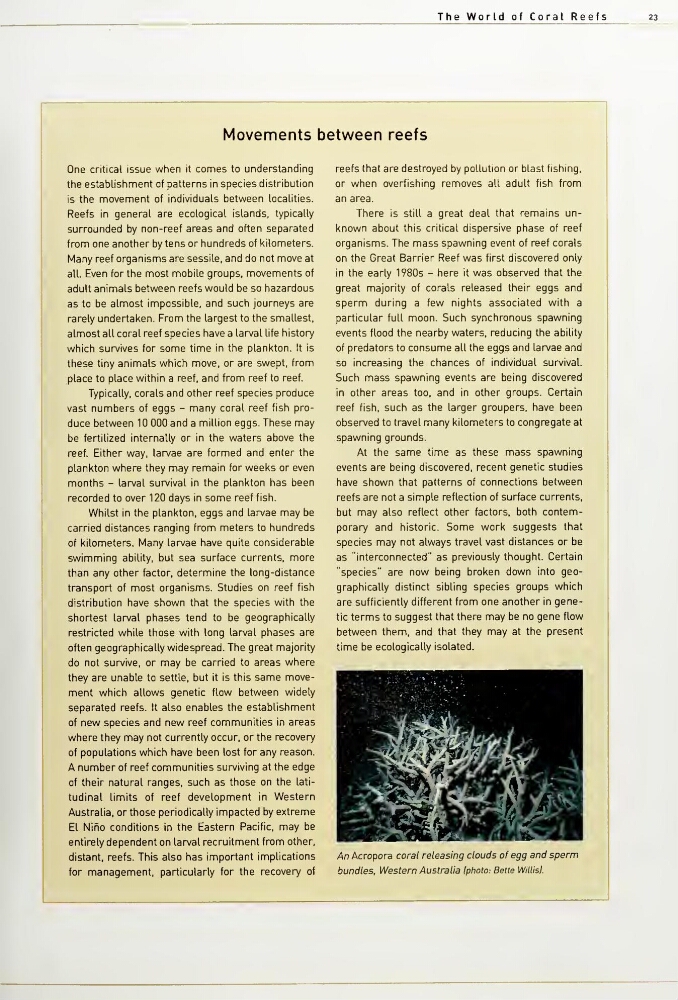
An Acropora corai releasing clouds of egg and sperm
bundles, Western Australia Iphoto: Bette Willis).
23
Movements between reefs
One critical issue when it comes to understanding
the establishment of patterns in species distribution
is the movement of individuals betvi/een localities.
Reefs in general are ecological islands, typically
surrounded by non-reef areas and often separated
from one another by tens or hundreds of kilometers.
Many reef organisms are sessile, and do not move at
all. Even for the most mobile groups, movements of
adult animals between reefs would be so hazardous
as to be almost impossible, and such journeys are
rarely undertaken. From the largest to the smallest,
almost all coral reef species have a larval life history
which survives for some time in the plankton. It is
these tiny animals which move, or are swept, from
place to place within a reef, and from reef to reef
Typically, corals and other reef species produce
vast numbers of eggs - many coral reef fish produce between 10 000 and a million eggs. These may
be fertilized internally or in the waters above the
reef. Either way, larvae are formed and enter the
plankton where they may remain for weeks or even
months - larval survival in the plankton has been
recorded to over 120 days in some reef fish.
Whilst in the plankton, eggs and larvae may be
carried distances ranging from meters to hundreds
of kilometers. Many larvae have quite considerable
swimming ability, but sea surface currents, more
than any other factor, determine the long-distance
transport of most organisms. Studies on reef fish
distribution have shown that the species with the
shortest larval phases tend to be geographically
restricted while those with long larval phases are
often geographically widespread. The great majority
do not survive, or may be carried to areas where
they are unable to settle, but it is this same movement which allows genetic flow between widely
separated reefs. It also enables the establishment
of new species and new reef communities in areas
where they may not currently occur, or the recovery
of populations which have been lost for any reason.
A number of reef communities surviving at the edge
of their natural ranges, such as those on the latitudinal limits of reef development in Western
Australia, or those periodically impacted by extreme
El Nino conditions in the Eastern Pacific, may be
entirely dependent on larval recruitment from other,
distant, reefs. This also has important implications
for management, particularly for the recovery of
reefs that are destroyed by pollution or blast fishing,
or when overfishing removes all adult fish from
an area.
There is still a great deal that remains unknown about this critical dispersive phase of reef
organisms. The mass spawning event of reef corals
on the Great Barrier Reef was first discovered only
in the early 1980s - here it was observed that the
great majority of corals released their eggs and
sperm during a few nights associated with a
particular full moon. Such synchronous spawning
events flood the nearby waters, reducing the ability
of predators to consume all the eggs and larvae and
so increasing the chances of individual survival.
Such mass spawning events are being discovered
in other areas too, and in other groups. Certain
reef fish, such as the larger groupers, have been
observed to travel many kilometers to congregate at
spawning grounds.
At the same time as these mass spawning
events are being discovered, recent genetic studies
have shown that patterns of connections between
reefs are not a simple reflection of surface currents,
but may also reflect other factors, both contemporary and historic. Some work suggests that
species may not always travel vast distances or be
as "interconnected" as previously thought. Certain
"species" are now being broken down into geographically distinct sibling species groups which
are sufficiently different from one another in genetic terms to suggest that there may be no gene flow
between them, and that they may at the present
time be ecologically isolated.
An Acropora corai releasing clouds of egg and sperm
bundles, Western Australia Iphoto: Bette Willis).