

Southeast Asia
265
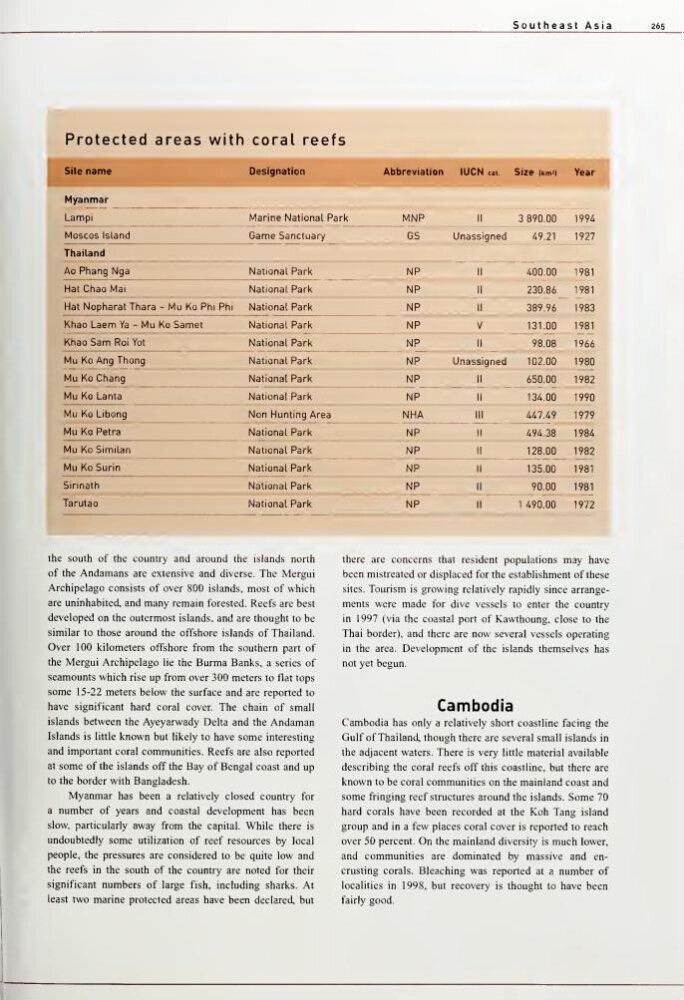
Protected areas with coral reefs
Site name
Designation
Abbreviation
tUCN cat.
Size [km']
Year
Myanmar
Lampi
Marine National Park
MNP
II
3 890.00
1994
l^oscos Island
Game Sanctuary
GS
Unassigned
i9.21
1927
Thailand
Ao Phang Nga
National Park
MP
II
400.00
1981
Hat Chao Mai
National Park
NP
II
230.86
1981
Hat Noptiarat Thara - Mu Ko Phi Phi
National Park
NP
II
389.96
1983
Khao Laem Ya - Ml Ko Samet
National Park
NP
V
131.00
1981
Khao Sam Roi Yot
National Park
NP
II
98.08
1966
Mu Ko Ang Thong
National Park
NP
Unassigned
102.00
1980
Mu Ko Chang
National Park
NP
II
650.00
1982
Mu Ko Lanta
National Park
NP
II
134.00
1990
Mu Ko Libong
Non Hunting Area
NHA
III
447.49
1979
Mu Ko Petra
National Park
NP
II
494.38
1984
Mu Ko Similan
National Park
NP
II
128.00
1982
Mu Ko Surin
National Park
NP
II
135.00
1981
Sirinath
National Park
NP
II
90.00
1981
Tarutao
National Park
NP
II
1
490.00
1972
.^m^
the south of the country and around the islands north
of the Andamans are extensive and diverse. The Mergui
Archipelago consists of over 800 islands, most of which
are uninhabited, and many remain forested. Reefs are best
developed on the outermost islands, and are thought to be
similar to those around the offshore islands of Thailand.
Over 100 kilometers offshore from the southern part of
the Mergui Archipelago lie the Burma Banks, a series of
seamounts which rise up from over 300 meters to flat tops
some 1 5-22 meters below the surface and are reported to
have significant hard coral cover. The chain of small
islands between the Ayeyarwady Delta and the Andaman
Islands is little known but likely to have some interesting
and important coral communities. Reefs are also reported
at some of the islands off the Bay of Bengal coast and up
to the border with Bangladesh.
Myanmar has been a relatively closed country for
a number of years and coastal development has been
slow, particularly away from the capital. While there is
undoubtedly some utilization of reef resources by local
people, the pressures are considered to be quite low and
the reefs in the south of the country are noted for their
significant numbers of large fish, including sharks. At
least two marine protected areas have been declared, but
there are concerns that resident populations may have
been mistreated or displaced for the establishment of these
sites. Tourism is growing relatively rapidly since arrangements were made for dive vessels to enter the country
in 1997 (via the coastal port of Kawthoung, close to the
Thai border), and there are now several vessels operating
in the area. Development of the islands themselves has
not yet begun.
Cambodia
Cambodia has only a relatively short coastline facing the
Gulf of Thailand, though there are several small islands in
the adjacent waters. There is very little material available
describing the coral reefs off this coastline, but there are
known to be coral communities on the mainland coast and
some fringing reef structures around the islands. Some 70
hard corals have been recorded at the Koh Tang island
group and in a few places coral cover is reported to reach
over 50 percent. On the mainland diversity is much lower,
and communities are dominated by massive and encrusting corals. Bleaching was reported at a number of
localities in 1998, but recovery is thought to have been
fairly good.
265
Protected areas with coral reefs
Site name
Designation
Abbreviation
tUCN cat.
Size [km']
Year
Myanmar
Lampi
Marine National Park
MNP
II
3 890.00
1994
l^oscos Island
Game Sanctuary
GS
Unassigned
i9.21
1927
Thailand
Ao Phang Nga
National Park
MP
II
400.00
1981
Hat Chao Mai
National Park
NP
II
230.86
1981
Hat Noptiarat Thara - Mu Ko Phi Phi
National Park
NP
II
389.96
1983
Khao Laem Ya - Ml Ko Samet
National Park
NP
V
131.00
1981
Khao Sam Roi Yot
National Park
NP
II
98.08
1966
Mu Ko Ang Thong
National Park
NP
Unassigned
102.00
1980
Mu Ko Chang
National Park
NP
II
650.00
1982
Mu Ko Lanta
National Park
NP
II
134.00
1990
Mu Ko Libong
Non Hunting Area
NHA
III
447.49
1979
Mu Ko Petra
National Park
NP
II
494.38
1984
Mu Ko Similan
National Park
NP
II
128.00
1982
Mu Ko Surin
National Park
NP
II
135.00
1981
Sirinath
National Park
NP
II
90.00
1981
Tarutao
National Park
NP
II
1
490.00
1972
.^m^
the south of the country and around the islands north
of the Andamans are extensive and diverse. The Mergui
Archipelago consists of over 800 islands, most of which
are uninhabited, and many remain forested. Reefs are best
developed on the outermost islands, and are thought to be
similar to those around the offshore islands of Thailand.
Over 100 kilometers offshore from the southern part of
the Mergui Archipelago lie the Burma Banks, a series of
seamounts which rise up from over 300 meters to flat tops
some 1 5-22 meters below the surface and are reported to
have significant hard coral cover. The chain of small
islands between the Ayeyarwady Delta and the Andaman
Islands is little known but likely to have some interesting
and important coral communities. Reefs are also reported
at some of the islands off the Bay of Bengal coast and up
to the border with Bangladesh.
Myanmar has been a relatively closed country for
a number of years and coastal development has been
slow, particularly away from the capital. While there is
undoubtedly some utilization of reef resources by local
people, the pressures are considered to be quite low and
the reefs in the south of the country are noted for their
significant numbers of large fish, including sharks. At
least two marine protected areas have been declared, but
there are concerns that resident populations may have
been mistreated or displaced for the establishment of these
sites. Tourism is growing relatively rapidly since arrangements were made for dive vessels to enter the country
in 1997 (via the coastal port of Kawthoung, close to the
Thai border), and there are now several vessels operating
in the area. Development of the islands themselves has
not yet begun.
Cambodia
Cambodia has only a relatively short coastline facing the
Gulf of Thailand, though there are several small islands in
the adjacent waters. There is very little material available
describing the coral reefs off this coastline, but there are
known to be coral communities on the mainland coast and
some fringing reef structures around the islands. Some 70
hard corals have been recorded at the Koh Tang island
group and in a few places coral cover is reported to reach
over 50 percent. On the mainland diversity is much lower,
and communities are dominated by massive and encrusting corals. Bleaching was reported at a number of
localities in 1998, but recovery is thought to have been
fairly good.