

Southeast Asia
263
coastline of the Andaman Sea. Early reef research into
coral bleaching was conducted in these waters, and the
reefs of Ko Phuket, which have adapted to high sediment
loads, are also of considerable interest. The 1998
bleaching event did not appear to affect reefs in the
Andaman Sea, though bleaching was widespread in the
Gulf of Thailand where it had not previously been
recorded, and up to 60 percent of corals were reported to
have been affected.
Pressures on much of Thailand's coastal zone are
considerable. Sedimentation is a significant problem for
reefs in many areas, but particularly on the mainland
coasts. The Gulf of Thailand also has a major trawl
fishery. Although this does not directly impact any true
reefs, it is likely to have destroyed or degraded small coral
communities which may have existed in the open waters
of the gulf Most of Thailand's fisheries are concentrated
on offshore stocks, which are believed to have been
overfished since the 1970s. In addition, many reefs are
utilized for fishing as well as for shell and aquarium fish
collection. There have been problems of destructive
fishing in some parts, although this is believed to have
declined. Some coastal fisherfolk are also now becoming
involved in tourism-based activities. In the Andaman Sea,
sea gypsies are responsible for some target species fishing
and collection for the aquarium trade. It has been estimated that over 50 percent of coastal mangrove forests
have been destroyed, largely for conversion to shrimp
ponds and for coastal development. Many of the shrimp
farms were poorly designed and have since been
abandoned, leaving vast areas with neither farms nor the
previously highly productive forest areas. Efforts are now
underway to restore some of these, although with little
success so far. Mangroves are still being cleared, but the
rate of loss has now diminished.
Tourism now exerts a considerable influence on reef
communities and is probably the most significant reef
use in many areas. Unfortunately much of this has been
associated with negative impacts. Construction of roads
and buildings has led to problems with siltation and
pollution. Anchor damage, direct tourist damage and even
collection of corals and shells may be having further
impacts. It has been estimated that over 40 percent of
Thailand's reefs lie within marine national parks, and the
Department of Fisheries has been running a coral reef
management program since 1995 focussed towards
research, training and public eduction to further the
protection of reefs outside these areas. Efforts are
continuing to establish mooring buoys at all popular
dive locations.
Myanmar
Extending from a northern border with Bangladesh to
Thailand in the south, Myanmar has a considerable coastline along the Bay of Bengal and the Andaman Sea. The
northern coast is bounded by the Arkan mountain range
which extends down to the Arkan Peninsula and then
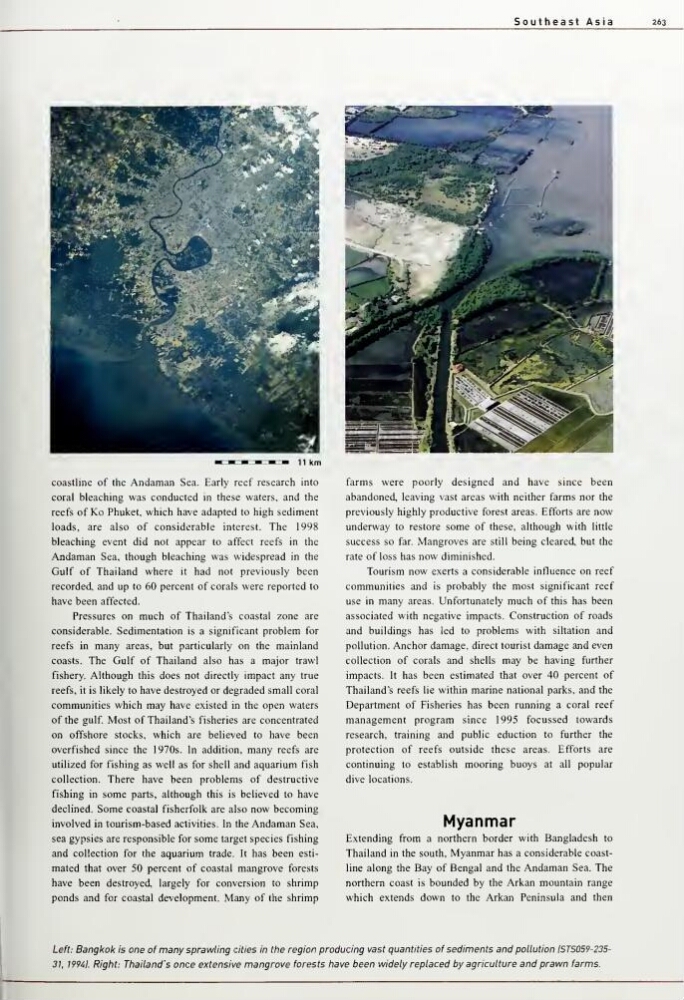
Left: Bangkok is one of many sprawling cities in (he region producing vast quantities of sediments and pollution ISTS059-23531, 1994i Rigfit: Thailand's once extensive mangrove forests liave been widely replaced by agriculture and prawn farms.
263
coastline of the Andaman Sea. Early reef research into
coral bleaching was conducted in these waters, and the
reefs of Ko Phuket, which have adapted to high sediment
loads, are also of considerable interest. The 1998
bleaching event did not appear to affect reefs in the
Andaman Sea, though bleaching was widespread in the
Gulf of Thailand where it had not previously been
recorded, and up to 60 percent of corals were reported to
have been affected.
Pressures on much of Thailand's coastal zone are
considerable. Sedimentation is a significant problem for
reefs in many areas, but particularly on the mainland
coasts. The Gulf of Thailand also has a major trawl
fishery. Although this does not directly impact any true
reefs, it is likely to have destroyed or degraded small coral
communities which may have existed in the open waters
of the gulf Most of Thailand's fisheries are concentrated
on offshore stocks, which are believed to have been
overfished since the 1970s. In addition, many reefs are
utilized for fishing as well as for shell and aquarium fish
collection. There have been problems of destructive
fishing in some parts, although this is believed to have
declined. Some coastal fisherfolk are also now becoming
involved in tourism-based activities. In the Andaman Sea,
sea gypsies are responsible for some target species fishing
and collection for the aquarium trade. It has been estimated that over 50 percent of coastal mangrove forests
have been destroyed, largely for conversion to shrimp
ponds and for coastal development. Many of the shrimp
farms were poorly designed and have since been
abandoned, leaving vast areas with neither farms nor the
previously highly productive forest areas. Efforts are now
underway to restore some of these, although with little
success so far. Mangroves are still being cleared, but the
rate of loss has now diminished.
Tourism now exerts a considerable influence on reef
communities and is probably the most significant reef
use in many areas. Unfortunately much of this has been
associated with negative impacts. Construction of roads
and buildings has led to problems with siltation and
pollution. Anchor damage, direct tourist damage and even
collection of corals and shells may be having further
impacts. It has been estimated that over 40 percent of
Thailand's reefs lie within marine national parks, and the
Department of Fisheries has been running a coral reef
management program since 1995 focussed towards
research, training and public eduction to further the
protection of reefs outside these areas. Efforts are
continuing to establish mooring buoys at all popular
dive locations.
Myanmar
Extending from a northern border with Bangladesh to
Thailand in the south, Myanmar has a considerable coastline along the Bay of Bengal and the Andaman Sea. The
northern coast is bounded by the Arkan mountain range
which extends down to the Arkan Peninsula and then
Left: Bangkok is one of many sprawling cities in (he region producing vast quantities of sediments and pollution ISTS059-23531, 1994i Rigfit: Thailand's once extensive mangrove forests liave been widely replaced by agriculture and prawn farms.