

254
WORLD ATLAS OF CORAL REEFS
low in all areas and many coral communities are dominated by large monospecific stands. Mortality associated
with coral bleaching events has been considerable, with
over 98 percent loss of Acropora in 1996 on reefs near
Abu Dhabi, and loss of most of the remaining colonies
during the 1998 bleaching event.
Qatar
There are fringing reefs along the north and east coasts, with
coral communities growing on the coastal shelf to the east,
but no real reef structures. Further offshore there are a
number of platform reefs. In the far southwest the Gulf of
Salwah is highly saline and unsuitable for coral growlh.
Shallow reefs to the east of Doha were reported to have
undergone mass mortalities as a result of the 1998 coral
bleaching event, with losses of up to 100 percent of
Acropora colonies.
Bahrain
There are no true fringing reefs in this country, but to
the north and east there are a number of quite extensive
platform reef structures. Diversity and coral cover were
generally low, while coral bleaching events in 1996 and
1998 led to mortalities of 85-90 percent of the living coral
on many offshore reefs. Over 70 kilometers north of the
main island, Abul Thama is a small raised platform with
relatively high coral cover of about 25-30 percent.
Surrounded by deeper water (50 meters), these corals
largely survived these bleaching events.
Bahrain is an industrialized nation. Trawl fisheries
undoubtedly had a major impact on offshore ecosystems,
and probably impacted a number of coral reefs, until the
industry was closed in 1998. Onshore land reclamation has
been considerable in the north and west, and there are
proposals to reclaim land on Fasht Adham, a large offshore
reef area in the east. Industrial effluents are significant,
and nearshore waters are routinely dredged, with a major
impact of increased sediments on the surrounding reefs.
Kuwait
Kuwait's reefs are largely located in the southern part of
the country, and are dominated by platform and patch
reefs along the coast from Kuwait City to the border with
Saudi Arabia, and with some fringing reefs around
offshore islands. Most active reef growth occurs in waters
shallower than 10 meters.
There are considerable impacts on these reefs from
various human activities. Perhaps the most direct are
problems of overfishing, solid waste disposal and widespread anchor damage. These reefs were also among those
most directly impacted by the oil spills from the Gulf War.
although this did not cause the mass mortalities which
were expected by many.
Iran
Very little information is currently available describing reef
communities off the coast of Iran. Fringing reefs are known
to occur along parts of the mainland and particularly around
some of the offshore islands, including Kharg and Kharko
Islands in the north and several other small islands to the
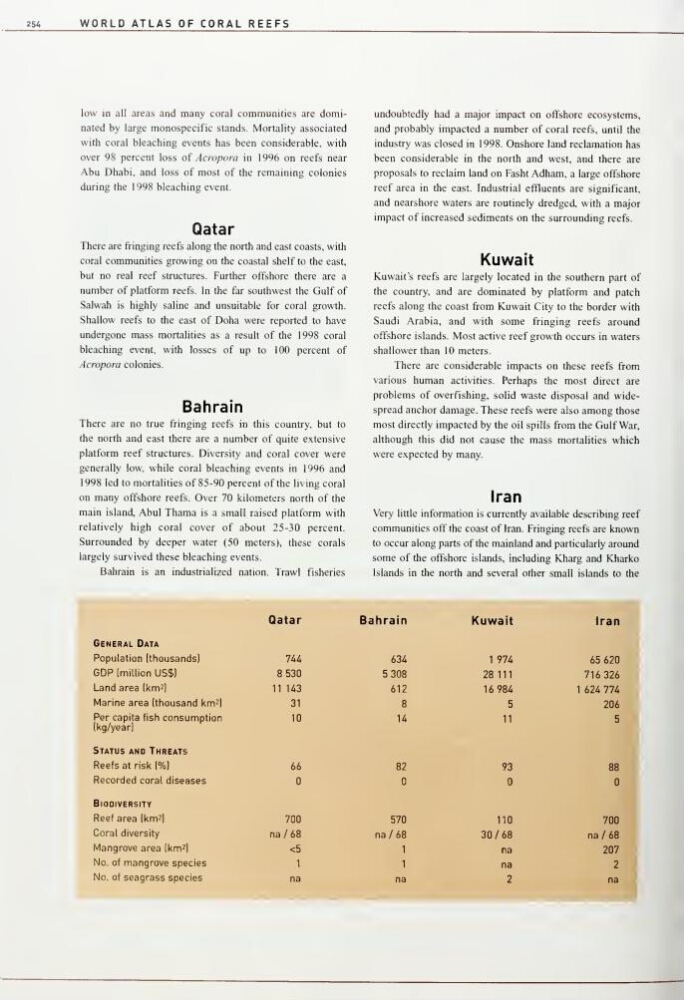
Qatar
Bahrain
Kuwait
Iran
General Data
Population (thousands)
74/i
63^
1 97i
65 620
GDP (million US$1
8 530
5 308
28 111
716 326
Land area (km^)
11 U3
612
16 984
1 62/, 774
Marine area (thousand km^l
31
8
5
206
Per capita fish consumption
(kg/yearl
10
U
11
5
Status and Threats
Reefs at risk (%|
66
82
93
88
Recorded coral diseases
Biodiversity
Reef area (km^l
700
570
110
700
Coral diversity
na/68
na/68
30/68
na/68
Mangrove area (km'l
<5
1
na
207
No. of mangrove species
1
1
na
2
No. of seagrass species
na
na
2
na
WORLD ATLAS OF CORAL REEFS
low in all areas and many coral communities are dominated by large monospecific stands. Mortality associated
with coral bleaching events has been considerable, with
over 98 percent loss of Acropora in 1996 on reefs near
Abu Dhabi, and loss of most of the remaining colonies
during the 1998 bleaching event.
Qatar
There are fringing reefs along the north and east coasts, with
coral communities growing on the coastal shelf to the east,
but no real reef structures. Further offshore there are a
number of platform reefs. In the far southwest the Gulf of
Salwah is highly saline and unsuitable for coral growlh.
Shallow reefs to the east of Doha were reported to have
undergone mass mortalities as a result of the 1998 coral
bleaching event, with losses of up to 100 percent of
Acropora colonies.
Bahrain
There are no true fringing reefs in this country, but to
the north and east there are a number of quite extensive
platform reef structures. Diversity and coral cover were
generally low, while coral bleaching events in 1996 and
1998 led to mortalities of 85-90 percent of the living coral
on many offshore reefs. Over 70 kilometers north of the
main island, Abul Thama is a small raised platform with
relatively high coral cover of about 25-30 percent.
Surrounded by deeper water (50 meters), these corals
largely survived these bleaching events.
Bahrain is an industrialized nation. Trawl fisheries
undoubtedly had a major impact on offshore ecosystems,
and probably impacted a number of coral reefs, until the
industry was closed in 1998. Onshore land reclamation has
been considerable in the north and west, and there are
proposals to reclaim land on Fasht Adham, a large offshore
reef area in the east. Industrial effluents are significant,
and nearshore waters are routinely dredged, with a major
impact of increased sediments on the surrounding reefs.
Kuwait
Kuwait's reefs are largely located in the southern part of
the country, and are dominated by platform and patch
reefs along the coast from Kuwait City to the border with
Saudi Arabia, and with some fringing reefs around
offshore islands. Most active reef growth occurs in waters
shallower than 10 meters.
There are considerable impacts on these reefs from
various human activities. Perhaps the most direct are
problems of overfishing, solid waste disposal and widespread anchor damage. These reefs were also among those
most directly impacted by the oil spills from the Gulf War.
although this did not cause the mass mortalities which
were expected by many.
Iran
Very little information is currently available describing reef
communities off the coast of Iran. Fringing reefs are known
to occur along parts of the mainland and particularly around
some of the offshore islands, including Kharg and Kharko
Islands in the north and several other small islands to the
Qatar
Bahrain
Kuwait
Iran
General Data
Population (thousands)
74/i
63^
1 97i
65 620
GDP (million US$1
8 530
5 308
28 111
716 326
Land area (km^)
11 U3
612
16 984
1 62/, 774
Marine area (thousand km^l
31
8
5
206
Per capita fish consumption
(kg/yearl
10
U
11
5
Status and Threats
Reefs at risk (%|
66
82
93
88
Recorded coral diseases
Biodiversity
Reef area (km^l
700
570
110
700
Coral diversity
na/68
na/68
30/68
na/68
Mangrove area (km'l
<5
1
na
207
No. of mangrove species
1
1
na
2
No. of seagrass species
na
na
2
na