

Middle Eastern Seas
247
Southern Arabian Region:
Yemen, Djibouti, northern
Sonnalia and Oman
MAP9d
South
of the Bab el Mandeb, the mouth of the Red
Sea, the waters rapidly open out into the Gulf of
Aden, a wide semi-enclosed sea bordered by
Djibouti in the west, Yemen in the North and Somalia and
the Yemeni islands of Socotra, Abd al Kiri. Darsa and
Semha in the south. This area is of similar tectonic origin to
the Red Sea. formed by the spreading of the Sheba Ridge
which runs down the center of the Gulf of Aden and out into
the Arabian Sea. Onshore, the coastlines are mountainous,
while offshore the bathymetry is steep - much of the central
part of the gulf is over 2 000 meters deep. To the east the
Gulf of Aden joins the Arabian Sea, which is bordered by
the coast of Oman in the north and then sweeps northwest
forming the Gulf of Oman.
One critical oceanographic feature in this region is that
of the seasonally reversing monsoon winds which operate
over the entire Northern Indian Ocean. During the summer
months there is a sustained strong wind blowing from the
southwest along the coast of southern Arabia. This wind
drives the surfaces waters away and, in the Arabian Sea,
they are replaced by cooler, nutrient-rich waters of about
16-17°C upwelling from the deeper ocean. In the Gulf of
Oman the cool water influence is less constant, although
occasional upwellings occur and can replace surface waters
very rapidly such that falls of up to 10°C over one or two
days have been observed. Such upwellings have a significant impact on the ecology, and areas of reef development
are few. In the Gulf of Aden, although there are still areas
of upwelling, these are not so widespread and have less
impact on the shallow inshore communities than is the case
in southern Oman.
From an ecological and a biogeographic perspective
this is a particularly interesting region. The cool nutrientrich upwellings in the east have enabled the development of
unusual communities dominated by macroalgae. These are
found over wide areas of hard substrate, where coral reefs
might normally occur and are dominated by Sargassum and
Nizamudinnia in shallow waters and by Eklonia in deeper
areas. Macroalgal communities such as these are more
typically associated with cooler, temperate waters. Small
numbers of corals are also sometimes found alongside these
algae, while in more sheltered areas, such as the landward
sides of some Omani islands, very extensive high cover
coral communities are found. Until the mid to late 1990s
the Gulf of Aden was almost entirely unknown, but recent
studies have revealed extensive and diverse coral communities supporting some of the most diverse fish populations
of the entire Arabian region. By contrast, macroalgal
communities appear to be much less widespread or
dominant in the Gulf of Aden. Another feature, which may
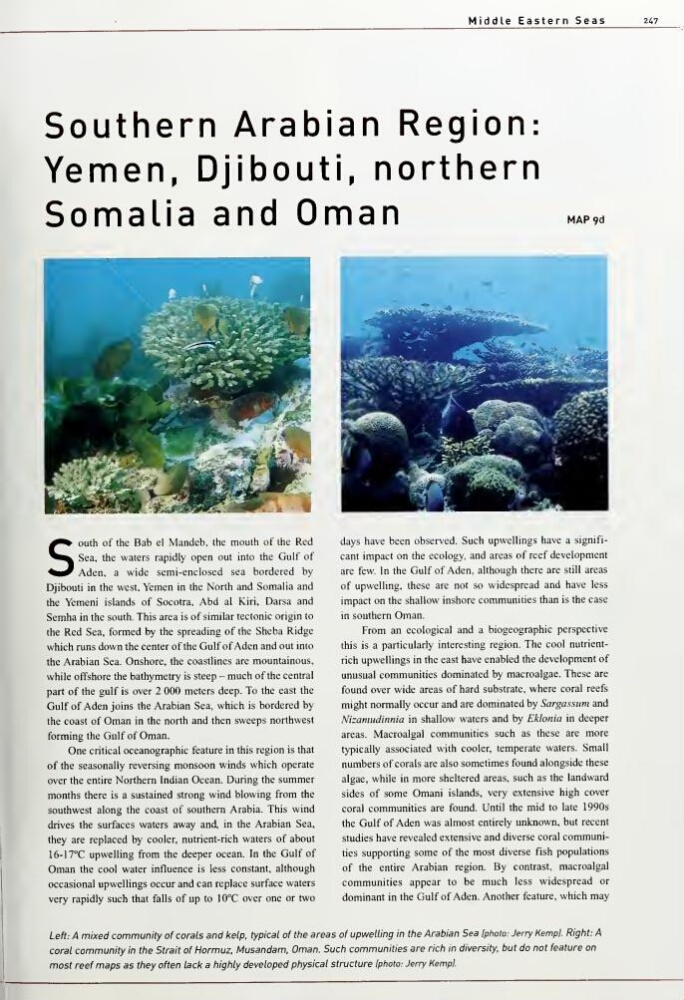
Left: A mixed community of corals and l<.elp, typical of the areas of upwelling in the Arabian Sea Iphoto: Jerry Kempl. Right: A
coral community in the Strait of Hormuz, Musandam, Oman. Such communities are rich in diversity, but do not feature on
most reef maps as they often lacl< a highly developed physical structure Iphoto: Jerry Kempl.
247
Southern Arabian Region:
Yemen, Djibouti, northern
Sonnalia and Oman
MAP9d
South
of the Bab el Mandeb, the mouth of the Red
Sea, the waters rapidly open out into the Gulf of
Aden, a wide semi-enclosed sea bordered by
Djibouti in the west, Yemen in the North and Somalia and
the Yemeni islands of Socotra, Abd al Kiri. Darsa and
Semha in the south. This area is of similar tectonic origin to
the Red Sea. formed by the spreading of the Sheba Ridge
which runs down the center of the Gulf of Aden and out into
the Arabian Sea. Onshore, the coastlines are mountainous,
while offshore the bathymetry is steep - much of the central
part of the gulf is over 2 000 meters deep. To the east the
Gulf of Aden joins the Arabian Sea, which is bordered by
the coast of Oman in the north and then sweeps northwest
forming the Gulf of Oman.
One critical oceanographic feature in this region is that
of the seasonally reversing monsoon winds which operate
over the entire Northern Indian Ocean. During the summer
months there is a sustained strong wind blowing from the
southwest along the coast of southern Arabia. This wind
drives the surfaces waters away and, in the Arabian Sea,
they are replaced by cooler, nutrient-rich waters of about
16-17°C upwelling from the deeper ocean. In the Gulf of
Oman the cool water influence is less constant, although
occasional upwellings occur and can replace surface waters
very rapidly such that falls of up to 10°C over one or two
days have been observed. Such upwellings have a significant impact on the ecology, and areas of reef development
are few. In the Gulf of Aden, although there are still areas
of upwelling, these are not so widespread and have less
impact on the shallow inshore communities than is the case
in southern Oman.
From an ecological and a biogeographic perspective
this is a particularly interesting region. The cool nutrientrich upwellings in the east have enabled the development of
unusual communities dominated by macroalgae. These are
found over wide areas of hard substrate, where coral reefs
might normally occur and are dominated by Sargassum and
Nizamudinnia in shallow waters and by Eklonia in deeper
areas. Macroalgal communities such as these are more
typically associated with cooler, temperate waters. Small
numbers of corals are also sometimes found alongside these
algae, while in more sheltered areas, such as the landward
sides of some Omani islands, very extensive high cover
coral communities are found. Until the mid to late 1990s
the Gulf of Aden was almost entirely unknown, but recent
studies have revealed extensive and diverse coral communities supporting some of the most diverse fish populations
of the entire Arabian region. By contrast, macroalgal
communities appear to be much less widespread or
dominant in the Gulf of Aden. Another feature, which may
Left: A mixed community of corals and l<.elp, typical of the areas of upwelling in the Arabian Sea Iphoto: Jerry Kempl. Right: A
coral community in the Strait of Hormuz, Musandam, Oman. Such communities are rich in diversity, but do not feature on
most reef maps as they often lacl< a highly developed physical structure Iphoto: Jerry Kempl.