

Middle Eastern Seas
237
:»-£ .^-^'^^*~'ii^i'i'fe<^:?**~» -*-r^"^^";^^
temperatures at Suez are 17.5°C, with low extremes
dropping to below IO°C. Salinities are also very high in
the north, typically about 40.5%o (parts per thousand), but
reaching 42.5%o in the northern Gulf of Suez.
Although biodiversity remains high even at the
northernmost tip of the Gulf of Aqaba, there is clearly
some reduction in species numbers with increasing
latitude in both of the northerly gulfs. This may be associated with the extreme winter cold, although high salinity
probably also plays a role, particularly in the Gulf of Suez.
Despite this general picture, a number of other coral and
fish species are found in the northern regions which
become rare or absent in similarly shallow waters further
south. Some 218 hard corals have been recorded in the
Gulf of Aqaba. Live coral cover is generally high
throughout the region, reaching 60-80 percent on many
reef slopes. The most northerly mangroves in the Indian
Ocean region are located along the Egyptian coastline of
Sinai and these, together with most other mangrove areas
in the northern and central Red Sea, are composed of
monospecific stands of Avicennia marina.
No reefs were observed to be bleached in 1998.
Crown-of-thorns starfish have generally been rare in the
region, though outbreaks have affected a number of reefs
in the southern Gulf of Aqaba since 1998. These were
quite localized and temporary, and large numbers were
removed, including 70 000 from Tiran and a further 27 000
from Gordon Reef in the Straits of Tiran. Similar outbreaks in more remote locations may have gone unnoticed.
Generally, human population densities are low along
most of the coastal zone and are ahnost entirely confined to
urban centers. Fisheries are generally not a major industry.
Most are artisanal, undertaken particularly by Bedouin
peoples using traditional techniques. Tourism, by contrast, is
a major mdustry, particularly in Egypt. Further details of
these and other impacts are considered for the separate
countries below.
Egypt
Egypt's extensive coastline incorporates a significant
proportion and a considerable range of the coral reefs
found in the Red Sea, including a small number of reefs
and islands lying in deep water at some distance from the
continental shelf Human activities along this coastline are
highly varied, and include areas of quite intensive use and
considerable reef degradation, but also areas which
remain relatively remote and inaccessible, and which are
largely unimpacted by humans.
Marine fishing is not a major industry in Egypt. There
is a small amount of commercial fishing in the southern
reef areas, and heavy trawling activity was reported in the
Gulf of Suez in the late 1990s. However, many reefs are
only lightly fished. In contrast, pollution from shipping
and oil spillage are a significant threat, notably along the
coastline of the Gulfs of Suez and Aqaba. Ship groundings
have also been a problem, causing direct physical
destruction to some reefs, and raising concerns about the
potential economic repercussions arising from any damage
to the major tourist beaches and dive sites. The Suez Canal
also provides an additional threat. The canal itself was first
opened in 1869 and provides a direct sea-level connection
between the Red Sea and the Mediterranean. Such a connection allows species to move between these two seas
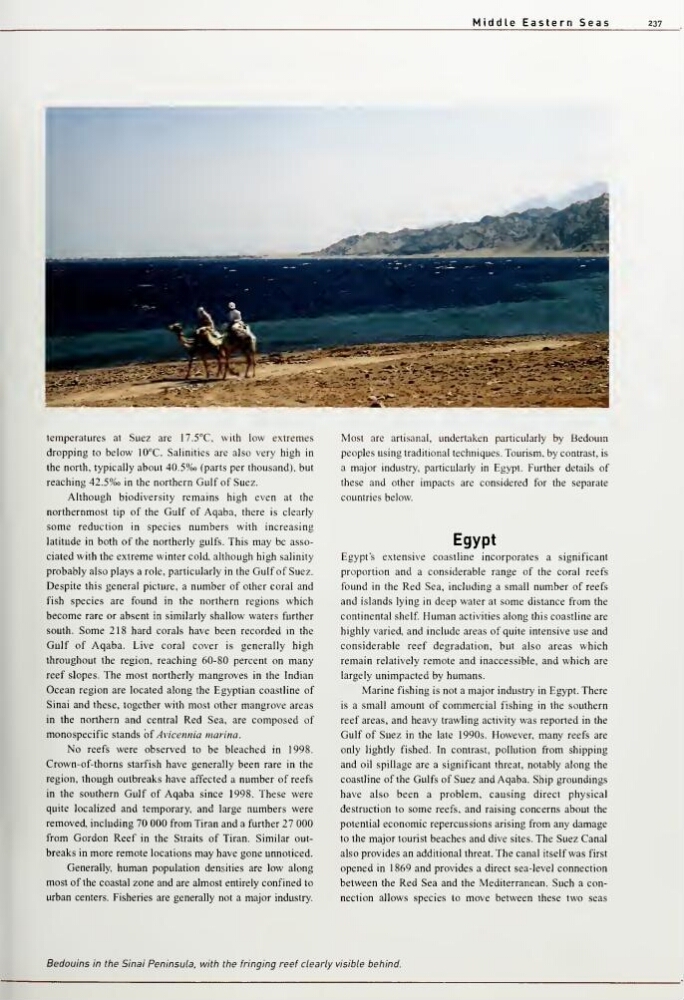
Bedouins in the Sinai Peninsula, with the fringing reef clearly visible behind.
237
:»-£ .^-^'^^*~'ii^i'i'fe<^:?**~» -*-r^"^^";^^
temperatures at Suez are 17.5°C, with low extremes
dropping to below IO°C. Salinities are also very high in
the north, typically about 40.5%o (parts per thousand), but
reaching 42.5%o in the northern Gulf of Suez.
Although biodiversity remains high even at the
northernmost tip of the Gulf of Aqaba, there is clearly
some reduction in species numbers with increasing
latitude in both of the northerly gulfs. This may be associated with the extreme winter cold, although high salinity
probably also plays a role, particularly in the Gulf of Suez.
Despite this general picture, a number of other coral and
fish species are found in the northern regions which
become rare or absent in similarly shallow waters further
south. Some 218 hard corals have been recorded in the
Gulf of Aqaba. Live coral cover is generally high
throughout the region, reaching 60-80 percent on many
reef slopes. The most northerly mangroves in the Indian
Ocean region are located along the Egyptian coastline of
Sinai and these, together with most other mangrove areas
in the northern and central Red Sea, are composed of
monospecific stands of Avicennia marina.
No reefs were observed to be bleached in 1998.
Crown-of-thorns starfish have generally been rare in the
region, though outbreaks have affected a number of reefs
in the southern Gulf of Aqaba since 1998. These were
quite localized and temporary, and large numbers were
removed, including 70 000 from Tiran and a further 27 000
from Gordon Reef in the Straits of Tiran. Similar outbreaks in more remote locations may have gone unnoticed.
Generally, human population densities are low along
most of the coastal zone and are ahnost entirely confined to
urban centers. Fisheries are generally not a major industry.
Most are artisanal, undertaken particularly by Bedouin
peoples using traditional techniques. Tourism, by contrast, is
a major mdustry, particularly in Egypt. Further details of
these and other impacts are considered for the separate
countries below.
Egypt
Egypt's extensive coastline incorporates a significant
proportion and a considerable range of the coral reefs
found in the Red Sea, including a small number of reefs
and islands lying in deep water at some distance from the
continental shelf Human activities along this coastline are
highly varied, and include areas of quite intensive use and
considerable reef degradation, but also areas which
remain relatively remote and inaccessible, and which are
largely unimpacted by humans.
Marine fishing is not a major industry in Egypt. There
is a small amount of commercial fishing in the southern
reef areas, and heavy trawling activity was reported in the
Gulf of Suez in the late 1990s. However, many reefs are
only lightly fished. In contrast, pollution from shipping
and oil spillage are a significant threat, notably along the
coastline of the Gulfs of Suez and Aqaba. Ship groundings
have also been a problem, causing direct physical
destruction to some reefs, and raising concerns about the
potential economic repercussions arising from any damage
to the major tourist beaches and dive sites. The Suez Canal
also provides an additional threat. The canal itself was first
opened in 1869 and provides a direct sea-level connection
between the Red Sea and the Mediterranean. Such a connection allows species to move between these two seas
Bedouins in the Sinai Peninsula, with the fringing reef clearly visible behind.