

228
WORLD ATLAS OF CORAL REEFS
British Indian Ocean Territory
General Data
Population'
GDPImiUion US$)
Land area Ikm^l
72
Marine area (thousand km^
55i
Per capita fisli consumption Ikg/yearl
Status and Threats
Reefs at risk (%l
3
Recorded coral diseases
Biodiversity
Reef area (km^l
3 770
Coral diversity
172/329
Mangrove area Ikm^l
na
No. of mangrove species
2
No. of seagrass species
1
• There is a non-resident population of some 3 000 military and
civilian personnel on Diego Garcia
and lagoonal reef slopes, typically 50-80 percent of
the substrate down to a depth of about 40 meters.
Unfortunately this area was heavily damaged during the
1998 coral bleaching event and, although no records of
bleaching intensity were made at the time, coral loss has
been estimated as averaging 80-85 percent on seaward
slopes, and was close to 100 percent in some areas. In
addition to its important marine fauna, the Chagos is
home to the most diverse and one of the largest
populations of breeding seabirds in the Indian Ocean.
In 1996, 167 000 breeding pairs of 17 species were
observed, including critical populations of the red-footed
booby Siila siila.
A number of the islands in the Chagos Archipelago,
inhabited from the late 18th century, were transformed
by the development of coconut plantations and the
introduction of rats and other animals. However, it is
unlikely that this had a major influence on the marine
environment as there was no major export fishery. There
was a forced evacuation of the islands in the early 1970s
when the military base on the southernmost island of
Diego Garcia was established. This has some 3 000 personnel and large vessels permanently at anchor in the
lagoon. The impacts of this base have included dredging in
the lagoon and some mining of the reef flat, as well as a
substantial recreational fishery. There are, however, strict
environmental controls on many activities. Personnel are
not permitted to dive, and snorkelling is also forbidden
on the outer reef slopes. The remaining islands are now
uninhabited, although there are a number of visiting yachts
and other vessels (commercial tourist-carrying vessels are
not permitted). These may be causing localized impacts
through anchor damage and sewage pollution, notably in
the enclosed lagoon of Salomon Atoll.
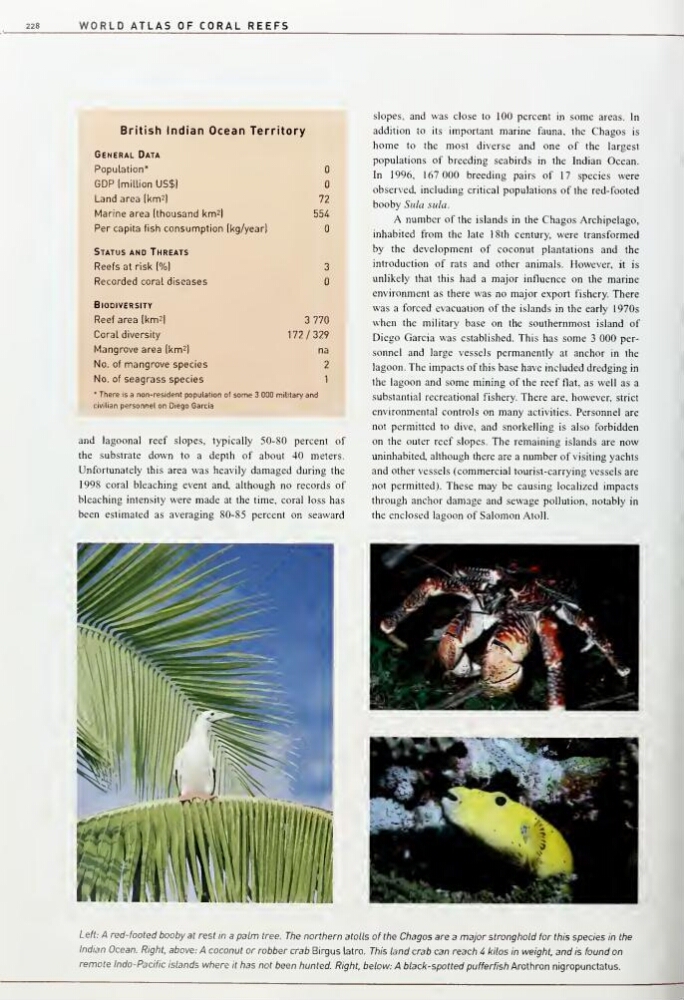
Left: A red-footed booby at rest in a palm tree. The northern atolls of the Chagos are a major stronghold for this species in the
Indian Ocean. Right, above. A coconut or robber crab Birgus latro. This land crab can reach i kilos in weight, and is found on
remote Indo-Paclfic islands where it has not been hunted. Right, below: A black-spotted pufferfish Arothron nigropunctatus.
WORLD ATLAS OF CORAL REEFS
British Indian Ocean Territory
General Data
Population'
GDPImiUion US$)
Land area Ikm^l
72
Marine area (thousand km^
55i
Per capita fisli consumption Ikg/yearl
Status and Threats
Reefs at risk (%l
3
Recorded coral diseases
Biodiversity
Reef area (km^l
3 770
Coral diversity
172/329
Mangrove area Ikm^l
na
No. of mangrove species
2
No. of seagrass species
1
• There is a non-resident population of some 3 000 military and
civilian personnel on Diego Garcia
and lagoonal reef slopes, typically 50-80 percent of
the substrate down to a depth of about 40 meters.
Unfortunately this area was heavily damaged during the
1998 coral bleaching event and, although no records of
bleaching intensity were made at the time, coral loss has
been estimated as averaging 80-85 percent on seaward
slopes, and was close to 100 percent in some areas. In
addition to its important marine fauna, the Chagos is
home to the most diverse and one of the largest
populations of breeding seabirds in the Indian Ocean.
In 1996, 167 000 breeding pairs of 17 species were
observed, including critical populations of the red-footed
booby Siila siila.
A number of the islands in the Chagos Archipelago,
inhabited from the late 18th century, were transformed
by the development of coconut plantations and the
introduction of rats and other animals. However, it is
unlikely that this had a major influence on the marine
environment as there was no major export fishery. There
was a forced evacuation of the islands in the early 1970s
when the military base on the southernmost island of
Diego Garcia was established. This has some 3 000 personnel and large vessels permanently at anchor in the
lagoon. The impacts of this base have included dredging in
the lagoon and some mining of the reef flat, as well as a
substantial recreational fishery. There are, however, strict
environmental controls on many activities. Personnel are
not permitted to dive, and snorkelling is also forbidden
on the outer reef slopes. The remaining islands are now
uninhabited, although there are a number of visiting yachts
and other vessels (commercial tourist-carrying vessels are
not permitted). These may be causing localized impacts
through anchor damage and sewage pollution, notably in
the enclosed lagoon of Salomon Atoll.
Left: A red-footed booby at rest in a palm tree. The northern atolls of the Chagos are a major stronghold for this species in the
Indian Ocean. Right, above. A coconut or robber crab Birgus latro. This land crab can reach i kilos in weight, and is found on
remote Indo-Paclfic islands where it has not been hunted. Right, below: A black-spotted pufferfish Arothron nigropunctatus.