

226
WORLD ATLAS OF CORAL REEFS
British Indian Ocean
Territory
MAPSe
4 km
The
British Indian Ocean Territory (BIOT) covers a
very large area of reefs and islands, also known as
the Chagos Archipelago. There are some 50 islands
and islets and, although the total land area is only 60 square
kilometers, there is a vast area of reefs. These include five
true atolls (Blenheim Reef, Diego Garcia, Egmont, Peros
Banhos and Salomon), a mostly submerged atoll (Great
Chagos Bank, the largest atoll structure in the world at
some 13 000 square kilometers), and a number of submerged banks (including Speakers Bank, Pitt Bank and
Centurion Bank). The southernmost atoll, Diego Garcia, is
unusual in having a narrow but continuous land rim
extending around 90 percent of the atoll's circumference.
The northerly atolls, by contrast, have only small islands
scattered around them. As with the Maldives, the Chagos
Archipelago has grown up over the volcanic trace of the
Reunion hotspot, and forms the newest and southerrunost
extension of the Chagos-Laccadive Ridge. The reefs and
islands are highly isolated - the nearest reef structures are
those of the Maldives, some 500 kilometers to the north,
while the nearest continental land mass is that of Sri
Lanka, more than 1 500 kilometers away.
With some 220 scleractinian species, the reefs of the
Chagos are among the most diverse known for hermatypic
corals in the Indian Ocean. While recorded fish faunas are
currently lower than those for the Maldives, it is likely that
many more have yet to be recorded. Like the Maldives, the
reefs of the Chagos lie close to the mid-point between the
eastern and western faunas of the Indian Ocean. This fact,
combined with their high diversity, lends support to their
role as an important biogeographic stepping stone in the
so-called Chagos stricture. The faunal characteristics of
the Chagos have close affinities to both the Indonesian
high diversity faunas and the East African faunas. Further
interesting biodiversity features, including a small number
of endemic or near endemic species, may be associated
with the isolation of the Chagos. Undoubtedly the most
interesting of these is the coral Ctenella chagius which may
be unique to the Chagos, although there is one reported
observation from Mauritius. This species is the only extant
representative of the family Meandrinidae in the entire
Indo-Pacific, although this family was widespread in the
Cretaceous (and is widespread in the Caribbean). The
Chagos goby Trimmalom offucius is endemic to the area
and the related T. nanus was first reported from these reefs.
The latter is the smallest fish species in the world, reaching
maturity at only 8 millimeters in length.
Prior to 1998, coral cover was high on both seaward
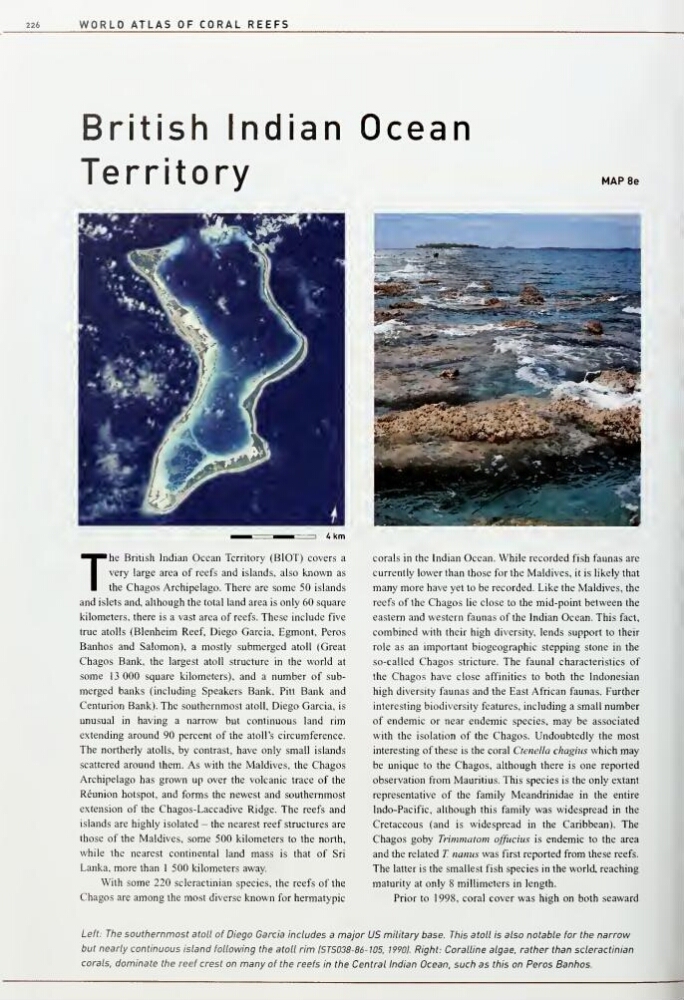
Left: The southernmost atoll of Diego Garcia includes a major US military base. This atoll is also notable for the narrow
but nearly continuous island following the atoll rim ISTS038-86-W5, 19901 Right: Coralline algae, rather than scleractinian
corals, dominate the reef crest on many of the reefs in the Central Indian Ocean, such as this on Peros Banhos.
WORLD ATLAS OF CORAL REEFS
British Indian Ocean
Territory
MAPSe
4 km
The
British Indian Ocean Territory (BIOT) covers a
very large area of reefs and islands, also known as
the Chagos Archipelago. There are some 50 islands
and islets and, although the total land area is only 60 square
kilometers, there is a vast area of reefs. These include five
true atolls (Blenheim Reef, Diego Garcia, Egmont, Peros
Banhos and Salomon), a mostly submerged atoll (Great
Chagos Bank, the largest atoll structure in the world at
some 13 000 square kilometers), and a number of submerged banks (including Speakers Bank, Pitt Bank and
Centurion Bank). The southernmost atoll, Diego Garcia, is
unusual in having a narrow but continuous land rim
extending around 90 percent of the atoll's circumference.
The northerly atolls, by contrast, have only small islands
scattered around them. As with the Maldives, the Chagos
Archipelago has grown up over the volcanic trace of the
Reunion hotspot, and forms the newest and southerrunost
extension of the Chagos-Laccadive Ridge. The reefs and
islands are highly isolated - the nearest reef structures are
those of the Maldives, some 500 kilometers to the north,
while the nearest continental land mass is that of Sri
Lanka, more than 1 500 kilometers away.
With some 220 scleractinian species, the reefs of the
Chagos are among the most diverse known for hermatypic
corals in the Indian Ocean. While recorded fish faunas are
currently lower than those for the Maldives, it is likely that
many more have yet to be recorded. Like the Maldives, the
reefs of the Chagos lie close to the mid-point between the
eastern and western faunas of the Indian Ocean. This fact,
combined with their high diversity, lends support to their
role as an important biogeographic stepping stone in the
so-called Chagos stricture. The faunal characteristics of
the Chagos have close affinities to both the Indonesian
high diversity faunas and the East African faunas. Further
interesting biodiversity features, including a small number
of endemic or near endemic species, may be associated
with the isolation of the Chagos. Undoubtedly the most
interesting of these is the coral Ctenella chagius which may
be unique to the Chagos, although there is one reported
observation from Mauritius. This species is the only extant
representative of the family Meandrinidae in the entire
Indo-Pacific, although this family was widespread in the
Cretaceous (and is widespread in the Caribbean). The
Chagos goby Trimmalom offucius is endemic to the area
and the related T. nanus was first reported from these reefs.
The latter is the smallest fish species in the world, reaching
maturity at only 8 millimeters in length.
Prior to 1998, coral cover was high on both seaward
Left: The southernmost atoll of Diego Garcia includes a major US military base. This atoll is also notable for the narrow
but nearly continuous island following the atoll rim ISTS038-86-W5, 19901 Right: Coralline algae, rather than scleractinian
corals, dominate the reef crest on many of the reefs in the Central Indian Ocean, such as this on Peros Banhos.