

Central Indian Ocean
217
Protected areas wi th coral reefs
1 Site name
Designation
Abbreviation
lUCN cat.
Size lkm!|
ITear
India
Great Nicobar
Biosphere Reserve (National!
BR
VI
885.00
989
Gulfof Kutch
Marine National Parl<
NP
II
162.89
980
GulfofKutch
/
Marine Sanctuary
S
IV
293.03
980
Gulf of Mannar
Marine National Parl<
NP
II
6.23
986
Gulf of Mannar
Biosphere Reserve INationall
BR
VI
10 500.00
989
Wandur IMahatma Gandhi)
Marine National Park
NP
II
281.50
983
growing activity: access requires a permit and tourist
numbers are currently below 1 000 per year. The 1998 El
Niiio warming event caused dramatic coral bleaching,
with significant subsequent coral mortality of 43-87
percent. This is probably slightly lower than that experienced further south in the Chagos-Laccadive chain.
The Andaman and Nicobar group consists of some
500 islands. Many are the high peaks of a submerged
mountain range, a continuation of the Arakan mountains of
Myanmar. The islands fall into two clear districts: Andaman
to the north and Nicobar to the south, separated by the 160
kilometer wide Ten Degree Channel. There are fringing
reefs along the coastlines of many of these islands. Their
location is far closer to Indonesia and the Southeast Asian
center of biodiversity than to India, and species diversity is
higher than at any other reefs in India, with some 219 coral
species recorded and around 571 species of reef fish.
Although only 38 islands are inhabited, the population has
been rising rapidly, largely through immigration, especially
in the Andaman District. Close to these areas there may
now be some human impacts on the reef communities,
while sedimentation is expected to increase as further areas
are opened up to logging. At the present time, however,
many of the reefs are still largely free from human impacts,
and pollution generally remains low. Despite access
difficulties, tourist numbers are growing, and dive operators are now taking divers to the islands on "live-aboards",
usually departing from Thailand. The reefs were apparently
very badly affected by the 1997-98 bleaching, with up to 80
percent mortality reported in some areas. Recent surveys
have nonetheless shown an average of 56 percent live coral
cover, suggesting a varied impact among the reefs. A
detailed network of protected areas has been established in
the islands. The majority of these are terrestrial but extend
to the coastline, offering at least partial protection to
adjacent reef communities.
Pakistan
While there is little published information describing the
sub-littoral marine communities of Pakistan, this country
is not believed to have any true coral reefs. However, coral
communities on hard substrates are suspected, particularly
in the west. Any such communities may be very similar to
those described for southern Arabia.
Bangladesh
In Bangladesh, as with much of the Indian coast of the
Bay of Bengal, the high levels of turbidity and freshwater
influx prevent reef development. There is one .small area
of reef development off the coast of St. Martins Island
or Jinjiradwip, where some 66 hard coral species from 22
genera have been recorded. These small reef areas are
considered seriously threatened by sedimentation, cyclone
damage, overfishing and anchor damage. Despite the small
area of corals, branching Acropora are harvested for the
curio trade and are now reported to be rare.
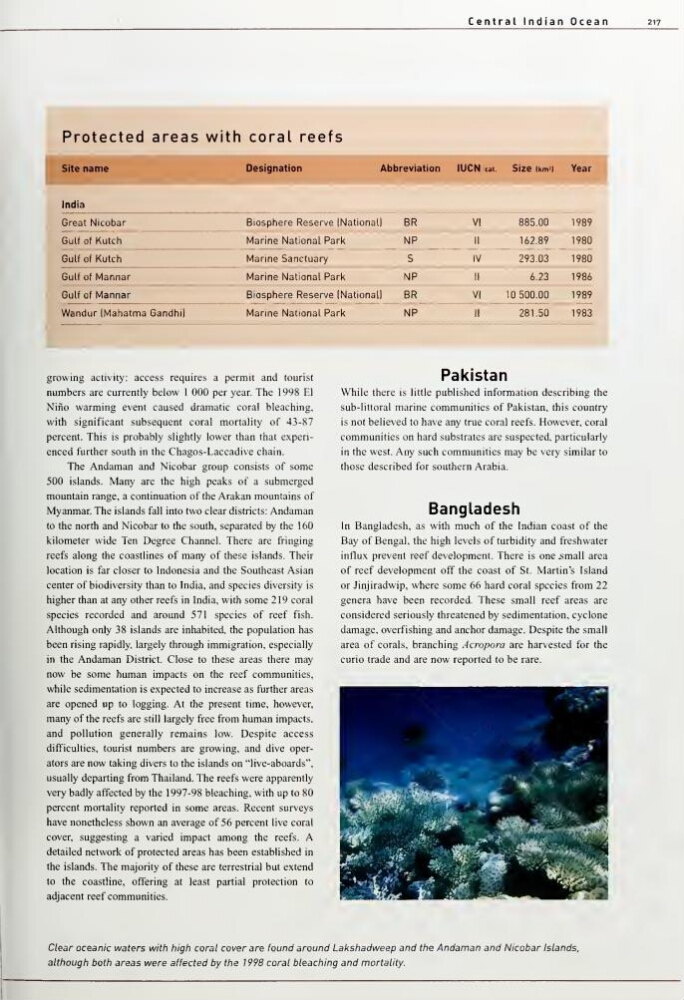
Clear oceanic waters with liigli coral cover are found around Lakshadweep and the Andaman and Nicobar Islands,
although both areas were affected by the 1998 coral bleaching and mortality.
217
Protected areas wi th coral reefs
1 Site name
Designation
Abbreviation
lUCN cat.
Size lkm!|
ITear
India
Great Nicobar
Biosphere Reserve (National!
BR
VI
885.00
989
Gulfof Kutch
Marine National Parl<
NP
II
162.89
980
GulfofKutch
/
Marine Sanctuary
S
IV
293.03
980
Gulf of Mannar
Marine National Parl<
NP
II
6.23
986
Gulf of Mannar
Biosphere Reserve INationall
BR
VI
10 500.00
989
Wandur IMahatma Gandhi)
Marine National Park
NP
II
281.50
983
growing activity: access requires a permit and tourist
numbers are currently below 1 000 per year. The 1998 El
Niiio warming event caused dramatic coral bleaching,
with significant subsequent coral mortality of 43-87
percent. This is probably slightly lower than that experienced further south in the Chagos-Laccadive chain.
The Andaman and Nicobar group consists of some
500 islands. Many are the high peaks of a submerged
mountain range, a continuation of the Arakan mountains of
Myanmar. The islands fall into two clear districts: Andaman
to the north and Nicobar to the south, separated by the 160
kilometer wide Ten Degree Channel. There are fringing
reefs along the coastlines of many of these islands. Their
location is far closer to Indonesia and the Southeast Asian
center of biodiversity than to India, and species diversity is
higher than at any other reefs in India, with some 219 coral
species recorded and around 571 species of reef fish.
Although only 38 islands are inhabited, the population has
been rising rapidly, largely through immigration, especially
in the Andaman District. Close to these areas there may
now be some human impacts on the reef communities,
while sedimentation is expected to increase as further areas
are opened up to logging. At the present time, however,
many of the reefs are still largely free from human impacts,
and pollution generally remains low. Despite access
difficulties, tourist numbers are growing, and dive operators are now taking divers to the islands on "live-aboards",
usually departing from Thailand. The reefs were apparently
very badly affected by the 1997-98 bleaching, with up to 80
percent mortality reported in some areas. Recent surveys
have nonetheless shown an average of 56 percent live coral
cover, suggesting a varied impact among the reefs. A
detailed network of protected areas has been established in
the islands. The majority of these are terrestrial but extend
to the coastline, offering at least partial protection to
adjacent reef communities.
Pakistan
While there is little published information describing the
sub-littoral marine communities of Pakistan, this country
is not believed to have any true coral reefs. However, coral
communities on hard substrates are suspected, particularly
in the west. Any such communities may be very similar to
those described for southern Arabia.
Bangladesh
In Bangladesh, as with much of the Indian coast of the
Bay of Bengal, the high levels of turbidity and freshwater
influx prevent reef development. There is one .small area
of reef development off the coast of St. Martins Island
or Jinjiradwip, where some 66 hard coral species from 22
genera have been recorded. These small reef areas are
considered seriously threatened by sedimentation, cyclone
damage, overfishing and anchor damage. Despite the small
area of corals, branching Acropora are harvested for the
curio trade and are now reported to be rare.
Clear oceanic waters with liigli coral cover are found around Lakshadweep and the Andaman and Nicobar Islands,
although both areas were affected by the 1998 coral bleaching and mortality.