

Central Indian Ocean
215
India, Pakistan and
Bangladesh
MAP 8a
InCliS.
despite its vast size, has only a few coral
reefs off its mainland coast, mostly concentrated
around the Gulf of Kutch to the northwest, and the Gulf
of Mannar near Sri Lanka in the southeast. Reefs are
highly developed in the more remote archipelagos of
Lakshadweep and the Andaman and Nicobar islands. The
distribution and status of any reefs outside these areas
remains largely unknown.
The reefs and coral communities of the Gulf of Kutch
are predominantly patchy structures built up on sandstone
or other banks or around the small islands on the southern
side of the gulf They have adapted to extreme environmental conditions of high temperatures, fluctuating and high
salinities, large tidal ranges and heavy sediment loads. As
a result diversity is low. with only 37 hard coral species
recorded and no branching species. Coral sand mining was
a significant industry in the Gulf of Kutch in the early 1980s
and may have added to already difficult conditions. Chronic
oil pollution in the area may also be affecting the reefs.
There is an oil pipeline right through the national park,
parts of which were impacted by a major oil spill in 1999.
Industrial pollution is a further concern, and the clearance of
mangroves may have increased levels of sedimentation. The
impacts of the 1998 coral bleaching were quite varied within
this area, but on average were much lower than on reefs to
the south, with about 30 percent mortality. Further down the
coast there are some small, low diversity communities, but
conditions here are quite harsh, with low salinities during
the monsoon and high turbidity and wave action. Corals are
also reported from the Gaveshani Bank some 100 kilometers
off the coast from Mangalore.
The best developed mainland reef structures are located
in the southeast, with fringing reefs occurring off Palk
Bay, and on the coasts and islands of the Gulf of Mannar,
including Adams Bridge, a string of reefs stretching across
towards Sri Lanka. Diversity is high in this area, with 117
hard coral species recorded as well as a number of ecosystems including seagrass and mangrove communities.
Unfortunately reefs in this region were recorded as rapidly
deteriorating as early as 1971. associated with high levels
of siltation and the removal of coral rock combined with
cyclone impacts. Coral rubble mining still occurs in the
region, and mining of sand from the beaches is ongoing.
Fisheries are thought to have a considerable impact, with
some 47 fishing villages comprising a total of 50 000
people. Apart from overexploitation of general reef fish
stocks there are concerns about other fisheries including
sea fans, sea cucumbers, spiny lobsters, seahorses and
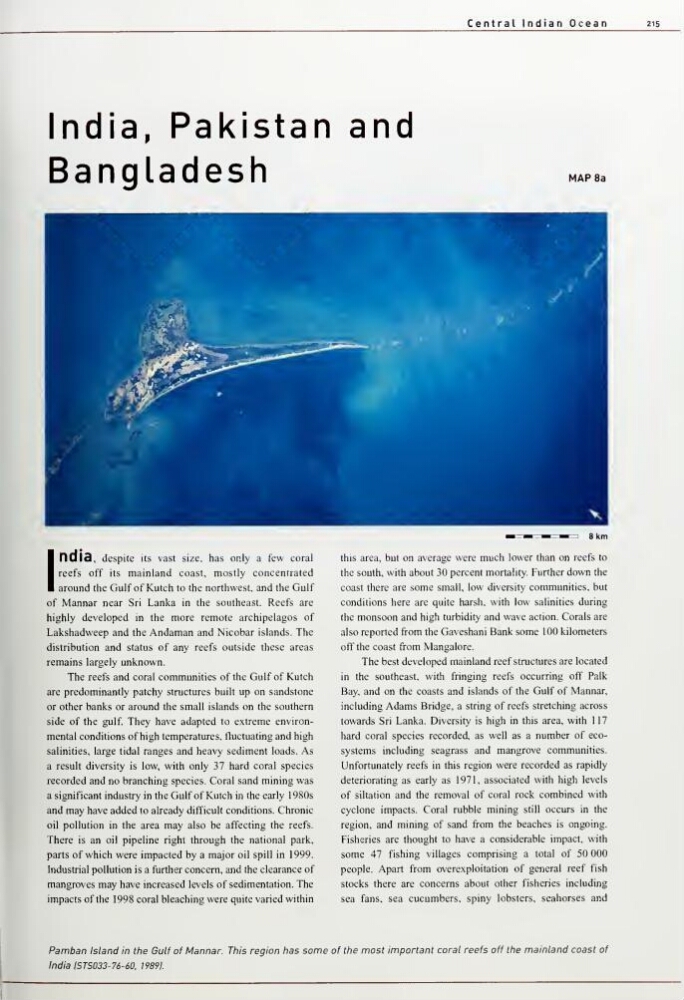
Pamban Island In the Gulf of Mannar. This region has some of the most important coral reefs off the mainland coast of
India IST5033-76-60. 19891
215
India, Pakistan and
Bangladesh
MAP 8a
InCliS.
despite its vast size, has only a few coral
reefs off its mainland coast, mostly concentrated
around the Gulf of Kutch to the northwest, and the Gulf
of Mannar near Sri Lanka in the southeast. Reefs are
highly developed in the more remote archipelagos of
Lakshadweep and the Andaman and Nicobar islands. The
distribution and status of any reefs outside these areas
remains largely unknown.
The reefs and coral communities of the Gulf of Kutch
are predominantly patchy structures built up on sandstone
or other banks or around the small islands on the southern
side of the gulf They have adapted to extreme environmental conditions of high temperatures, fluctuating and high
salinities, large tidal ranges and heavy sediment loads. As
a result diversity is low. with only 37 hard coral species
recorded and no branching species. Coral sand mining was
a significant industry in the Gulf of Kutch in the early 1980s
and may have added to already difficult conditions. Chronic
oil pollution in the area may also be affecting the reefs.
There is an oil pipeline right through the national park,
parts of which were impacted by a major oil spill in 1999.
Industrial pollution is a further concern, and the clearance of
mangroves may have increased levels of sedimentation. The
impacts of the 1998 coral bleaching were quite varied within
this area, but on average were much lower than on reefs to
the south, with about 30 percent mortality. Further down the
coast there are some small, low diversity communities, but
conditions here are quite harsh, with low salinities during
the monsoon and high turbidity and wave action. Corals are
also reported from the Gaveshani Bank some 100 kilometers
off the coast from Mangalore.
The best developed mainland reef structures are located
in the southeast, with fringing reefs occurring off Palk
Bay, and on the coasts and islands of the Gulf of Mannar,
including Adams Bridge, a string of reefs stretching across
towards Sri Lanka. Diversity is high in this area, with 117
hard coral species recorded as well as a number of ecosystems including seagrass and mangrove communities.
Unfortunately reefs in this region were recorded as rapidly
deteriorating as early as 1971. associated with high levels
of siltation and the removal of coral rock combined with
cyclone impacts. Coral rubble mining still occurs in the
region, and mining of sand from the beaches is ongoing.
Fisheries are thought to have a considerable impact, with
some 47 fishing villages comprising a total of 50 000
people. Apart from overexploitation of general reef fish
stocks there are concerns about other fisheries including
sea fans, sea cucumbers, spiny lobsters, seahorses and
Pamban Island In the Gulf of Mannar. This region has some of the most important coral reefs off the mainland coast of
India IST5033-76-60. 19891