

Western Indian Ocean
205
Mauritius and Reunion
MAP7h
15knn
The
Mascarene islands of Mauritius, Rodrigues and
Reunion lie at the southern end of the Mascarene
Ridge and are geologically relatively young. All
three islands are of volcanic origin and show a clear
sequence of reef development. Reunion is the youngest.
Still volcanically active, it lies directly over the hot spot
which has provided the geological origin of the entire
Chagos-Laccadive Ridge (Chapter 8), as well as the
southerly parts of the Mascarene Ridge. Moving eastwards the islands become comparatively older, and with
this the coral reefs are both better developed and
further offshore.
In addition to the main islands listed here there are
several others which fall under the jurisdiction of
Mauritius and of Reunion. These lie at some distance from
the main islands and are considered separately, below.
Mauritius and Rodrigues
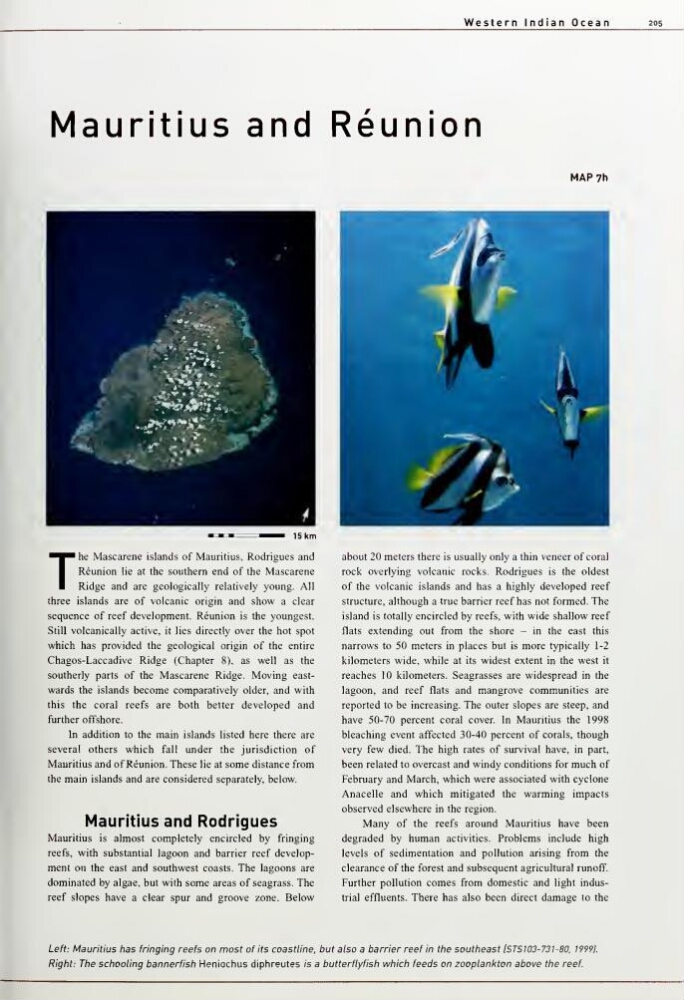
Mauritius is almost completely encircled by fringing
reefs, with substantial lagoon and barrier reef development on the east and southwest coasts. The lagoons are
dominated by algae, but with some areas of seagrass. The
reef slopes have a clear spur and groove zone. Below
about 20 meters there is usually only a thin veneer of coral
rock overlying volcanic rocks. Rodrigues is the oldest
of the volcanic islands and has a highly developed reef
structure, although a true barrier reef has not formed. The
island is totally encircled by reefs, with wide shallow reef
flats extending out from the shore - in the east this
narrows to 50 meters in places but is more typically 1-2
kilometers wide, while at its widest extent in the west it
reaches 10 kilometers. Seagrasses are widespread in the
lagoon, and reef flats and mangrove communities are
reported to be increasing. The outer slopes are steep, and
have 50-70 percent coral cover In Mauritius the 1998
bleaching event affected 30-40 percent of corals, though
very few died. The high rates of survival have, in part,
been related to overcast and windy conditions for much of
February and March, which were associated with cyclone
Anacelle and which mitigated the warming impacts
observed elsewhere in the region.
Many of the reefs around Mauritius have been
degraded by human activities. Problems include high
levels of sedimentation and pollution arising from the
clearance of the forest and subsequent agricultural runoff.
Further pollution comes from domestic and light industrial effluents. There has also been direct damage to the
Left: Mauritius tias fringing reefs on most of its coastiine, but also a barrier reef in the southeast ISTSt03-731-80, 19991.
Right: The schooling bannerfish Heniochus diphreutes is a butterftyfish which feeds on zooplanl
205
Mauritius and Reunion
MAP7h
15knn
The
Mascarene islands of Mauritius, Rodrigues and
Reunion lie at the southern end of the Mascarene
Ridge and are geologically relatively young. All
three islands are of volcanic origin and show a clear
sequence of reef development. Reunion is the youngest.
Still volcanically active, it lies directly over the hot spot
which has provided the geological origin of the entire
Chagos-Laccadive Ridge (Chapter 8), as well as the
southerly parts of the Mascarene Ridge. Moving eastwards the islands become comparatively older, and with
this the coral reefs are both better developed and
further offshore.
In addition to the main islands listed here there are
several others which fall under the jurisdiction of
Mauritius and of Reunion. These lie at some distance from
the main islands and are considered separately, below.
Mauritius and Rodrigues
Mauritius is almost completely encircled by fringing
reefs, with substantial lagoon and barrier reef development on the east and southwest coasts. The lagoons are
dominated by algae, but with some areas of seagrass. The
reef slopes have a clear spur and groove zone. Below
about 20 meters there is usually only a thin veneer of coral
rock overlying volcanic rocks. Rodrigues is the oldest
of the volcanic islands and has a highly developed reef
structure, although a true barrier reef has not formed. The
island is totally encircled by reefs, with wide shallow reef
flats extending out from the shore - in the east this
narrows to 50 meters in places but is more typically 1-2
kilometers wide, while at its widest extent in the west it
reaches 10 kilometers. Seagrasses are widespread in the
lagoon, and reef flats and mangrove communities are
reported to be increasing. The outer slopes are steep, and
have 50-70 percent coral cover In Mauritius the 1998
bleaching event affected 30-40 percent of corals, though
very few died. The high rates of survival have, in part,
been related to overcast and windy conditions for much of
February and March, which were associated with cyclone
Anacelle and which mitigated the warming impacts
observed elsewhere in the region.
Many of the reefs around Mauritius have been
degraded by human activities. Problems include high
levels of sedimentation and pollution arising from the
clearance of the forest and subsequent agricultural runoff.
Further pollution comes from domestic and light industrial effluents. There has also been direct damage to the
Left: Mauritius tias fringing reefs on most of its coastiine, but also a barrier reef in the southeast ISTSt03-731-80, 19991.
Right: The schooling bannerfish Heniochus diphreutes is a butterftyfish which feeds on zooplanl