

Western Indian Ocean
entire archipelago were very heavily impacted by the
1997-98 El Nifio event, with bleaching occurring on
60-95 percent of corals, and subsequent coral mortalities
of 50-90 percent. The longer-term impacts on the reef
communities are somewhat unpredictable given the scale
of damage in all areas.
Human impacts on the reefs are varied, but clearly
significant in the granitic islands. Most of the national fish
consumption is of nearshore fishes, a large proportion
of which are reef associated. The reefs of the Seychelles
Bank are thus quite heavily utilized, and there are clearly
documented examples of overfishing from a few localities.
Fishing pressure in the southern islands, by contrast, is
relatively low. There is some fishing by vessels visiting
from the granitic islands, but also some small commercial
fisheries operations run from a few of the inhabited islands.
The offshore tuna populations are the center of a major
export fishery, with a tuna cannery in Mahe serving a large
number of vessels from the Indian Ocean.
Tourism is a critical industry in the Seychelles, being
one of the main providers of employment and the main
foreign exchange earner. In 1996 there were some 131 000
visitors, with receipts totalling US$147 million. Virtually
all tourism is coastal and beach orientated, with a large
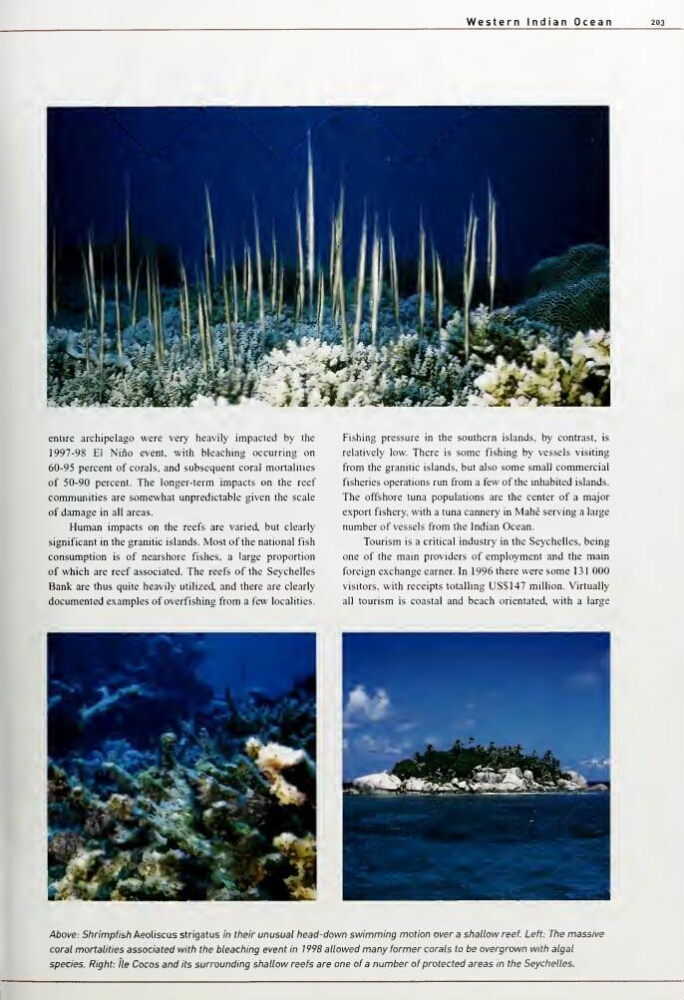
Above: Shrimpfish Aeoliscus strigatus in their unusual liead-down swimming motion over a shallow reef Left: The massive
coral mortalities associated with the bleaching event in 1998 allowed many former corals to be overgrown with algal
species. Right: tie Cocas and its surrounding shallow reefs are one of a number of protected areas in the Seychelles.
entire archipelago were very heavily impacted by the
1997-98 El Nifio event, with bleaching occurring on
60-95 percent of corals, and subsequent coral mortalities
of 50-90 percent. The longer-term impacts on the reef
communities are somewhat unpredictable given the scale
of damage in all areas.
Human impacts on the reefs are varied, but clearly
significant in the granitic islands. Most of the national fish
consumption is of nearshore fishes, a large proportion
of which are reef associated. The reefs of the Seychelles
Bank are thus quite heavily utilized, and there are clearly
documented examples of overfishing from a few localities.
Fishing pressure in the southern islands, by contrast, is
relatively low. There is some fishing by vessels visiting
from the granitic islands, but also some small commercial
fisheries operations run from a few of the inhabited islands.
The offshore tuna populations are the center of a major
export fishery, with a tuna cannery in Mahe serving a large
number of vessels from the Indian Ocean.
Tourism is a critical industry in the Seychelles, being
one of the main providers of employment and the main
foreign exchange earner. In 1996 there were some 131 000
visitors, with receipts totalling US$147 million. Virtually
all tourism is coastal and beach orientated, with a large
Above: Shrimpfish Aeoliscus strigatus in their unusual liead-down swimming motion over a shallow reef Left: The massive
coral mortalities associated with the bleaching event in 1998 allowed many former corals to be overgrown with algal
species. Right: tie Cocas and its surrounding shallow reefs are one of a number of protected areas in the Seychelles.