

WORLD ATLAS OF CORAL REEFS
Chapter 7
Western Indian Ocean
The
Western Indian Ocean is distinctive in
terms of coral reefs. Its eastern boundary is
marked by the Seychelles and the shallow
Mascarene Ridge which extends down
towards Mauritius. East of these is a considerable expanse of deep ocean separating the reefs
of this region from those of the Maldives and Chagos.
The region's southern margins are the oceanic waters
to the south of Mauritius, Reunion and Madagascar,
while on the continental coastlines of southern
Mozambique and northern South Africa the gradual
cooling of water temperatures is mirrored by a
diminution in coral diversity. The growth of reefs ceases
close to this international border The northern edge of
the region ends along the eastern coast of Somalia
where coral growth again becomes highly restricted,
here by cold water upwellings associated with regional
patterns in oceanic currents.
The reefs of mainland East Africa are predominantly fringing, closely following the coastlines of
the mainland and islands on the continental shelf.
Madagascar has some discontinuous fringing reef
development, as well as some barrier reef systems
off its west coast. The remainder of the region is
dominated by oceanic islands. The northern Seychelles
are actually a remnant of continental crust, with high
islands and fringing reef systems. There are also two
volcanic island chains, the Comoros and the ReunionRodrigues chain. Both show classic reef development,
with limited fringing reefs on the most recent islands,
but wide fringing and barrier reef development on the
older ones. The Reunion hotspot also produced the vast
reef areas of the Chagos-Laccadive ridge across the
Central Indian Ocean (Chapter 81.
The reefs of this region have high levels of species
diversity Although they are similar to those of the
Central Indian Ocean, there are distinctive and endemic
species which have led to the recognition by some
authors of a Western Indian Ocean center of diversity.
Detailed knowledge of the reef biotas is lacking for much
of the region, a factor which is related to a lack of
infrastructure and indigenous expertise combined with
problems of national security in some areas. This region
was badly damaged by the coral bleaching event of 1998,
with many areas suffering over 50 percent mortality.
Human populations along much of the coastline
are rapidly increasing. Most of the coastal populations
are very poor, and heavily dependent on the adjacent
reefs for food. Unfortunately there is little control over
the utilization of these resources, either through
traditional or formal management regimes, and large
areas of reefs have been degraded through overfishing
or destructive fishing techniques. Growing interest in
the reefs for tourism is leading to new pressures in
some areas, however it is also providing an economically powerful incentive for protecting reefs, and
there is considerable potential for environmentally
sustainable tourism developments.
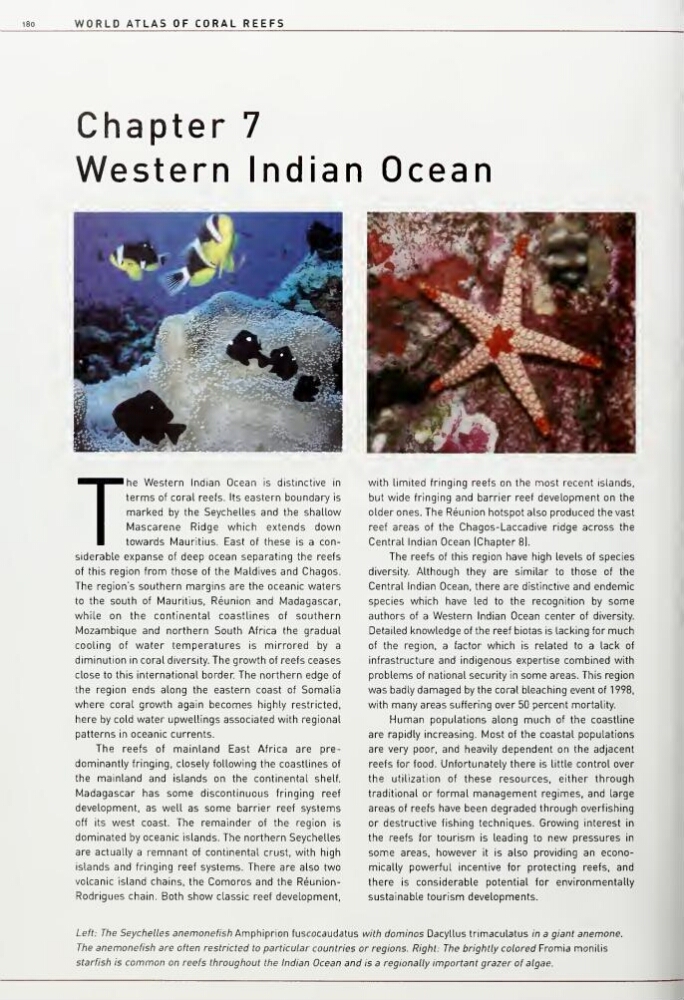
Left: The Seychelles anemonefish Amphiprion fuscocaudatus with dominos Dacyllus trimaculatus in a giant anemone.
The anemonefish are often restricted to particular countries or regions. Right: The brightly colored Fromia monilis
starfish is common on reefs throughout the Indian Ocean and is a regionally important grazer of algae.
Chapter 7
Western Indian Ocean
The
Western Indian Ocean is distinctive in
terms of coral reefs. Its eastern boundary is
marked by the Seychelles and the shallow
Mascarene Ridge which extends down
towards Mauritius. East of these is a considerable expanse of deep ocean separating the reefs
of this region from those of the Maldives and Chagos.
The region's southern margins are the oceanic waters
to the south of Mauritius, Reunion and Madagascar,
while on the continental coastlines of southern
Mozambique and northern South Africa the gradual
cooling of water temperatures is mirrored by a
diminution in coral diversity. The growth of reefs ceases
close to this international border The northern edge of
the region ends along the eastern coast of Somalia
where coral growth again becomes highly restricted,
here by cold water upwellings associated with regional
patterns in oceanic currents.
The reefs of mainland East Africa are predominantly fringing, closely following the coastlines of
the mainland and islands on the continental shelf.
Madagascar has some discontinuous fringing reef
development, as well as some barrier reef systems
off its west coast. The remainder of the region is
dominated by oceanic islands. The northern Seychelles
are actually a remnant of continental crust, with high
islands and fringing reef systems. There are also two
volcanic island chains, the Comoros and the ReunionRodrigues chain. Both show classic reef development,
with limited fringing reefs on the most recent islands,
but wide fringing and barrier reef development on the
older ones. The Reunion hotspot also produced the vast
reef areas of the Chagos-Laccadive ridge across the
Central Indian Ocean (Chapter 81.
The reefs of this region have high levels of species
diversity Although they are similar to those of the
Central Indian Ocean, there are distinctive and endemic
species which have led to the recognition by some
authors of a Western Indian Ocean center of diversity.
Detailed knowledge of the reef biotas is lacking for much
of the region, a factor which is related to a lack of
infrastructure and indigenous expertise combined with
problems of national security in some areas. This region
was badly damaged by the coral bleaching event of 1998,
with many areas suffering over 50 percent mortality.
Human populations along much of the coastline
are rapidly increasing. Most of the coastal populations
are very poor, and heavily dependent on the adjacent
reefs for food. Unfortunately there is little control over
the utilization of these resources, either through
traditional or formal management regimes, and large
areas of reefs have been degraded through overfishing
or destructive fishing techniques. Growing interest in
the reefs for tourism is leading to new pressures in
some areas, however it is also providing an economically powerful incentive for protecting reefs, and
there is considerable potential for environmentally
sustainable tourism developments.
Left: The Seychelles anemonefish Amphiprion fuscocaudatus with dominos Dacyllus trimaculatus in a giant anemone.
The anemonefish are often restricted to particular countries or regions. Right: The brightly colored Fromia monilis
starfish is common on reefs throughout the Indian Ocean and is a regionally important grazer of algae.