

168
WORLD ATLAS OF CORAL REEFS
Venezuela and Aruba,
Bonaire and Curacao
MAP6e
V6n6ZU6l3
is a large country with a long,
north-facing coastline delimiting the southeastern
edge of the Caribbean Sea. In the east this coastline is dominated by the vast delta of the Orinoco River,
which carries considerable quantities of freshwater into
the Western Atlantic, just south of the island of Trinidad.
Further west, the coastline generally has higher relief, and
there are numerous smaller rivers. Coral reef development
is thus highly limited by freshwater and sediment runoff,
and nearshore coral reefs are scarce. Small reef systems
exist at Morrocoy and coral communities in Mochima.
Between these two locations there are a few other small
reef developments, for example in San Esteban, Turiamo
Bay and Cienaga de Ocumare Bay. The reefs in the Parque
Nacional Morrocoy occur along the seaward margins of
small cays at the mouth of the Golfete de Guare (Borracho
and Cayo Sombrero) and to the south of Punta Tucacas.
This is a generally low energy area with moderate to low
wave activity, and hurricanes are very rare. Mangroves,
mainly Rhizophora mangle, grow on the leeward side of
these islands, which are separated from the mainland by
extensive seagrass beds. The reef platforms are approximately 50 meters wide and typically slope down to a
depth of 12 meters. Until recently, they were dominated by
Montaslrea cavernosa, M. annularis and several species
of soft coral (Pseiidoplerogorgia spp., Plexaura spp. and
Eunicea spp.). Further reefs are located on the continental
coastline around the Mochima National Park, although
diversity is lower here, with only about 25 scleractinian
coral species recorded.
In January 1996 there was mass coral mortality at
Morrocoy, which left less than 5 percent live coral cover
All corals except Porites poriles. Sideraslrea siderea and
Millepora alcicornis at the main monitoring station were
killed. In addition to corals, mass mortalities were
recorded amongst fish, crustaceans, molluscs, echinoderms and sponges. The ultimate cause of this event
remains unclear. The more protected reefs, in the lee of
coral cays and away from open water, appeared to show
greater levels of survival. Given the proximity of these
reefs to an oil refinery, petrochemical plant and various
other industries, it has been suggested that an unreported
anthropogenic impact such as a chemical spill may have
been responsible.
Venezuela also holds jurisdiction over a number of
offshore islands, most lying in oceanic water at some
distance from the continental shelf These include Las
Aves, Los Roques, Isla la Orchilla and La Blanquilla,
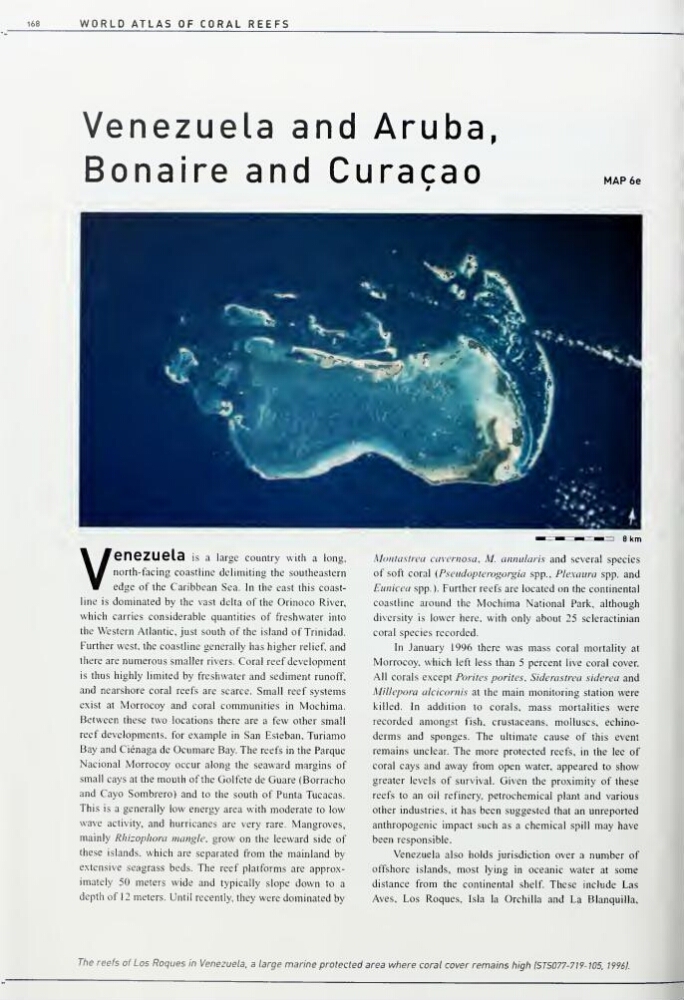
The reefs of Los Roques in Venezuela, a large marine protected area where coral cover remains high ISTS077-719- 105, 19961.
WORLD ATLAS OF CORAL REEFS
Venezuela and Aruba,
Bonaire and Curacao
MAP6e
V6n6ZU6l3
is a large country with a long,
north-facing coastline delimiting the southeastern
edge of the Caribbean Sea. In the east this coastline is dominated by the vast delta of the Orinoco River,
which carries considerable quantities of freshwater into
the Western Atlantic, just south of the island of Trinidad.
Further west, the coastline generally has higher relief, and
there are numerous smaller rivers. Coral reef development
is thus highly limited by freshwater and sediment runoff,
and nearshore coral reefs are scarce. Small reef systems
exist at Morrocoy and coral communities in Mochima.
Between these two locations there are a few other small
reef developments, for example in San Esteban, Turiamo
Bay and Cienaga de Ocumare Bay. The reefs in the Parque
Nacional Morrocoy occur along the seaward margins of
small cays at the mouth of the Golfete de Guare (Borracho
and Cayo Sombrero) and to the south of Punta Tucacas.
This is a generally low energy area with moderate to low
wave activity, and hurricanes are very rare. Mangroves,
mainly Rhizophora mangle, grow on the leeward side of
these islands, which are separated from the mainland by
extensive seagrass beds. The reef platforms are approximately 50 meters wide and typically slope down to a
depth of 12 meters. Until recently, they were dominated by
Montaslrea cavernosa, M. annularis and several species
of soft coral (Pseiidoplerogorgia spp., Plexaura spp. and
Eunicea spp.). Further reefs are located on the continental
coastline around the Mochima National Park, although
diversity is lower here, with only about 25 scleractinian
coral species recorded.
In January 1996 there was mass coral mortality at
Morrocoy, which left less than 5 percent live coral cover
All corals except Porites poriles. Sideraslrea siderea and
Millepora alcicornis at the main monitoring station were
killed. In addition to corals, mass mortalities were
recorded amongst fish, crustaceans, molluscs, echinoderms and sponges. The ultimate cause of this event
remains unclear. The more protected reefs, in the lee of
coral cays and away from open water, appeared to show
greater levels of survival. Given the proximity of these
reefs to an oil refinery, petrochemical plant and various
other industries, it has been suggested that an unreported
anthropogenic impact such as a chemical spill may have
been responsible.
Venezuela also holds jurisdiction over a number of
offshore islands, most lying in oceanic water at some
distance from the continental shelf These include Las
Aves, Los Roques, Isla la Orchilla and La Blanquilla,
The reefs of Los Roques in Venezuela, a large marine protected area where coral cover remains high ISTS077-719- 105, 19961.