

Eastern Caribbean and Atlantic
considerable here, but numbers are now reported to be
increasing. Coral bleaching in the late 1980s caused
significant mortality, and a major bleaching event was
also observed in 1998, though little associated mortality
appears to have occurred.
Puerto Rico has one of the most dynamic economies
in the Caribbean and tourism has traditionally been an
important source of income, with estimated arrivals of
nearly 4 million people in 1993. Construction and tourism
were the leading sectors in the economy in 1998, and this
has had considerable impacts on the reefs. Clearance of
over 75 percent of Puerto Ricos mangroves, combined
with dredging, agricultural runoff, pollution from untreated sewage, and sedimentation from forest clearance
have had a considerable impact on most coastal reefs.
Although there are no big commercial fisheries, smallscale fisheries are significant, with a total catch of over
1
600 tons in 1996. Overfishing of large predators,
parrotfishes and spiny lobsters is widely reported. Oil
spills have further impacted reefs in some areas. The
offshore island of Vieques is used by the US military as a
bombing range, resulting in many craters on the reefs
measuring some 5-13 meters in diameter Whether the
positive impacts associated with the exclusion of fishers
and tourists from these reefs by the military compensates
for this destruction is still a matter of some controversy.
Efforts to control some of the more damaging
activities and protect some of the reefs from further
decline are now underway. A number of marine protected
areas have been designated, together with seasonal fishery
on some spawning aggregations. New legislation is being
developed to begin to address some of the pollution
problems of the area.
US Virgin Islands
Coral reefs are widespread around all of the main islands.
These are mostly fringing reefs, but there is a small barrier
reef off St. Croix, and there are a number of offshore patch
reefs and bank structures.
Nowhere else in the Caribbean have the combined
effects of hurricanes and disease on coral reef population
structure been more pronounced than in the US Virgin
Islands. In 1976 live coral cover on the fore reef at Buck
Island, dominated by Acropora palmata. was 85 percent.
Since then, eight hurricanes have caused serious physical
damage to these reefs. Hurricane Hugo, in 1989, was
undoubtedly the most severe, but in 1995 Hurricanes Luis
and Marilyn hit the islands within a ten-day period and
caused extensive damage in some areas. Others were less
affected, either because of the uneven impacts of the storms
themselves or because there was so little coral remaining to
be damaged. White band disease has also greatly impacted
the region and killed many acroporid corals, with as many
as 64 percent of all colonies being affected. Other diseases
have also hit less abundant species in the Virgin Islands,
such as Agaricia agaricites and Stephanocoenia michelinii.
The situation in St. John is similar, with 80 percent of
Acropora palmata colonies in Hawksnest Bay being lost
in just seven months. Coral cover around St. John was
about 30 percent before Hurricane Hugo reduced it to
some 8-18 percent. In Lameshur Bay the dominant coral,
Montastrea annularis, declined by about 35 percent and
there has been no substantial recovery even though coral
recruitment is occurring. Despite extensive bleaching in
1998, there was little associated mortality.
Tourism is the islands' primary economic activity,
accounting for more than 70 percent of gross domestic
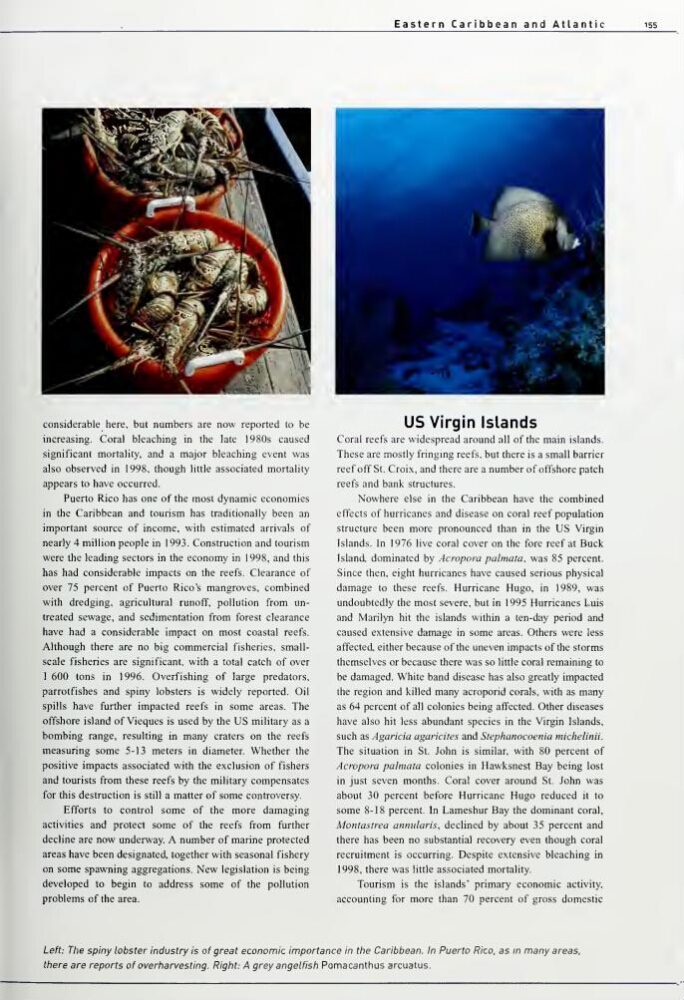
Left: The spiny lobster industry is of great economic importance in the Caribbean. In Puerto Rico, as in many areas,
there are reports of overharvesting. Right: A grey angelfish Pomacanthus arcuatus.
considerable here, but numbers are now reported to be
increasing. Coral bleaching in the late 1980s caused
significant mortality, and a major bleaching event was
also observed in 1998, though little associated mortality
appears to have occurred.
Puerto Rico has one of the most dynamic economies
in the Caribbean and tourism has traditionally been an
important source of income, with estimated arrivals of
nearly 4 million people in 1993. Construction and tourism
were the leading sectors in the economy in 1998, and this
has had considerable impacts on the reefs. Clearance of
over 75 percent of Puerto Ricos mangroves, combined
with dredging, agricultural runoff, pollution from untreated sewage, and sedimentation from forest clearance
have had a considerable impact on most coastal reefs.
Although there are no big commercial fisheries, smallscale fisheries are significant, with a total catch of over
1
600 tons in 1996. Overfishing of large predators,
parrotfishes and spiny lobsters is widely reported. Oil
spills have further impacted reefs in some areas. The
offshore island of Vieques is used by the US military as a
bombing range, resulting in many craters on the reefs
measuring some 5-13 meters in diameter Whether the
positive impacts associated with the exclusion of fishers
and tourists from these reefs by the military compensates
for this destruction is still a matter of some controversy.
Efforts to control some of the more damaging
activities and protect some of the reefs from further
decline are now underway. A number of marine protected
areas have been designated, together with seasonal fishery
on some spawning aggregations. New legislation is being
developed to begin to address some of the pollution
problems of the area.
US Virgin Islands
Coral reefs are widespread around all of the main islands.
These are mostly fringing reefs, but there is a small barrier
reef off St. Croix, and there are a number of offshore patch
reefs and bank structures.
Nowhere else in the Caribbean have the combined
effects of hurricanes and disease on coral reef population
structure been more pronounced than in the US Virgin
Islands. In 1976 live coral cover on the fore reef at Buck
Island, dominated by Acropora palmata. was 85 percent.
Since then, eight hurricanes have caused serious physical
damage to these reefs. Hurricane Hugo, in 1989, was
undoubtedly the most severe, but in 1995 Hurricanes Luis
and Marilyn hit the islands within a ten-day period and
caused extensive damage in some areas. Others were less
affected, either because of the uneven impacts of the storms
themselves or because there was so little coral remaining to
be damaged. White band disease has also greatly impacted
the region and killed many acroporid corals, with as many
as 64 percent of all colonies being affected. Other diseases
have also hit less abundant species in the Virgin Islands,
such as Agaricia agaricites and Stephanocoenia michelinii.
The situation in St. John is similar, with 80 percent of
Acropora palmata colonies in Hawksnest Bay being lost
in just seven months. Coral cover around St. John was
about 30 percent before Hurricane Hugo reduced it to
some 8-18 percent. In Lameshur Bay the dominant coral,
Montastrea annularis, declined by about 35 percent and
there has been no substantial recovery even though coral
recruitment is occurring. Despite extensive bleaching in
1998, there was little associated mortality.
Tourism is the islands' primary economic activity,
accounting for more than 70 percent of gross domestic
Left: The spiny lobster industry is of great economic importance in the Caribbean. In Puerto Rico, as in many areas,
there are reports of overharvesting. Right: A grey angelfish Pomacanthus arcuatus.