

Western Caribbean
Ecuador
A few coral communities occur on the mainland coast of
Ecuador and one true reef at Machalilla. However, it is in
the Galapagos Islands that reefs are best developed. This
archipelago is influenced by a major surface current, the
South Equatorial Current, which flows from the east,
largely fed by the cool Peru Oceanic Current (20-24°C)
and the colder Peru Coastal Current (15°C), This current
is strongly driven by the nearly constant southeast trade
winds, while additional impetus is given by the Panama
Current which flows south from the Panama Bight in
December to January. Below the South Equatorial
Current, an easterly Equatorial Undercurrent is generated
at a depth of 100 meters, which is deflected to the surface
by Fernandina and Isabela. Cool nutrient-rich water is
therefore present all year round (except during El Nifio
events) and this restricts coral growth and reef development to the eastern sides of Isabela. Santa Cruz and the
northern coasts of San Cristobal.
For the most part these reefs are poorly developed
patches and do not form true fringing structures. Species
diversity is also low. Although the reefs are well protected
there have been some impacts from bleaching and bioerosion. Fishing pressures have recently increased dramatically in a few areas, notably for the export trade in sea
cucumbers and shark. Significant bleaching also impacted
these reefs, both in 1982-83 and in 1997-98. with both
events causing considerable coral mortality.
Although the overall human population is low in the
Galapagos, the fishing lobby is significant and powerful.
In nearshore waters, the most important industrial fisheries include lobster and sea cucumber, while numbers of
fishers have grown considerably. The number of lobster
fishers alone grew from 500 in 1999 to nearly I 000 in 2000.
Efforts to place restrictions on these industries have led to
considerable hostility and violence by the fishers, but also to
some weakening of catch limits as a form of appeasement.
^^1
or
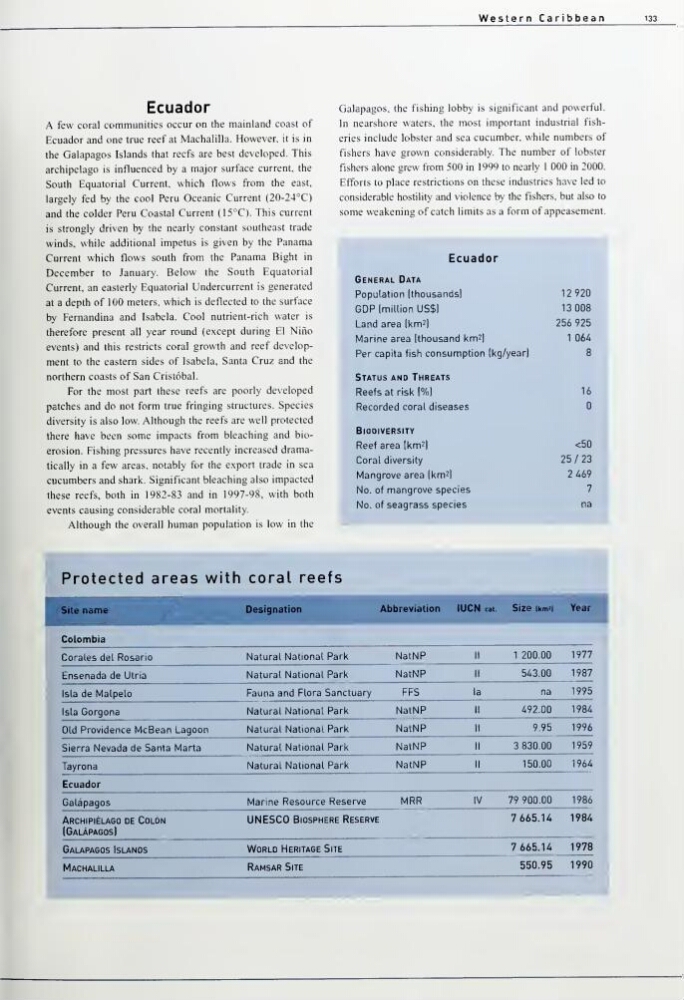
General Data
Population (thousands!
12 920
GDP Imillion US$1
13 008
Land area Ikm^l
256 925
Marine area (thousand km^l
1 06i
Per capita fish consumption Ikg/yearj
8
Status and Threats
Reefs at risk |%1
16
Recorded coral diseases
Biodiversity
Reef area Ikiri'l
<50
Coral diversity
25/23
Mangrove area (km^l
2^69
No. ol mangrove species
7
No. of seagrass species
na
^Protected areas with
1
,
^
coral reefs
^"
H Site name
Designation
Abbreviation
lUCN cat.
Size IkmM
Y..r
Colombia
Corales del Rosario
Natural National Park
NatNP
II
1 200.00
1977
Ensenada de Utria
Natural National Park
NatNP
II
543.00
1987
Isla de Malpelo
Fauna and Flora Sanctuary
FFS
la
na
1995
Isla Gorgona
Natural National Park
NatNP
II
492.00
1984
Old Providence McBean Lagoon
Natural National Park
NatNP
II
9.95
1996
Sierra Nevada de Santa Marta
Natural National Park
NatNP
II
3 830.00
1959
Tayrona
Natural National Park
NatNP
II
150.00
1964
Ecuador
Galapagos
Marine Resource Reserve
MRR
IV
79 900.00
1986
Archipielago de Colon
(Galapagos)
UNESCO Biosphere Reserve
7 665.U
1984
1978
Galapagos Islands
World Heritage Site
7 665.U
Machalilla
Ramsar Site
550.95
1990
Ecuador
A few coral communities occur on the mainland coast of
Ecuador and one true reef at Machalilla. However, it is in
the Galapagos Islands that reefs are best developed. This
archipelago is influenced by a major surface current, the
South Equatorial Current, which flows from the east,
largely fed by the cool Peru Oceanic Current (20-24°C)
and the colder Peru Coastal Current (15°C), This current
is strongly driven by the nearly constant southeast trade
winds, while additional impetus is given by the Panama
Current which flows south from the Panama Bight in
December to January. Below the South Equatorial
Current, an easterly Equatorial Undercurrent is generated
at a depth of 100 meters, which is deflected to the surface
by Fernandina and Isabela. Cool nutrient-rich water is
therefore present all year round (except during El Nifio
events) and this restricts coral growth and reef development to the eastern sides of Isabela. Santa Cruz and the
northern coasts of San Cristobal.
For the most part these reefs are poorly developed
patches and do not form true fringing structures. Species
diversity is also low. Although the reefs are well protected
there have been some impacts from bleaching and bioerosion. Fishing pressures have recently increased dramatically in a few areas, notably for the export trade in sea
cucumbers and shark. Significant bleaching also impacted
these reefs, both in 1982-83 and in 1997-98. with both
events causing considerable coral mortality.
Although the overall human population is low in the
Galapagos, the fishing lobby is significant and powerful.
In nearshore waters, the most important industrial fisheries include lobster and sea cucumber, while numbers of
fishers have grown considerably. The number of lobster
fishers alone grew from 500 in 1999 to nearly I 000 in 2000.
Efforts to place restrictions on these industries have led to
considerable hostility and violence by the fishers, but also to
some weakening of catch limits as a form of appeasement.
^^1
or
General Data
Population (thousands!
12 920
GDP Imillion US$1
13 008
Land area Ikm^l
256 925
Marine area (thousand km^l
1 06i
Per capita fish consumption Ikg/yearj
8
Status and Threats
Reefs at risk |%1
16
Recorded coral diseases
Biodiversity
Reef area Ikiri'l
<50
Coral diversity
25/23
Mangrove area (km^l
2^69
No. ol mangrove species
7
No. of seagrass species
na
^Protected areas with
1
,
^
coral reefs
^"
H Site name
Designation
Abbreviation
lUCN cat.
Size IkmM
Y..r
Colombia
Corales del Rosario
Natural National Park
NatNP
II
1 200.00
1977
Ensenada de Utria
Natural National Park
NatNP
II
543.00
1987
Isla de Malpelo
Fauna and Flora Sanctuary
FFS
la
na
1995
Isla Gorgona
Natural National Park
NatNP
II
492.00
1984
Old Providence McBean Lagoon
Natural National Park
NatNP
II
9.95
1996
Sierra Nevada de Santa Marta
Natural National Park
NatNP
II
3 830.00
1959
Tayrona
Natural National Park
NatNP
II
150.00
1964
Ecuador
Galapagos
Marine Resource Reserve
MRR
IV
79 900.00
1986
Archipielago de Colon
(Galapagos)
UNESCO Biosphere Reserve
7 665.U
1984
1978
Galapagos Islands
World Heritage Site
7 665.U
Machalilla
Ramsar Site
550.95
1990