

WORLD ATLAS OF CORAL REEFS
to the presence of a monitoring site. Most of the shallow
nearshore reefs have dechned over the last decade so that
Hve coral cover is now less than 10 percent. An increase in
sewage is the probable cause, especially because the island
is quite densely populated (500 people per square kilometer)
in comparison to the rest of the coast (5 people per square
kilometer). Waste from two fish processing plants, which
produce 40 percent of the country's seafood exports, may be
polluting nearshore waters. Deeper reefs have remained
more stable, with an average cover of 38 percent algae, 22
percent hard coral, I percent sponges and 1 percent soft
corals. No bleaching has been observed. The effects of
Hurricane Mitch on the coral reefs of Nicaragua in late 1998
are unknown.
Indigenous Miskito Indians, together with some other
communities, use the reefs in the north of the country for
artisanal fisheries. For the most part this would appear
sustainable, however the green turtle harvest is very high
(14 000 per year) and in urgent need of control. Illegal
fishing from neighboring countries may be reducing fish
stocks in some places.
Guatemala and El Salvador
There are no true reefs in either Guatemala or El Salvador.
Guatemala has a few small coral communities in the Gulf
of Honduras, but none are known from its longer Pacific
coast. El Salvador is reported to have small coral communities at Los Cobanos although there is no available
information describing them.
Protected areas with coral reefs
I Site name
Designation
Honduras
Abbreviation
lUCN cat.
Size ikm:)
Year
Bahia de Chismuyo
Wildlife Refuge
WRef
IV
290.00
1992
Cayos Cochinos
Biological Reserve
BIR
V
i60.00
1993
El Jicarito
Wildlife Refuge
WRef
IV
15.41
1992
El Quebrachal
Wildlife Refuge
WRef
IV
1.98
1992
Guameru
Wildlife Refuge
WRef
IV
na
1992
Guapinol
Wildlife Refuge
WRef
IV
na
1992
Islas del Cisne
Marine National Park
IvINP
II
na
1991
Jeanette Kavjas
National Parl<
NP
II
781.62
1988
La Alemania
Wildlife Refuge
WRef
IV
na
1992
Laguna de Guaymoreto
Wildlife Refuge
WRef
IV
50.00
1992
Las Iguanas
Wildlife Refuge
WRef
IV
U.26
1992
Montecristo
Wildlife Refuge
WRef
IV
na
1992
Punta Isopo
Wildlife Refuge
WRef
IV
112.00
1992
Ragged Cay
Wildlife Refuge
WRef
IV
na
na
Teonostal
Wildlife Refuge
WRef
IV
na
1992
Parque Nacional Jeanette Kawas
Ramsar Site
781.50
1995
Refugio de Vida Silvestre
Punta Izopo
Ramsar Site
112.00
1996
Nicaragua
Cayos Miskitos
fvlarine Reserve
RMar
la
500.00
1991
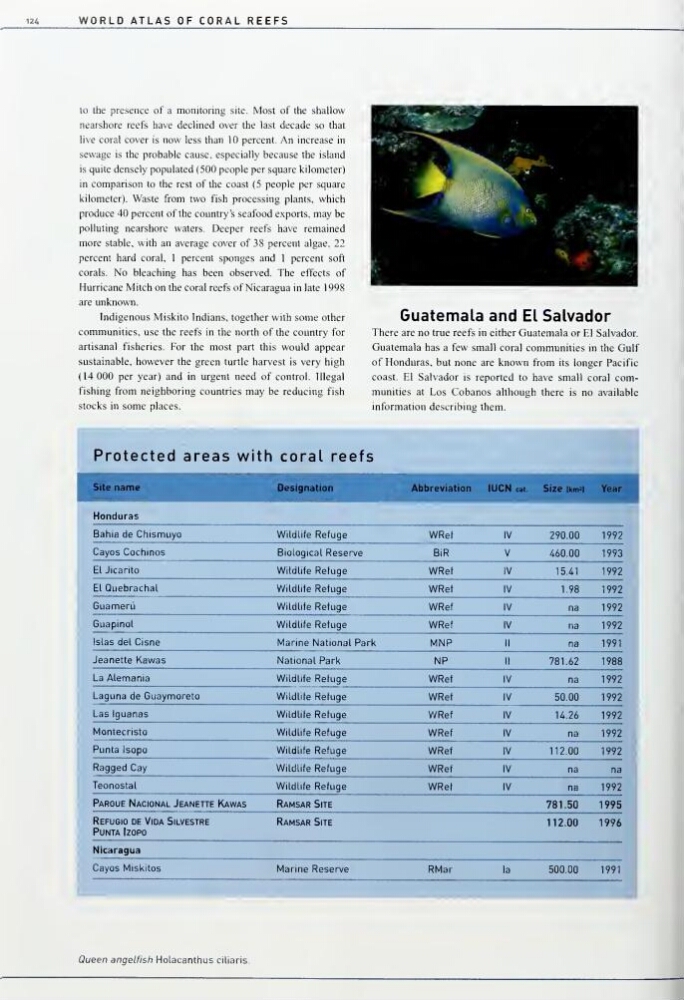
Queen angelfish Holacanthus ciliaris.
to the presence of a monitoring site. Most of the shallow
nearshore reefs have dechned over the last decade so that
Hve coral cover is now less than 10 percent. An increase in
sewage is the probable cause, especially because the island
is quite densely populated (500 people per square kilometer)
in comparison to the rest of the coast (5 people per square
kilometer). Waste from two fish processing plants, which
produce 40 percent of the country's seafood exports, may be
polluting nearshore waters. Deeper reefs have remained
more stable, with an average cover of 38 percent algae, 22
percent hard coral, I percent sponges and 1 percent soft
corals. No bleaching has been observed. The effects of
Hurricane Mitch on the coral reefs of Nicaragua in late 1998
are unknown.
Indigenous Miskito Indians, together with some other
communities, use the reefs in the north of the country for
artisanal fisheries. For the most part this would appear
sustainable, however the green turtle harvest is very high
(14 000 per year) and in urgent need of control. Illegal
fishing from neighboring countries may be reducing fish
stocks in some places.
Guatemala and El Salvador
There are no true reefs in either Guatemala or El Salvador.
Guatemala has a few small coral communities in the Gulf
of Honduras, but none are known from its longer Pacific
coast. El Salvador is reported to have small coral communities at Los Cobanos although there is no available
information describing them.
Protected areas with coral reefs
I Site name
Designation
Honduras
Abbreviation
lUCN cat.
Size ikm:)
Year
Bahia de Chismuyo
Wildlife Refuge
WRef
IV
290.00
1992
Cayos Cochinos
Biological Reserve
BIR
V
i60.00
1993
El Jicarito
Wildlife Refuge
WRef
IV
15.41
1992
El Quebrachal
Wildlife Refuge
WRef
IV
1.98
1992
Guameru
Wildlife Refuge
WRef
IV
na
1992
Guapinol
Wildlife Refuge
WRef
IV
na
1992
Islas del Cisne
Marine National Park
IvINP
II
na
1991
Jeanette Kavjas
National Parl<
NP
II
781.62
1988
La Alemania
Wildlife Refuge
WRef
IV
na
1992
Laguna de Guaymoreto
Wildlife Refuge
WRef
IV
50.00
1992
Las Iguanas
Wildlife Refuge
WRef
IV
U.26
1992
Montecristo
Wildlife Refuge
WRef
IV
na
1992
Punta Isopo
Wildlife Refuge
WRef
IV
112.00
1992
Ragged Cay
Wildlife Refuge
WRef
IV
na
na
Teonostal
Wildlife Refuge
WRef
IV
na
1992
Parque Nacional Jeanette Kawas
Ramsar Site
781.50
1995
Refugio de Vida Silvestre
Punta Izopo
Ramsar Site
112.00
1996
Nicaragua
Cayos Miskitos
fvlarine Reserve
RMar
la
500.00
1991
Queen angelfish Holacanthus ciliaris.