

Western Caribbean
117
Belize
MAP5C
Although
a relatively small country. Belize has some
of the most extensive coral reef resources in the
region. The coastline is fringed by a shallow shelf
with a barrier reef running along its outer edge. The Belize
Barrier Reef is the longest in the Caribbean. 230 kilometers
in length, though there are barrier-like reef tracts in Florida
and Cuba which are considerably longer. To the north the
barrier reef becomes joined to the mainland at Ambergris
Cay, a southerly extension of the Yucatan Peninsula. At
this point the reef system becomes fringing, and continues
north along the coastline of Mexico. These reefs, together
with others to the south in Honduras, are sometimes known
as the Meso-American Reef, in recognition of the interconnected nature of their ecosystems.
The mainland coast is dominated by narrow sandy
beaches or mangrove forests, often associated with river
deltas. The development of reefs along the mainland is
extremely limited by fluctuations in turbidity and
sediments. Some reefs do occur in the south between
Placencia and PuntaYcacos, but have low species richness
and are dominated by sediment-resistant genera such as
Siderasnea and Porites. The lagoon is 20-40 kilometers
wide, typically only a few meters deep in the north, but
reaching 50 meters in the south. It supports some of the
most extensive seagrass beds in the Caribbean. Patch reefs
occur across the whole shelf, though they are much more
abundant in the south. These patch reefs vary considerably
in size from small collections of corals to large reefs many
tens of meters in diameter, as their form and species
composition are determined largely by the location on the
shelf, wave and current energy, and depth. Rhomboidal
atoll-like structures called faros are very unusual features
associated with the southern shelf They are believed to be
formed by corals growing on top of submerged sand or
rubble cays. The lagoon also houses regionally important
populations of the Caribbean manatee, although there are
concerns that illegal hunting may be reducing its numbers,
particularly in the south of the country. The barrier reef
Itself typically consists of a rubble strewn reef flat with
numerous mangrove cays on its central and landward side,
fronted by a reef crest. The outer slope is best developed
(and studied) in the central section, where the reefs are
typically long and unbroken with a deep spur and groove
system which in some areas becomes a double ridge
separated by a rubble-filled channel. The reef is split by a
series of channels, and in the south it breaks up and
becomes partially submerged.
The other striking feature of Belizean reefs is three
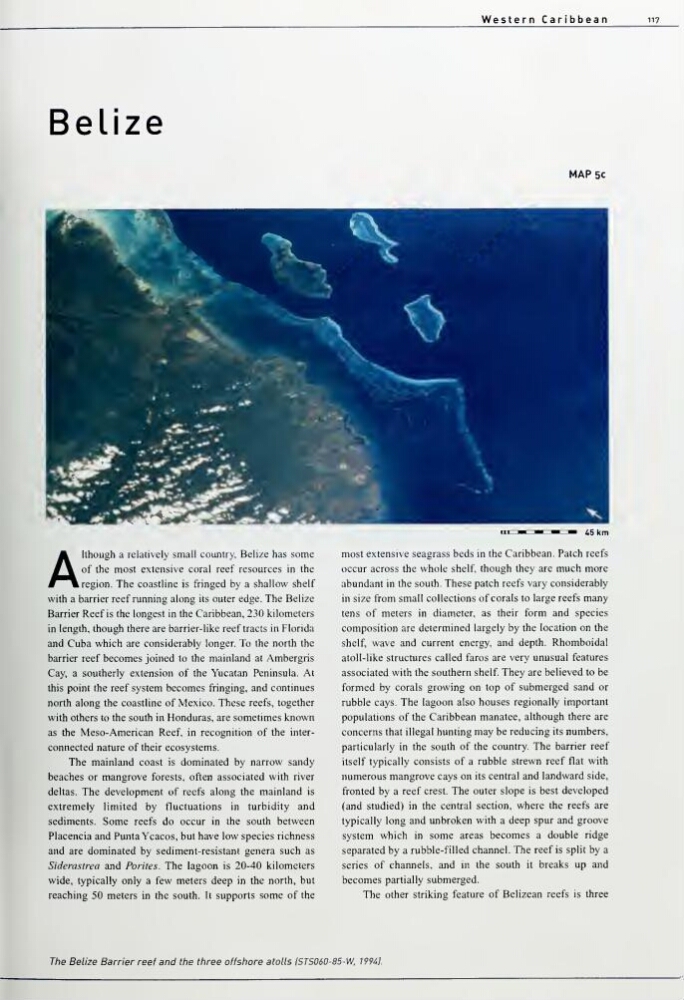
The Belize Barrier reef and the three offshore atoUs ISTS060-85-W, 19941.
117
Belize
MAP5C
Although
a relatively small country. Belize has some
of the most extensive coral reef resources in the
region. The coastline is fringed by a shallow shelf
with a barrier reef running along its outer edge. The Belize
Barrier Reef is the longest in the Caribbean. 230 kilometers
in length, though there are barrier-like reef tracts in Florida
and Cuba which are considerably longer. To the north the
barrier reef becomes joined to the mainland at Ambergris
Cay, a southerly extension of the Yucatan Peninsula. At
this point the reef system becomes fringing, and continues
north along the coastline of Mexico. These reefs, together
with others to the south in Honduras, are sometimes known
as the Meso-American Reef, in recognition of the interconnected nature of their ecosystems.
The mainland coast is dominated by narrow sandy
beaches or mangrove forests, often associated with river
deltas. The development of reefs along the mainland is
extremely limited by fluctuations in turbidity and
sediments. Some reefs do occur in the south between
Placencia and PuntaYcacos, but have low species richness
and are dominated by sediment-resistant genera such as
Siderasnea and Porites. The lagoon is 20-40 kilometers
wide, typically only a few meters deep in the north, but
reaching 50 meters in the south. It supports some of the
most extensive seagrass beds in the Caribbean. Patch reefs
occur across the whole shelf, though they are much more
abundant in the south. These patch reefs vary considerably
in size from small collections of corals to large reefs many
tens of meters in diameter, as their form and species
composition are determined largely by the location on the
shelf, wave and current energy, and depth. Rhomboidal
atoll-like structures called faros are very unusual features
associated with the southern shelf They are believed to be
formed by corals growing on top of submerged sand or
rubble cays. The lagoon also houses regionally important
populations of the Caribbean manatee, although there are
concerns that illegal hunting may be reducing its numbers,
particularly in the south of the country. The barrier reef
Itself typically consists of a rubble strewn reef flat with
numerous mangrove cays on its central and landward side,
fronted by a reef crest. The outer slope is best developed
(and studied) in the central section, where the reefs are
typically long and unbroken with a deep spur and groove
system which in some areas becomes a double ridge
separated by a rubble-filled channel. The reef is split by a
series of channels, and in the south it breaks up and
becomes partially submerged.
The other striking feature of Belizean reefs is three
The Belize Barrier reef and the three offshore atoUs ISTS060-85-W, 19941.