

110
WORLD ATLAS OF CORAL REEFS
Chapter 5
Western Caribbean
11 km
This
region incorporates some of the largest
islands in the Caribbean, including Cuba, as
well as the mainland of Central America
from Mexico south to Colombia, It also
harbors considerable areas of coral reef.
The reefs of Discovery Bay in Jamaica have been the
subject of intensive studies since the 1950s, and
together with the extensive barrier and fringing reef
systems of Belize and the Caribbean coastline of
t^lexico are among the best known reefs of the region.
Reef development across the continental shelf of
Nicaragua is poorly documented but believed to be
extensive. Cuba has considerable though little-known
reefs on all sides, particularly associated with the
long-shore archipelagos which border more than half
of its coastline.
Human impacts on the reefs in this region are
highly varied. Some, such as those in Jamaica, have
been heavily utilized by humans for many decades. In
recent years these have been severely degraded by
a combination of the Diadema die-off and disease,
together with direct human impacts, notably overfishing,
but also sedimentation and nutrient
pollution. Others have been protected by their
distance from the coast along with relatively low
human population densities.
The East Pacific coastline of the Americas holds a
number of unique tropical coral assemblages. For the
most part these do not form true reefs, although
there are some reef structures in a few locations.
Biodiversity is low on the reefs, though they contain a
number of unique and important species. The diversity of
reef corals in this region was much reduced during the
Pliocene/Pleistocene glaciations and has not recovered.
This region is regularly impacted by extreme
environmental conditions. Coastal waters are typically
cool and rich in nutrients, associated with upwellings,
but there is also occasional extreme warming linked to
El Nino Southern Oscillation (ENSO) events. This can
cause widespread coral bleaching and subsequent
mortality, driving localized extinctions of particular
species. The frequent occurrence of such events further helps to explain the lack of more extensive reef
development. Clipperton Atoll is the only major reef
structure on the western edge of this region. Because
it is administered from French Polynesia and shares
some features with the Indo-Pacific reefs, it is covered
in Chapter 14.
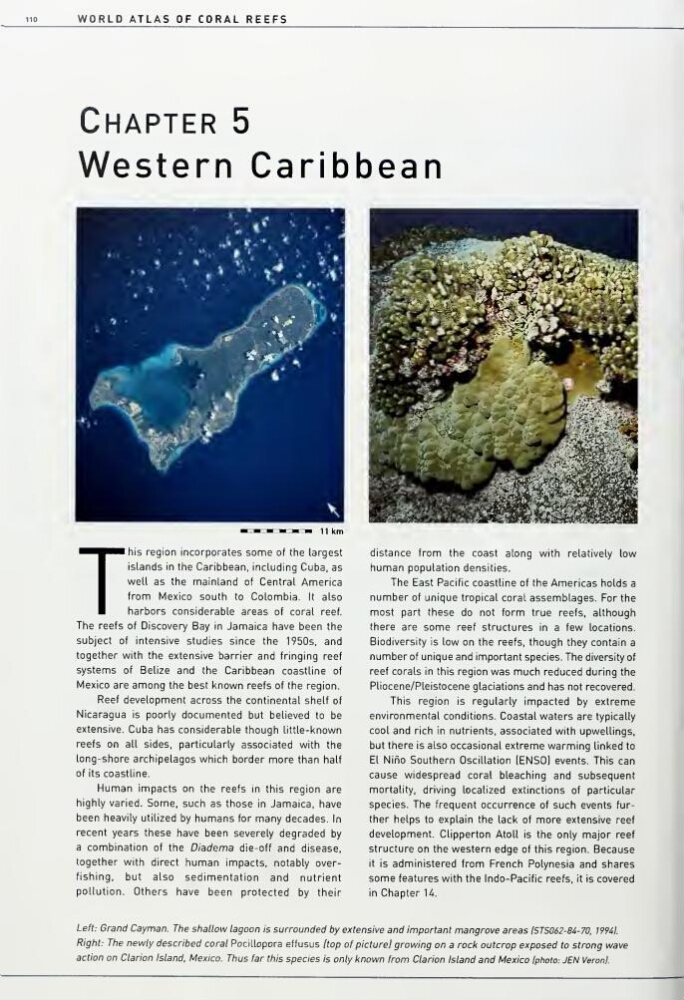
Left: Grand Cayman. The shallow lagoon is surrounded by extensive and important mangrove areas ISTS062-8i-70, 19941.
Right: The newly described coral Pocillopora effusus Itop of picturel growing on a rock outcrop exposed to strong wave
action on Clarion Island, Mexico. Thus far this species is only known from Clarion Island and Mexico Iphoto: JEN Veronl.
WORLD ATLAS OF CORAL REEFS
Chapter 5
Western Caribbean
11 km
This
region incorporates some of the largest
islands in the Caribbean, including Cuba, as
well as the mainland of Central America
from Mexico south to Colombia, It also
harbors considerable areas of coral reef.
The reefs of Discovery Bay in Jamaica have been the
subject of intensive studies since the 1950s, and
together with the extensive barrier and fringing reef
systems of Belize and the Caribbean coastline of
t^lexico are among the best known reefs of the region.
Reef development across the continental shelf of
Nicaragua is poorly documented but believed to be
extensive. Cuba has considerable though little-known
reefs on all sides, particularly associated with the
long-shore archipelagos which border more than half
of its coastline.
Human impacts on the reefs in this region are
highly varied. Some, such as those in Jamaica, have
been heavily utilized by humans for many decades. In
recent years these have been severely degraded by
a combination of the Diadema die-off and disease,
together with direct human impacts, notably overfishing,
but also sedimentation and nutrient
pollution. Others have been protected by their
distance from the coast along with relatively low
human population densities.
The East Pacific coastline of the Americas holds a
number of unique tropical coral assemblages. For the
most part these do not form true reefs, although
there are some reef structures in a few locations.
Biodiversity is low on the reefs, though they contain a
number of unique and important species. The diversity of
reef corals in this region was much reduced during the
Pliocene/Pleistocene glaciations and has not recovered.
This region is regularly impacted by extreme
environmental conditions. Coastal waters are typically
cool and rich in nutrients, associated with upwellings,
but there is also occasional extreme warming linked to
El Nino Southern Oscillation (ENSO) events. This can
cause widespread coral bleaching and subsequent
mortality, driving localized extinctions of particular
species. The frequent occurrence of such events further helps to explain the lack of more extensive reef
development. Clipperton Atoll is the only major reef
structure on the western edge of this region. Because
it is administered from French Polynesia and shares
some features with the Indo-Pacific reefs, it is covered
in Chapter 14.
Left: Grand Cayman. The shallow lagoon is surrounded by extensive and important mangrove areas ISTS062-8i-70, 19941.
Right: The newly described coral Pocillopora effusus Itop of picturel growing on a rock outcrop exposed to strong wave
action on Clarion Island, Mexico. Thus far this species is only known from Clarion Island and Mexico Iphoto: JEN Veronl.