

WORLD ATLAS OF CORAL REEFS
I
Protected areas with coral reefs
Site name
Designation
Abbreviation
lUCN cat.
Size ikm^i
Year
Turl(s and Caicos
Fort George Land and Sea
National Park
NP
IV
4.94
1987
French, Bush and Se;al Cays
Sanctuary
S
IV
0.20
1987
Grand Turk Cays,
Land and Sea
National Park
NP
IV
1.56
1987
West Caicos Marine
National Park
NP
IV
3.97
1992
North, Middle
AND East Caicos Islands
Ramsar Site
544.00
1990
have been reported and are thought to have contributed to
extensive losses of Acropora. though considerable stands of
Acropora palmala still remain.
The Turks and Caicos economy is based on tourism,
fishing and offshore financial services. Nearly all capital
goods and food for domestic consumption are imported,
and there is minimal manufacturing and agriculture. With
no rivers, terrestrial runoff is very low. In 1999, over
120 000 visitors were recorded, with the USA being the
primary source of tourists. The primary export fisheries are
conch and lobster, with exports of 646 tons and 314 tons
respectively in 1998, mainly to the USA. Reef fish are
largely taken for internal markets, generally sustainably.
Nutrient discharge is a localized problem, notably
on Providenciales, resulting from coastal development,
including hotels and marinas, but also conch aquaculture
and fish processing plants. Direct damage to the reefs by
divers may be a localized problem at some dive sites.
Generally the reefs of the Turks and Caicos Islands show
little signs of being adversely affected by human activity,
however development in the tourism sector may pose a
significant threat, notably newly proposed harbor and
tourist developments on East and South Caicos. A
considerable number of marine protected areas have been
designated, although active management of these is limited
away from Providenciales.
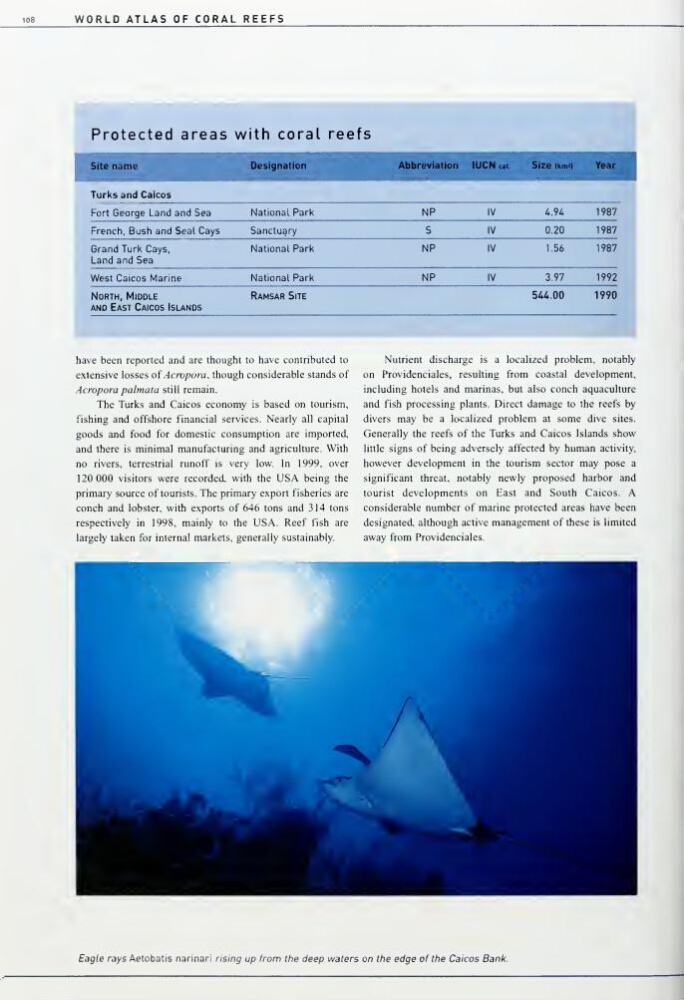
Eagle rays Aetobatis narinari rising up from the deep waters on the edge of the Caicos Bank.
I
Protected areas with coral reefs
Site name
Designation
Abbreviation
lUCN cat.
Size ikm^i
Year
Turl(s and Caicos
Fort George Land and Sea
National Park
NP
IV
4.94
1987
French, Bush and Se;al Cays
Sanctuary
S
IV
0.20
1987
Grand Turk Cays,
Land and Sea
National Park
NP
IV
1.56
1987
West Caicos Marine
National Park
NP
IV
3.97
1992
North, Middle
AND East Caicos Islands
Ramsar Site
544.00
1990
have been reported and are thought to have contributed to
extensive losses of Acropora. though considerable stands of
Acropora palmala still remain.
The Turks and Caicos economy is based on tourism,
fishing and offshore financial services. Nearly all capital
goods and food for domestic consumption are imported,
and there is minimal manufacturing and agriculture. With
no rivers, terrestrial runoff is very low. In 1999, over
120 000 visitors were recorded, with the USA being the
primary source of tourists. The primary export fisheries are
conch and lobster, with exports of 646 tons and 314 tons
respectively in 1998, mainly to the USA. Reef fish are
largely taken for internal markets, generally sustainably.
Nutrient discharge is a localized problem, notably
on Providenciales, resulting from coastal development,
including hotels and marinas, but also conch aquaculture
and fish processing plants. Direct damage to the reefs by
divers may be a localized problem at some dive sites.
Generally the reefs of the Turks and Caicos Islands show
little signs of being adversely affected by human activity,
however development in the tourism sector may pose a
significant threat, notably newly proposed harbor and
tourist developments on East and South Caicos. A
considerable number of marine protected areas have been
designated, although active management of these is limited
away from Providenciales.
Eagle rays Aetobatis narinari rising up from the deep waters on the edge of the Caicos Bank.