

Northern Caribbean
105
I
p
Protected areas with coral reefs
Site name
Designation
Abbreviation
lUCN cat.
Size Ikm!)
Year
Bahamas
Conception Island
National Park
NP
II
8.09
1973
1958
Exuma Land and Sea Park
National Park
NP
II
455.84
Inagua
National Park
NP
II
743.33
1965
Little San Salvador (Little Island)
Wild Bird Reserve
WBR
IV
1.82
1961
Pelican Cays Land and Sea
National Park
NP
II
8.50
1981
Pptprc;nn Cav
National Park
NP
II
0.01
1971
around New Providence Island. Near complete bleaching
of all the hard corals and some gorgonians was seen at
Little Inagua, Sweetings Cay, Chubb Cay, Little San
Salvador, San Salvador and Egg Islands. Samana Cay was
much less affected. There was also extensive bleaching at
Walker's Cay in the northern Bahamas, with many types of
coral affected. Some subsequent mortality was noted,
particularly at the Exuma Cays.
Edible reef animals are still common on many
Bahamian reefs, and fish stocks are generally abundant.
There is a well developed commercial and export fishery,
with total landings in 1999 close to 5 000 tons, valued
at over US$70 million. This figure includes over 2 700
tons of the very high value spiny lobster tails. There is
local overexploitation of certain stocks, including whelk
Citlariim pica, queen conch, spiny lobster and several
^i^^"'^^'
I^HHH
^^^^^^
Bahamas
1 ^^^H
General Data
t
Population Ithousandsl
295
GDP Imillion US$1
3712
Land area (km^l
12 869
Marine area (thousand km^l
652
Per capita fish consumption (kg/year)
22
Status and Threats
Reefs at risk (%1
49
Recorded coral diseases
8
Biodiversity
Reef area (km^l
3 150
Coral diversity
32/58
Mangrove area (km^l
2 332
No. of mangrove species
4
No. of seagrass species
2
species of grouper Concern has been expressed that
spawning aggregations of groupers have become the target
for spearfishers. A number of illegal fishing activities
occur which include the use of toxic chemicals, the harvesting of hawksbill turtles, the taking of undersized or
juvenile queen conch, and the collection of spiny lobster
out of season or with prohibited diving gear. Artificial
shelters are often positioned close to reefs to attract spiny
lobsters, although there is concern that these may simply
aggregate existing spiny lobsters rather than enhancing
natural stocks. There is a limited legal harvest of adult
green turtles during an open season (April-July). Sand is
still being mined from a few reef sites on a fairly small
scale. Over half of the commercial dive sites have mooring
buoys. Declines in coral cover have been recorded in some
locations. On New Providence dredging, landfill, sedimentation and the construction of a cruiseship port have
led to the loss of 60 percent of the coral reef habitat.
The Bahamas is a stable, developing nation with an
economy heavily dependent on tourism and offshore
banking. Tourism alone accounts for more than 60 percent
of gross domestic product and directly or indirectly
employs 40 percent of the archipelago's labor force.
Moderate growth in tourism receipts and a boom in the
construction of new hotels, resorts and residences has led
to localized pressures on coral reefs, but the total area is
so great that the majority of reefs are probably little
affected.
Shark feeding, a new speciality of the Bahamian dive
industry, is attracting increasing numbers of tourists.
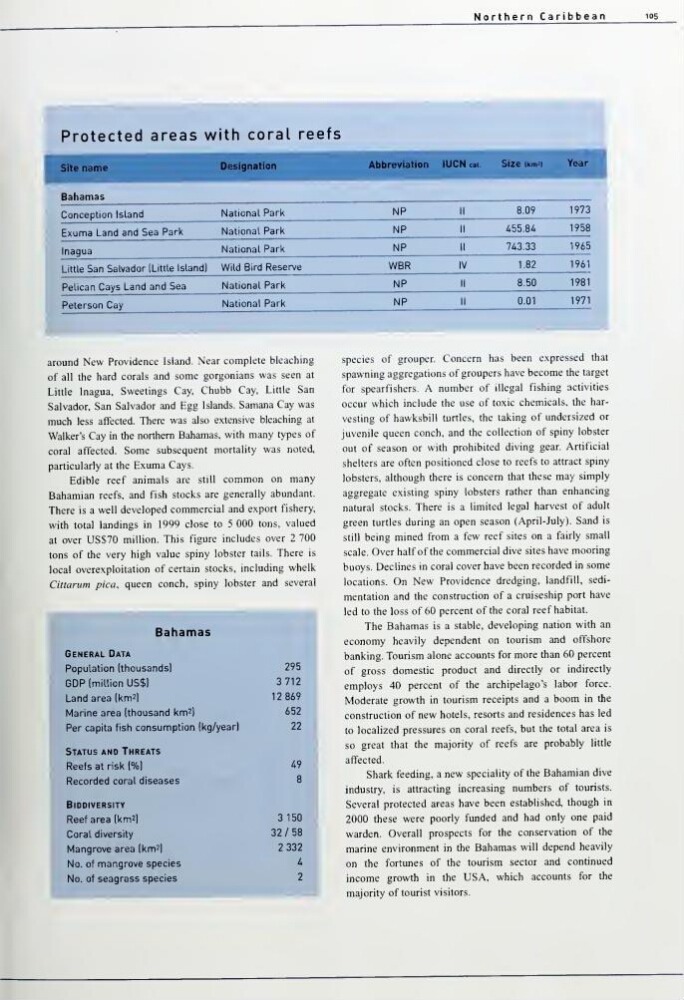
Several protected areas have been established, though in
2000 these were poorly funded and had only one paid
warden. Overall prospects for the conservation of the
marine environment in the Bahamas will depend heavily
on the fortunes of the tourism sector and continued
income growth in the USA, which accounts for the
majority of tourist visitors.
105
I
p
Protected areas with coral reefs
Site name
Designation
Abbreviation
lUCN cat.
Size Ikm!)
Year
Bahamas
Conception Island
National Park
NP
II
8.09
1973
1958
Exuma Land and Sea Park
National Park
NP
II
455.84
Inagua
National Park
NP
II
743.33
1965
Little San Salvador (Little Island)
Wild Bird Reserve
WBR
IV
1.82
1961
Pelican Cays Land and Sea
National Park
NP
II
8.50
1981
Pptprc;nn Cav
National Park
NP
II
0.01
1971
around New Providence Island. Near complete bleaching
of all the hard corals and some gorgonians was seen at
Little Inagua, Sweetings Cay, Chubb Cay, Little San
Salvador, San Salvador and Egg Islands. Samana Cay was
much less affected. There was also extensive bleaching at
Walker's Cay in the northern Bahamas, with many types of
coral affected. Some subsequent mortality was noted,
particularly at the Exuma Cays.
Edible reef animals are still common on many
Bahamian reefs, and fish stocks are generally abundant.
There is a well developed commercial and export fishery,
with total landings in 1999 close to 5 000 tons, valued
at over US$70 million. This figure includes over 2 700
tons of the very high value spiny lobster tails. There is
local overexploitation of certain stocks, including whelk
Citlariim pica, queen conch, spiny lobster and several
^i^^"'^^'
I^HHH
^^^^^^
Bahamas
1 ^^^H
General Data
t
Population Ithousandsl
295
GDP Imillion US$1
3712
Land area (km^l
12 869
Marine area (thousand km^l
652
Per capita fish consumption (kg/year)
22
Status and Threats
Reefs at risk (%1
49
Recorded coral diseases
8
Biodiversity
Reef area (km^l
3 150
Coral diversity
32/58
Mangrove area (km^l
2 332
No. of mangrove species
4
No. of seagrass species
2
species of grouper Concern has been expressed that
spawning aggregations of groupers have become the target
for spearfishers. A number of illegal fishing activities
occur which include the use of toxic chemicals, the harvesting of hawksbill turtles, the taking of undersized or
juvenile queen conch, and the collection of spiny lobster
out of season or with prohibited diving gear. Artificial
shelters are often positioned close to reefs to attract spiny
lobsters, although there is concern that these may simply
aggregate existing spiny lobsters rather than enhancing
natural stocks. There is a limited legal harvest of adult
green turtles during an open season (April-July). Sand is
still being mined from a few reef sites on a fairly small
scale. Over half of the commercial dive sites have mooring
buoys. Declines in coral cover have been recorded in some
locations. On New Providence dredging, landfill, sedimentation and the construction of a cruiseship port have
led to the loss of 60 percent of the coral reef habitat.
The Bahamas is a stable, developing nation with an
economy heavily dependent on tourism and offshore
banking. Tourism alone accounts for more than 60 percent
of gross domestic product and directly or indirectly
employs 40 percent of the archipelago's labor force.
Moderate growth in tourism receipts and a boom in the
construction of new hotels, resorts and residences has led
to localized pressures on coral reefs, but the total area is
so great that the majority of reefs are probably little
affected.
Shark feeding, a new speciality of the Bahamian dive
industry, is attracting increasing numbers of tourists.
Several protected areas have been established, though in
2000 these were poorly funded and had only one paid
warden. Overall prospects for the conservation of the
marine environment in the Bahamas will depend heavily
on the fortunes of the tourism sector and continued
income growth in the USA, which accounts for the
majority of tourist visitors.