

The National Marine Fishery Service (NMFS) Southeast Fisheries Center conducted
annual bottom longline fishing surveys around Puerto Rico and the USVI from 1980 -
1984. Fishing effort was concentrated in the 90 - 450 m (300 -1,500 feet) depth range of
the insular slope. The primary purpose of these surveys was to evaluate the abundance
and spatial distribution of commercial fish resources, with particular interest on deep
water snappers and groupers (Nelson et al. 1984).
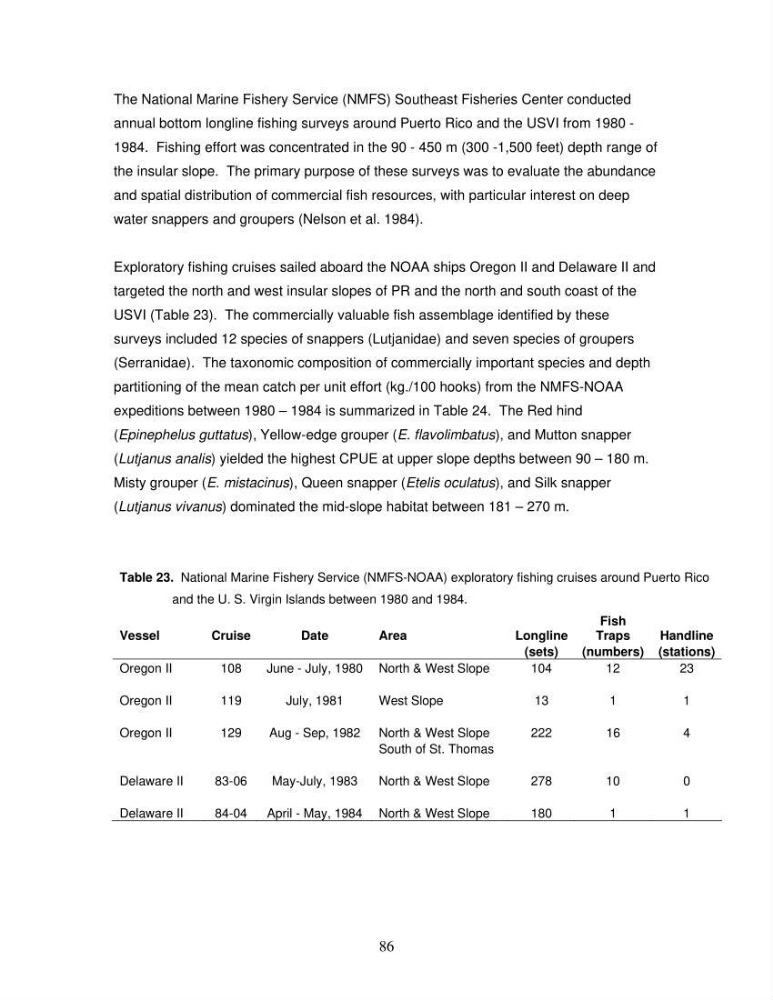
Exploratory fishing cruises sailed aboard the NOAA ships Oregon II and Delaware II and
targeted the north and west insular slopes of PR and the north and south coast of the
USVI (Table 23). The commercially valuable fish assemblage identified by these
surveys included 12 species of snappers (Lutjanidae) and seven species of groupers
(Serranidae). The taxonomic composition of commercially important species and depth
partitioning of the mean catch per unit effort (kg./100 hooks) from the NMFS-NOAA
expeditions between 1980 – 1984 is summarized in Table 24. The Red hind
(Epinephelus guttatus), Yellow-edge grouper (E. flavolimbatus), and Mutton snapper
(Lutjanus analis) yielded the highest CPUE at upper slope depths between 90 – 180 m.
Misty grouper (E. mistacinus), Queen snapper (Etelis oculatus), and Silk snapper
(Lutjanus vivanus) dominated the mid-slope habitat between 181 – 270 m.
Table 23. National Marine Fishery Service (NMFS-NOAA) exploratory fishing cruises around Puerto Rico
and the U. S. Virgin Islands between 1980 and 1984.
Vessel
Cruise
Date
Area
Longline
Fish
Traps
Handline
(sets)
(numbers) (stations)
Oregon II
108
June - July, 1980 North & West Slope
104
12
23
Oregon II
119
July, 1981
West Slope
13
1
1
Oregon II
129
Aug - Sep, 1982 North & West Slope
222
16
4
South of St. Thomas
Delaware II
83-06
May-July, 1983
North & West Slope
278
10
0
Delaware II
84-04
April - May, 1984 North & West Slope
180
1
1
86
annual bottom longline fishing surveys around Puerto Rico and the USVI from 1980 -
1984. Fishing effort was concentrated in the 90 - 450 m (300 -1,500 feet) depth range of
the insular slope. The primary purpose of these surveys was to evaluate the abundance
and spatial distribution of commercial fish resources, with particular interest on deep
water snappers and groupers (Nelson et al. 1984).
Exploratory fishing cruises sailed aboard the NOAA ships Oregon II and Delaware II and
targeted the north and west insular slopes of PR and the north and south coast of the
USVI (Table 23). The commercially valuable fish assemblage identified by these
surveys included 12 species of snappers (Lutjanidae) and seven species of groupers
(Serranidae). The taxonomic composition of commercially important species and depth
partitioning of the mean catch per unit effort (kg./100 hooks) from the NMFS-NOAA
expeditions between 1980 – 1984 is summarized in Table 24. The Red hind
(Epinephelus guttatus), Yellow-edge grouper (E. flavolimbatus), and Mutton snapper
(Lutjanus analis) yielded the highest CPUE at upper slope depths between 90 – 180 m.
Misty grouper (E. mistacinus), Queen snapper (Etelis oculatus), and Silk snapper
(Lutjanus vivanus) dominated the mid-slope habitat between 181 – 270 m.
Table 23. National Marine Fishery Service (NMFS-NOAA) exploratory fishing cruises around Puerto Rico
and the U. S. Virgin Islands between 1980 and 1984.
Vessel
Cruise
Date
Area
Longline
Fish
Traps
Handline
(sets)
(numbers) (stations)
Oregon II
108
June - July, 1980 North & West Slope
104
12
23
Oregon II
119
July, 1981
West Slope
13
1
1
Oregon II
129
Aug - Sep, 1982 North & West Slope
222
16
4
South of St. Thomas
Delaware II
83-06
May-July, 1983
North & West Slope
278
10
0
Delaware II
84-04
April - May, 1984 North & West Slope
180
1
1
86