

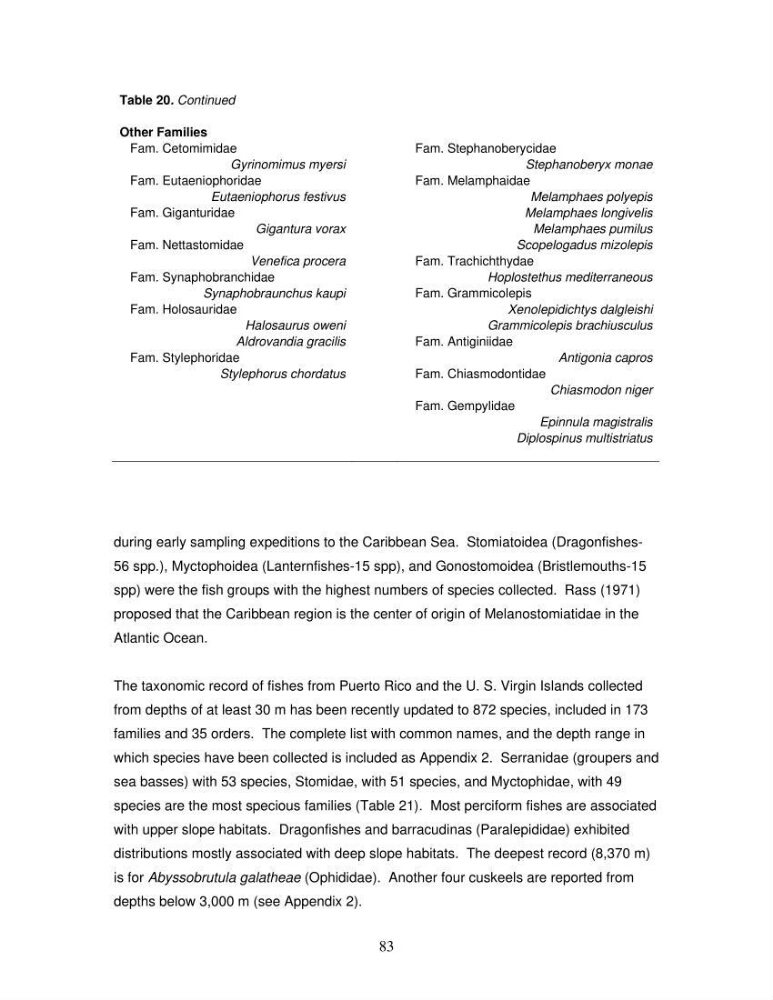
Table 20. Continued
Other Families
Fam. Cetomimidae
Fam. Stephanoberycidae
Gyrinomimus myersi
Stephanoberyx monae
Fam. Eutaeniophoridae
Fam. Melamphaidae
Eutaeniophorus festivus
Melamphaes polyepis
Fam. Giganturidae
Melamphaes longivelis
Gigantura vorax
Melamphaes pumilus
Fam. Nettastomidae
Scopelogadus mizolepis
Venefica procera
Fam. Trachichthydae
Fam. Synaphobranchidae
Hoplostethus mediterraneous
Synaphobraunchus kaupi
Fam. Grammicolepis
Fam. Holosauridae
Xenolepidichtys dalgleishi
Halosaurus oweni
Grammicolepis brachiusculus
Aldrovandia gracilis
Fam. Antiginiidae
Fam. Stylephoridae
Antigonia capros
Stylephorus chordatus
Fam. Chiasmodontidae
Chiasmodon niger
Fam. Gempylidae
Epinnula magistralis
Diplospinus multistriatus
during early sampling expeditions to the Caribbean Sea. Stomiatoidea (Dragonfishes56 spp.), Myctophoidea (Lanternfishes-15 spp), and Gonostomoidea (Bristlemouths-15
spp) were the fish groups with the highest numbers of species collected. Rass (1971)
proposed that the Caribbean region is the center of origin of Melanostomiatidae in the
Atlantic Ocean.
The taxonomic record of fishes from Puerto Rico and the U. S. Virgin Islands collected
from depths of at least 30 m has been recently updated to 872 species, included in 173
families and 35 orders. The complete list with common names, and the depth range in
which species have been collected is included as Appendix 2. Serranidae (groupers and
sea basses) with 53 species, Stomidae, with 51 species, and Myctophidae, with 49
species are the most specious families (Table 21). Most perciform fishes are associated
with upper slope habitats. Dragonfishes and barracudinas (Paralepididae) exhibited
distributions mostly associated with deep slope habitats. The deepest record (8,370 m)
is for Abyssobrutula galatheae (Ophididae). Another four cuskeels are reported from
depths below 3,000 m (see Appendix 2).
83
Other Families
Fam. Cetomimidae
Fam. Stephanoberycidae
Gyrinomimus myersi
Stephanoberyx monae
Fam. Eutaeniophoridae
Fam. Melamphaidae
Eutaeniophorus festivus
Melamphaes polyepis
Fam. Giganturidae
Melamphaes longivelis
Gigantura vorax
Melamphaes pumilus
Fam. Nettastomidae
Scopelogadus mizolepis
Venefica procera
Fam. Trachichthydae
Fam. Synaphobranchidae
Hoplostethus mediterraneous
Synaphobraunchus kaupi
Fam. Grammicolepis
Fam. Holosauridae
Xenolepidichtys dalgleishi
Halosaurus oweni
Grammicolepis brachiusculus
Aldrovandia gracilis
Fam. Antiginiidae
Fam. Stylephoridae
Antigonia capros
Stylephorus chordatus
Fam. Chiasmodontidae
Chiasmodon niger
Fam. Gempylidae
Epinnula magistralis
Diplospinus multistriatus
during early sampling expeditions to the Caribbean Sea. Stomiatoidea (Dragonfishes56 spp.), Myctophoidea (Lanternfishes-15 spp), and Gonostomoidea (Bristlemouths-15
spp) were the fish groups with the highest numbers of species collected. Rass (1971)
proposed that the Caribbean region is the center of origin of Melanostomiatidae in the
Atlantic Ocean.
The taxonomic record of fishes from Puerto Rico and the U. S. Virgin Islands collected
from depths of at least 30 m has been recently updated to 872 species, included in 173
families and 35 orders. The complete list with common names, and the depth range in
which species have been collected is included as Appendix 2. Serranidae (groupers and
sea basses) with 53 species, Stomidae, with 51 species, and Myctophidae, with 49
species are the most specious families (Table 21). Most perciform fishes are associated
with upper slope habitats. Dragonfishes and barracudinas (Paralepididae) exhibited
distributions mostly associated with deep slope habitats. The deepest record (8,370 m)
is for Abyssobrutula galatheae (Ophididae). Another four cuskeels are reported from
depths below 3,000 m (see Appendix 2).
83