

management str
ecently published by
emeth (2005).
on
e of
Plate
ian, two
f
re
roduced by Nemeth et al. (2004) and Herzlieb et al. (in press).
ategy for protection of the Red Hind population was r
N
The SeaBED AUV imaging platform was used in June 2003 to survey the Hind Bank (MCD)
benthic habitats at depths between 32 to 54 m. Four digital phototransects provided data
benthic species composition and percent cover of reef substrate. Within the western sid
the MCD, a well-developed hermatypic coral reef with 43 % mean living coral was found
(Armstrong et al., in press). The flattened growth form of boulder star coral, Montastrea
franksi was the dominant taxonomic component of the sessile-benthos at all four sites
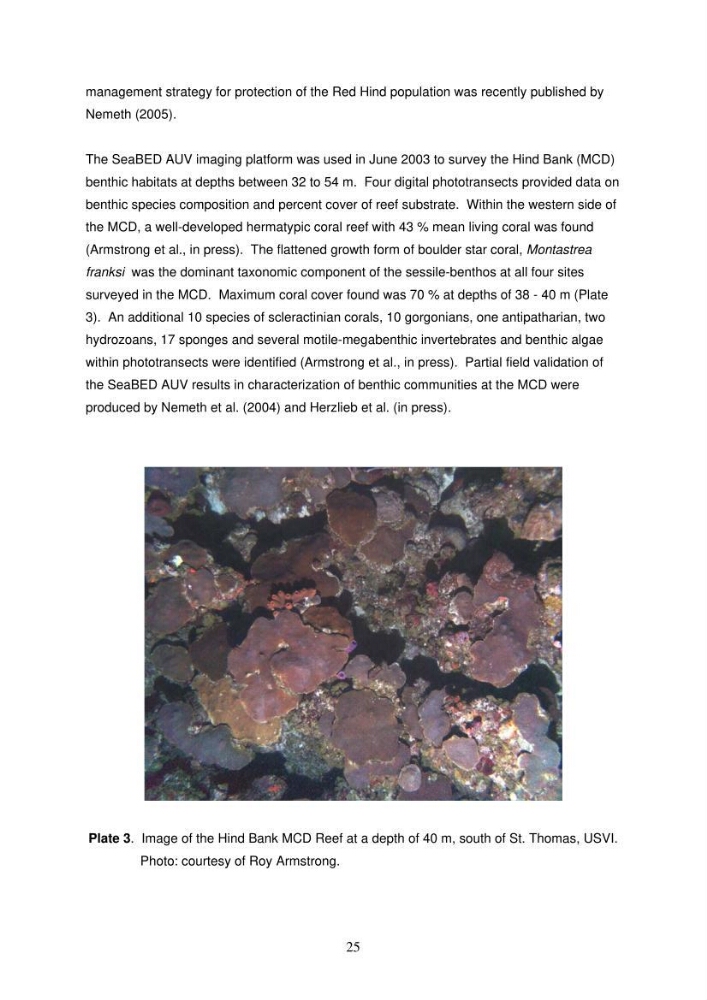
surveyed in the MCD. Maximum coral cover found was 70 % at depths of 38 - 40 m (
3). An additional 10 species of scleractinian corals, 10 gorgonians, one antipathar
hydrozoans, 17 sponges and several motile-megabenthic invertebrates and benthic algae
within phototransects were identified (Armstrong et al., in press). Partial field validation o
the SeaBED AUV results in characterization of benthic communities at the MCD we
p
Plate 3. Image of the Hind Bank MCD Reef at a depth of 40 m, south of St. Thomas, USVI
Photo: courtesy of Roy Armstrong.
.
25
ecently published by
emeth (2005).
on
e of
Plate
ian, two
f
re
roduced by Nemeth et al. (2004) and Herzlieb et al. (in press).
ategy for protection of the Red Hind population was r
N
The SeaBED AUV imaging platform was used in June 2003 to survey the Hind Bank (MCD)
benthic habitats at depths between 32 to 54 m. Four digital phototransects provided data
benthic species composition and percent cover of reef substrate. Within the western sid
the MCD, a well-developed hermatypic coral reef with 43 % mean living coral was found
(Armstrong et al., in press). The flattened growth form of boulder star coral, Montastrea
franksi was the dominant taxonomic component of the sessile-benthos at all four sites
surveyed in the MCD. Maximum coral cover found was 70 % at depths of 38 - 40 m (
3). An additional 10 species of scleractinian corals, 10 gorgonians, one antipathar
hydrozoans, 17 sponges and several motile-megabenthic invertebrates and benthic algae
within phototransects were identified (Armstrong et al., in press). Partial field validation o
the SeaBED AUV results in characterization of benthic communities at the MCD we
p
Plate 3. Image of the Hind Bank MCD Reef at a depth of 40 m, south of St. Thomas, USVI
Photo: courtesy of Roy Armstrong.
.
25