

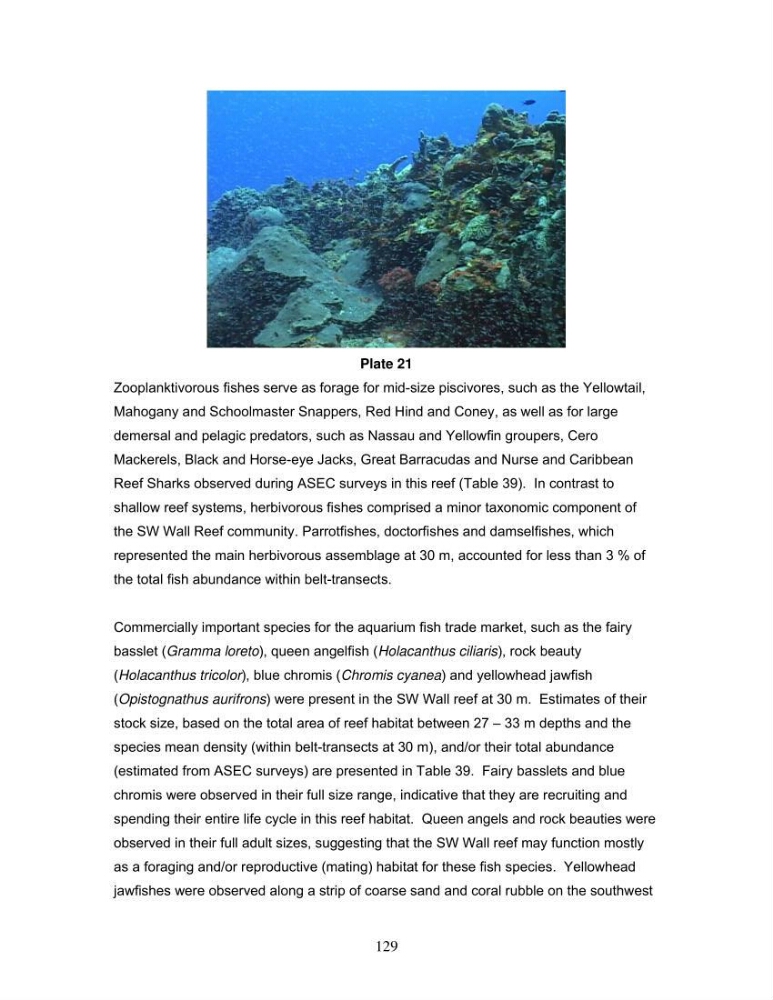
Plate 21
Zooplanktivorous fishes serve as forage for mid-size piscivores, such as the Yellowta
Mahogany and Schoolmaster Snappers, Red Hind and Coney, as well as for large
demersal and pelagic predators, such as Nassau and Yellowfin groupers, Cero
Mack
il,
erels, Black and Horse-eye Jacks, Great Barracudas and Nurse and Caribbean
eef Sharks observed during ASEC surveys in this reef (Table 39). In contrast to
% of
ir
e
ance
airy basslets and blue
hromis were observed in their full size range, indicative that they are recruiting and
pending their entire life cycle in this reef habitat. Queen angels and rock beauties were
bserved in their full adult sizes, suggesting that the SW Wall reef may function mostly
as a foraging and/or reproductive (mating) habitat for these fish species. Yellowhead
jawfishes were observed along a strip of coarse sand and coral rubble on the southwest
R
shallow reef systems, herbivorous fishes comprised a minor taxonomic component of
the SW Wall Reef community. Parrotfishes, doctorfishes and damselfishes, which
represented the main herbivorous assemblage at 30 m, accounted for less than 3
the total fish abundance within belt-transects.
Commercially important species for the aquarium fish trade market, such as the fairy
basslet (Gramma loreto), queen angelfish (Holacanthus ciliaris), rock beauty
(Holacanthus tricolor), blue chromis (Chromis cyanea) and yellowhead jawfish
(Opistognathus aurifrons) were present in the SW Wall reef at 30 m. Estimates of the
stock size, based on the total area of reef habitat between 27 – 33 m depths and th
species mean density (within belt-transects at 30 m), and/or their total abund
(estimated from ASEC surveys) are presented in Table 39. F
c
s
o
129
Zooplanktivorous fishes serve as forage for mid-size piscivores, such as the Yellowta
Mahogany and Schoolmaster Snappers, Red Hind and Coney, as well as for large
demersal and pelagic predators, such as Nassau and Yellowfin groupers, Cero
Mack
il,
erels, Black and Horse-eye Jacks, Great Barracudas and Nurse and Caribbean
eef Sharks observed during ASEC surveys in this reef (Table 39). In contrast to
% of
ir
e
ance
airy basslets and blue
hromis were observed in their full size range, indicative that they are recruiting and
pending their entire life cycle in this reef habitat. Queen angels and rock beauties were
bserved in their full adult sizes, suggesting that the SW Wall reef may function mostly
as a foraging and/or reproductive (mating) habitat for these fish species. Yellowhead
jawfishes were observed along a strip of coarse sand and coral rubble on the southwest
R
shallow reef systems, herbivorous fishes comprised a minor taxonomic component of
the SW Wall Reef community. Parrotfishes, doctorfishes and damselfishes, which
represented the main herbivorous assemblage at 30 m, accounted for less than 3
the total fish abundance within belt-transects.
Commercially important species for the aquarium fish trade market, such as the fairy
basslet (Gramma loreto), queen angelfish (Holacanthus ciliaris), rock beauty
(Holacanthus tricolor), blue chromis (Chromis cyanea) and yellowhead jawfish
(Opistognathus aurifrons) were present in the SW Wall reef at 30 m. Estimates of the
stock size, based on the total area of reef habitat between 27 – 33 m depths and th
species mean density (within belt-transects at 30 m), and/or their total abund
(estimated from ASEC surveys) are presented in Table 39. F
c
s
o
129