

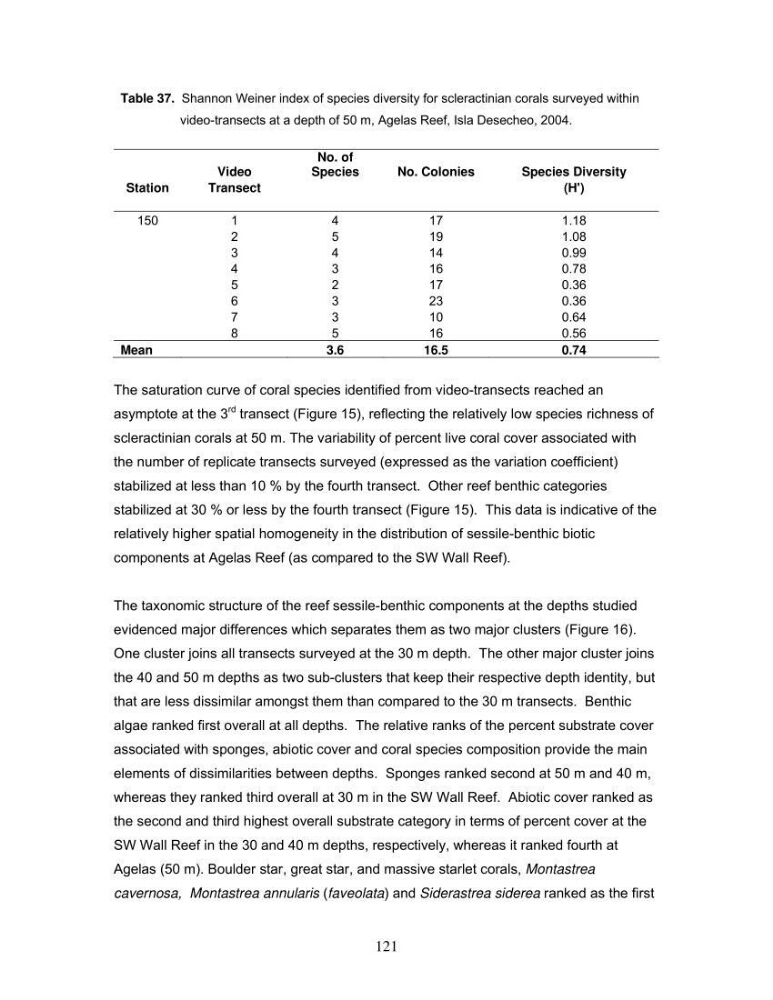
Table 37. Shannon Weiner index of species diversity for scleractinian corals surveyed within
video-transects at a depth of 50 m, Agelas Reef, Isla Desecheo, 2004.
Video
No. of
Species
No. Colonies
Species Diversity
Station
Transect
(H')
150
1
4
17
1.18
2
5
19
1.08
3
4
14
0.99
4
3
16
0.78
5
2
17
0.36
6
3
23
0.36
7
3
10
0.64
8
5
16
0.56
Mean
3.6
16.5
0.74
The saturation curve of coral species identified from video-transects reached an
asymptote at the 3
rd transect (Figure 15), reflecting the relatively low species richness of
scleractinian corals at 50 m. The variability of percent live coral cover associated with
the number of replicate transects surveyed (expressed as the variation coefficient)
stabilized at less than 10 % by the fourth transect. Other reef benthic categories
stabilized at 30 % or less by the fourth transect (Figure 15). This data is indicative of the
relatively higher spatial homogeneity in the distribution of sessile-benthic biotic
components at Agelas Reef (as compared to the SW Wall Reef).
The taxonomic structure of the reef sessile-benthic components at the depths studied
evidenced major differences which separates them as two major clusters (Figure 16).
One cluster joins all transects surveyed at the 30 m depth. The other major cluster joins
the 40 and 50 m depths as two sub-clusters that keep their respective depth identity, but
that are less dissimilar amongst them than compared to the 30 m transects. Benthic
algae ranked first overall at all depths. The relative ranks of the percent substrate cover
associated with sponges, abiotic cover and coral species composition provide the main
elements of dissimilarities between depths. Sponges ranked second at 50 m and 40 m,
whereas they ranked third overall at 30 m in the SW Wall Reef. Abiotic cover ranked as
cavernosa, Montastrea annularis (faveolata nd Siderastrea siderea ranked as the first
the second and third highest overall substrate category in terms of percent cover at the
SW Wall Reef in the 30 and 40 m depths, respectively, whereas it ranked fourth at
Agelas (50 m). Boulder star, great star, and massive starlet corals, Montastrea
) a
121
video-transects at a depth of 50 m, Agelas Reef, Isla Desecheo, 2004.
Video
No. of
Species
No. Colonies
Species Diversity
Station
Transect
(H')
150
1
4
17
1.18
2
5
19
1.08
3
4
14
0.99
4
3
16
0.78
5
2
17
0.36
6
3
23
0.36
7
3
10
0.64
8
5
16
0.56
Mean
3.6
16.5
0.74
The saturation curve of coral species identified from video-transects reached an
asymptote at the 3
rd transect (Figure 15), reflecting the relatively low species richness of
scleractinian corals at 50 m. The variability of percent live coral cover associated with
the number of replicate transects surveyed (expressed as the variation coefficient)
stabilized at less than 10 % by the fourth transect. Other reef benthic categories
stabilized at 30 % or less by the fourth transect (Figure 15). This data is indicative of the
relatively higher spatial homogeneity in the distribution of sessile-benthic biotic
components at Agelas Reef (as compared to the SW Wall Reef).
The taxonomic structure of the reef sessile-benthic components at the depths studied
evidenced major differences which separates them as two major clusters (Figure 16).
One cluster joins all transects surveyed at the 30 m depth. The other major cluster joins
the 40 and 50 m depths as two sub-clusters that keep their respective depth identity, but
that are less dissimilar amongst them than compared to the 30 m transects. Benthic
algae ranked first overall at all depths. The relative ranks of the percent substrate cover
associated with sponges, abiotic cover and coral species composition provide the main
elements of dissimilarities between depths. Sponges ranked second at 50 m and 40 m,
whereas they ranked third overall at 30 m in the SW Wall Reef. Abiotic cover ranked as
cavernosa, Montastrea annularis (faveolata nd Siderastrea siderea ranked as the first
the second and third highest overall substrate category in terms of percent cover at the
SW Wall Reef in the 30 and 40 m depths, respectively, whereas it ranked fourth at
Agelas (50 m). Boulder star, great star, and massive starlet corals, Montastrea
) a
121